We unfortunately have decided that we cannot continue providing access to our models through Cursor and are ending our partnership. It boils down to trust and we’ve asked that this takes effect on November 12 to give you some time to plan.
Many have used the GPT models through Cursor and here are options we know should work in the future:
- We will continue to allow using your own OpenAI API key and similarly will continue to provide access through our IDE extensions for Cursor.
- We will keep working with the broadest range of tools and harnesses, some of which are OSS, but also many many closed-source ones.
We are as committed as ever to continue supporting developers and the flourishing ecosystem of tools, harnesses and products. We will also continue to invest in our own open-source initiatives and believe in broad optionality for developers.
You can read more about our decision in the blog:
https://t.co/Oj76Bkc2KX
Origin, our code hosting platform, is now live.
It's fast, easy to use, and deeply integrated with Cursor.
Get started by syncing your repos from GitHub.
Frank Bach hasn't opened Figma in a month because he built his own tool. Brian Lovin went back to Figma and dialed the AI way down. Honestly love both of these.
I went the third way: I use Figma/Paper and creative direct Claude with it. New screens, prototypes, design files, all happening at once while I drive the system. I'm basically a design team of three. Me the creative director, me the designer, me the developer.
One thing I've learned though you just can't trust AI's UX thinking, and you definitely can't trust it's eye/taste for design. I see so many people blindly shipping whatever it makes with zero design thinking and it shows. Like Brian said, be careful bc once it knows what you like, it just starts trying to please you.
So between Frank, Brian, and me, that's three designers who have worked with the best design teams in the world and we now have three completely different design processes using AI.
One thing in common is that none of us are waiting for a tool to match our process anymore nor do we restrict ourselves to one way of designing. We just go, move, adjust and build the setup ourselves that work best for us on that particular project.
Design was never about the tools or specific processes. Still isn't. You could know how to use Figma, Paper, Claude, Codex, Cursor perfectly but still not know how to design.
Yesterday me and my friends talked about the Dead Internet Theory
If nobody asks questions anymore on Stack Overflow, and sites like Reddit are now taken over by AI reply bots to promote brands, as well as AI reply bots on here, there is no real content anymore on the internet
And then there is no fresh training data anymore
I thought about something like, how would you find out the best outdoor action camera? Before I would search :
site:https://t.co/hzXOs1G2mg best outdoor action camera
But now I just ask my AI which is the best
The problem is if nobody creates new content anymore and just asks their AI every question, the AI has nothing to train on anymore
And then I thought so what will happen? Will you get companies with giant warehouses that just buy stuff and review it with manually or with humanoid robots? Will you get humanoid robots backpacking in South East Asia to get life experience as training data? Or will we all train it by giving it access to our AI chats and user data?
I don't know but I think it's likely the web will dead in the future and AI companies will have to find training data elsewhere
continuing my war on paid software that should be free, today's victim is: granola.
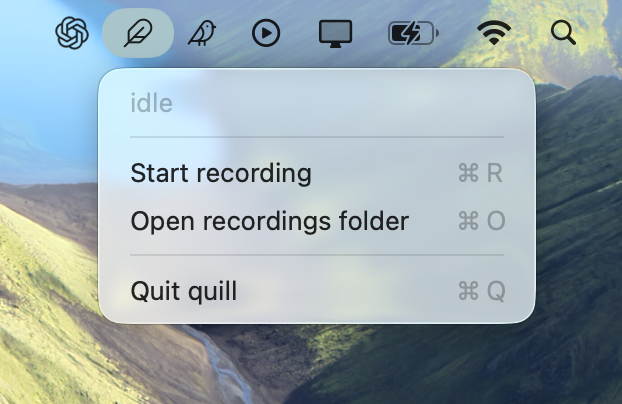
quill gives you the same thing for free and completely private, just start recording and after you stop it, the entire audio gets transcribed into a default folder.
completely open source as always
Introducing Canvas UI, the first ever html-in-canvas component library.
Your DOM is the render target now. Real-time shaders over real, interactive UI.
24 components. React, Vue, Svelte, vanilla TS.
Free. Open source. 🧵
https://t.co/Y5ZZDNxPUX
One way you can recognize AI slop is when the ideas and the diction don't match — when the ideas are completely ordinary, but the diction is that of someone announcing a brilliant discovery that they're really excited about.
El CEO de Anthropic viendo como China lanza un nuevo modelo de IA que supera a Claude Opus 4.8 en TODO, iguala a Fable 5 costando 8 VECES MENOS, que encima es 100% Open source y no puede hacer nada al respecto
As engineering, product, design, DS, etc. melt into a new kind of role, I was reflecting on what roles might look like in the future. For example, when I look at the Claude Code team I see what I think is five archetypes:
1. Prototyper: comes up with brand new ideas; churns out many ideas, most of which don't ship
2. Builder: quickly turns a prototype/idea into production-grade product/infra
3. Sweeper: cleans up the UI, simplifies the code and system, unships, optimizes performance
4. Grower: takes a product that has been built and iterates on it to improve Product-Market Fit
5. Maintainer: owns a mature system to make it secure, reliable, fast, and efficient as it scales
Many people span across 2 roles, and sometimes 3 roles. I also notice that these roles are not really tied to job function -- eg. across Anthropic, some designers match category 1, some 2, some 3; same for engineers, PM, DS.
A healthy team needs a mix of these, depending on the product:
- A product that is new and pre-PMF needs people that are strong at 1+2+3
- A product that is growing and has found PMF needs 2+3+4 and some 5
- A product that has strong PMF needs 3+4+5 and some 2
Maybe product roles of the future will look more like this, and less like the domain-specific roles of today?