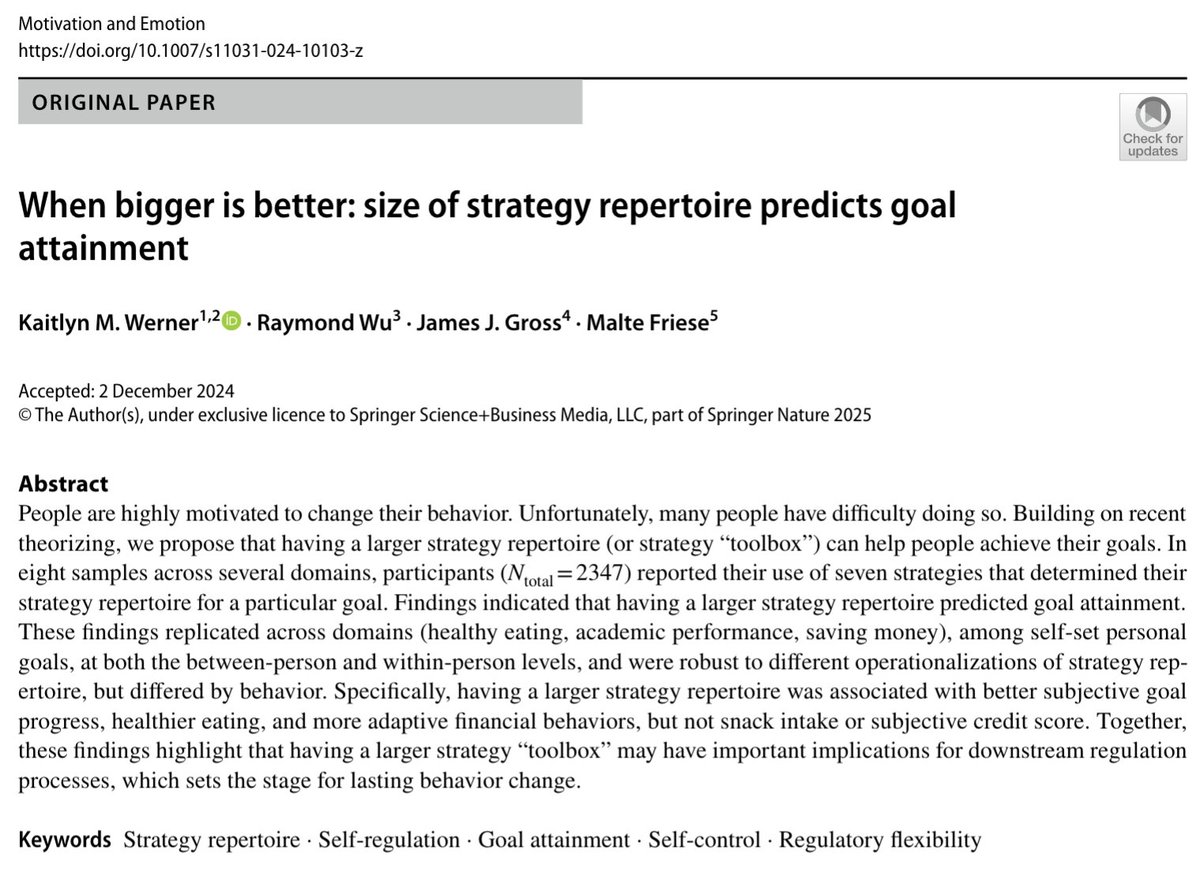
Thrilled to finally have this paper officially out! Across eight samples (n=2k+), we find that having a larger strategy repertoire can benefit goal attainment. We also discuss challenges with measuring repertoire and flexibility more broadly. w/@rayrwu J. Gross & @malfrie
Try this @googlechrome extension I made to make X/Twitter better for science/research!
You can highlight/remove posts with links to academic/non-academic sources etc. (thanks @DG_Rand for suggesting this!)
https://t.co/QaRSoq0hGu
🚨Out in Nature Human Behaviour🚨
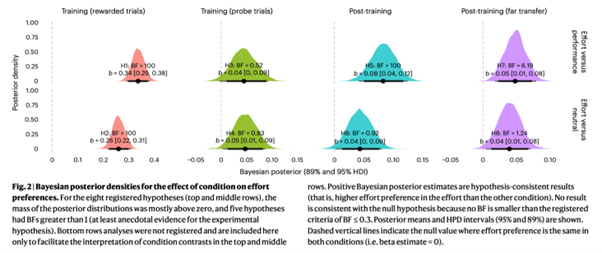
Effort is costly--how can we learn to value doing effortful things? Reward effort, not outcomes/performance!
Our registered report (w/ @hauselin@j_a_westbrook) shows people can learn to prefer doing effortful tasks https://t.co/Wt5Wpr28Xr /1
📢Strange time to have a paper published… but just out today in CiHB, Gabriel Brooks and me @LukeClark01: The gamblers of the future? Migration from #lootboxes to #gambling in a longitudinal study of young adults @UBCPsych@DMCBrainHealth 🧵⬇️ https://t.co/6mYYrTJJSe
You'll probably have seen tweets urging you to read this paper. But seriously, read this paper. It's the most I've enjoyed reading a paper in, maybe, ever.
New PREPRINT from Martin Zack and me @LukeClark01 on @PsyArXiv: “Engineered highs: reward variability and frequency as prerequisites for behavioural addiction” @UBCPsych@DMCBrainHealth mini-🧵👇 https://t.co/FPnvbFenOO
Today, we’re introducing a new model that eliminates accept/reject decisions.
By publishing every paper with eLife reviews as a Reviewed Preprint, we plan to restore autonomy to authors, ensuring that they will be judged by what, not where, they publish. https://t.co/OAsiOVFStI
Effort feels meaningful (w/ @AidanVCampbell)
https://t.co/l9Z8jFPMJr
"Perhaps effort’s felt meaningfulness is a cultural product that sustains the perceived legitimacy of unequal societies...Does the concept of merit require that people internalize belief that effort pays? 1/2
Just published - average reward rate modulates behav/neural indices effort allocation - with @arossotto@minzlicht & Jelena Ristic!
Higher reward per unit time *reduces* control allocation signals identified using a new dimension reduction technique https://t.co/BJyFpDN0iS
FIRST FIRST-AUTHOR PAPER ACCEPTED!! 🥹
@zakijam and I argue in Trends in Cognitive Sciences that people easily get trapped in a cynical mindset.
People can overestimate others' self-interest, create it through their expectations, or overstate their own to not appear naïve.
1/6
🚨 New paper in @TrendsCognSci with @celestekidd!
We review evidence that certainty is a valuable learning signal even for very young children.
Short 🧵below, and article here: https://t.co/xN7bkc2H2A
The benefits of clear writing: articles with concrete language, examples, active voice, and common (vs. technical) words are better cited. Articles +1 SD clearer got 157 more Google Scholar citations than comparable articles with less clear writing #AcWri#AcademicTwitter 😎
Why do we feel tired after a daylong of mental work?
As we keep doing mental work all day, glutamate levels rises in the lateral prefrontal cortex, which makes it difficult for us to take hard decision and we go for easy stuff with instant gratification.
https://t.co/VhfRrs8PAj
🚨New pre-print with @rayrwu@malfrie!
In 8 samples (n=2k+) across several domains, we examined if strategy repertoire predicts goal progress. Inspired by the emotion regulation literature, we also compared different strategy repertoire indices
➡️https://t.co/z7DImaRItR
1/7
Have you ever wondered what features of studies science journalists pay attention to when deciding whether to report on a finding? I did! So I asked some of them, with help from my wonderful collaborators @siminevazire, @mijkenijk, and @cragcrest. https://t.co/Ygx2fz57zJ 1/8
Interested in micro-analysis of slot machine gambling behaviour, realistic slot simulations, OR real-world aspects of habit formation?? Check out Mario Ferrari’s new paper in IGS w @neuro_tweet , available OA https://t.co/VcjnmwkAQ2 🧵 1/n @UBCPsych@DMCBrainHealth
1/ Working on this project shifted how I think about self control, individual differences, development, equity in our science, and my heritage. I'm grateful to have been a part of it and would love to hear your thoughts. https://t.co/Iat5l9CT9Z
New publication!!💪👇
Our paper with Ben Prissé has been accepted at the Journal of Behavioral and Experimental Economics @LoyolaBehLab@LoyolaResearch@LoyolaEcon