The Hellenes were a big family; and that's exactly why Greek ancestry was their way of checking "who's who"
One of the clearest expressions of shared Greek ancestry comes not from a philosopher, but from the historian Thucydides, recording the diplomatic language of the Peloponnesian War.
In 427 BC, the people of Mytilene on Lesbos revolted against Athens. Seeking Spartan assistance, their representatives addressed the assembled Greeks at Olympia.
They appealed explicitly to ethnic kinship:
ἡμεῖς δὲ Αἰολῆς ὄντες καὶ οἱ ξύμμαχοι ἡμῶν Ἴωνες
“We are Aeolians, while our allies [the Athenians] are Ionians.”
This distinction mattered because the Mytilenaeans were attempting to abandon an alliance dominated by Athens and enter the Spartan alliance. Their speech repeatedly frames political relationships through the language of kinship, ethnic subdivision and common Hellenic identity.
This reflects something fundamental about the Greek world: Greeks did not simply identify as an undifferentiated collection of people who happened to speak Greek. They maintained elaborate traditions of descent within the larger Hellenic people:
Dorians traced themselves to Dorus.
Ionians to Ion.
Aeolians to Aeolus.
And Dorus, Ion and Aeolus were themselves incorporated into genealogies descending from Hellen, the mythical ancestor from whom the Hellenes derived their collective name.
Thucydides elsewhere describes this process explicitly. In his account of early Greece, he says that when Hellen and his sons became powerful in Phthiotis, other communities sought their assistance:
καθ᾽ ἑκάστους μὲν ἤδη τῇ ὁμιλίᾳ μᾶλλον καλεῖσθαι Ἕλληνας
“One by one, through their association with them, they increasingly came to be called Hellenes.”
He even uses Homer as historical evidence, observing that Homer knew the name Hellenes, but applied it particularly to the people associated with Achilles rather than yet using it consistently for the entire Greek coalition at Troy. The significance is easy to overlook.
For Thucydides, “Hellenes” itself had a history. The Greeks remembered themselves as numerous related peoples—Dorians, Ionians, Aeolians and others—who eventually acquired a common Hellenic identity.
Their myths expressed that relationship through an enormous family tree. Whether Hellen, Dorus, Ion or Aeolus were historical individuals is beside the point. They almost certainly were not (as such).
What matters historically is that Greeks themselves chose genealogy as one of the ways of explaining the relationship between their different ethnic groups.
They imagined the Hellenes, quite literally, as an extended family of peoples.
Thucydides, History of the Peloponnesian War 1.3; 3.9–14
E.R. Dodds believed that the mythical figure of Orpheus had been influenced by northern shamanic traditions, spread through Scythia and Thrace, esp. given his ability to charm animals with his lyre, which parallels the musical ecstasy of the Eurasian shamans.
Aristotle not only taught young Alexander about sophrosyne ("temperance") but also about becoming a megalopsychos or "great-souled man" one who shows magnanimity not a mikropsychos or "small-souled man' that is, neither be a petty tyrant with a kingdom nor be one in private.
"A man must believe what his conscience dictates, and if he believes in pacifism, so be it. But I'd rather be shot down in a battle than live under the heel of an arrogant alien despotism."
— Robert E. Howard, from a Letter to H. P. Lovecraft
reminder that Mother Mary turned the wind against the Ottoman fleet, stopped an atomic bomb from killing 8 priests praying her Rosary, held back a million-acre firestorm, liberated Austria from the Soviets, & physically repelled Ted Bundy from a sleeping girl clutching her beads
Abraham was a native of Ur of the Chaldees in ancient Sumeria, a culture distinct from ancient Canaan, Phoenicia, Philistine or Mycenaeans. (https://t.co/Y7ykHMKVBj) so this is your first wrong claim lmfao.
His ethnic and historical origins are traced to Mesopotamia, not the Levant. Jacob was explicitly designated a "wandering Aramean" in Deuteronomy 26:5, along with Isaac.
Historical-critical scholarship views these patriarchs as composite figures or "types" of tribes tied to theological identity rather than strict modern ethnic ancestry. (https://t.co/n17ijoVr46)
Even prominent rabbinic traditions, such as Maimonides, affirmed Abraham wasn't a Jew.
The anecdote only makes sense if you know Boeotians were stereotyped as idiotic, fat hicks by Athenians, thus in Greek lit in general and in many idioms. Pindar says in his day people used Βοιωτία ὗς Boeotian pig (O. 6.90). Plutarch, a Boeotian, lists off insults as well:
This 1616 illustration captures Vanitas and memento mori: a fashionable youth enters a glass globe filled with a beautiful landscape, unaware of time’s passage. He emerges as an old man with an empty hourglass, stepping into an open grave. “Vive memento mori.” ⏳
For decades the Romans had tried to make the Jews acknowledge Caesar as their legitimate leader, and they refused. When it came to Christ, Pilate asked mockingly "Shall I kill the King of the Jews?", and they responded "we have no king but Caesar".
One of the *many* reasons I left Islam for the Orthodox Church was the Islamic narrative & a principled tenant of their belief that the Christians eventually “corrupted” their own religion.
However, reading through history such a bold claim is shown to be motively dubious & historically a ridiculous narrative.
Why? Well…Before the conversion of the Roman Empire to Christianity, the pagan-Romans persecuted Christians everywhere continually for around 300yrs, because they refused to accept the Gospel or the faith, because they wouldn’t say that Christ is God. This is because, for the Romans, their religion dictated that no god could be honoured without the approval of the Senate. For if they accepted Christ as the Word of God, they would’ve been forced to give up their other gods, which was itself contrary to the customs of the provinces & of the Roman laws.
Herein exposes the absurdity of the Islamic polemical charge against Christians to have “changed” the teaching of Christ (I.e; by claiming that Christ is the Word of the Father).
For, how is it, therefore, that the Christians, to the loss/death of their very own men & in the destruction of their faith & to the provocation of the Roman leaders against them began to add to the gospels an element, like “Christ is God”, if it was not to lead them towards a deceptive benefit?
But rather such a claim lead the Christians towards their brutal death-moreso, for advocating a claim that Christ is God, & disregarding that title for the Senate, a provocation for their brutal persecution.
For changing/being deceptive towards something occurs only within a scenario wherein one gains comfort, not discomfort. But, with the Christians all they received for this claim that Christ is the Word of God, was discomfort & persecution on an unprecedented level.
Why would they “change” their belief, when in that belief, only rivers of blood & death flow? Rendering the Islamic claim hysterically baseless, utterly invalid, unmerited & untruthful.
It fails to account the immense martyrdom early Christians suffered in defence of the very belief that Islam claims they invented.
You're severely underselling just how much Alexander LARPed. Keeping a copy of the Illiad under his pillow was the least of it. He's recorded as having gone to Alexanders grave stone in Illium, running races around it, adorning it in Garlands, and saying that how lucky was he to have a friend such as Patroclus and bards to sing his name.
And later in his campaigns, when his friend Hephaestion died, he took the enemy commander of the city to whom he attributed that death to, and dragged him behind his chariot in imitation of Alexander. Do not let anyone accuse you of LARP as though its some terrible thing. Literally all the greatest men of Western Civilization were LARPers. They all loved Capeshit. And there is nothing wrong with this. In fact, I would argue its a necessary component.
Reject cynicism. Embrace Romanticism, embrace the LARP, embrace a love of the greats and the heroes.
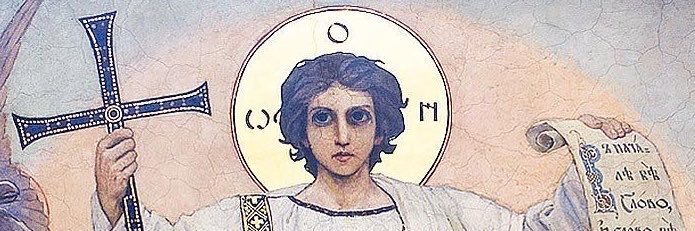
Christianity is sacramental; so therefore the Mystery of the Cross runs the other direction:
the Logos descends into matter, enters death itself, & overcomes it from within
If life itself were *evil,* the central Christian mystery would become unintelligible!



![thewolvenhour's tweet photo. The Hellenes were a big family; and that's exactly why Greek ancestry was their way of checking "who's who"
One of the clearest expressions of shared Greek ancestry comes not from a philosopher, but from the historian Thucydides, recording the diplomatic language of the Peloponnesian War.
In 427 BC, the people of Mytilene on Lesbos revolted against Athens. Seeking Spartan assistance, their representatives addressed the assembled Greeks at Olympia.
They appealed explicitly to ethnic kinship:
ἡμεῖς δὲ Αἰολῆς ὄντες καὶ οἱ ξύμμαχοι ἡμῶν Ἴωνες
“We are Aeolians, while our allies [the Athenians] are Ionians.”
This distinction mattered because the Mytilenaeans were attempting to abandon an alliance dominated by Athens and enter the Spartan alliance. Their speech repeatedly frames political relationships through the language of kinship, ethnic subdivision and common Hellenic identity.
This reflects something fundamental about the Greek world: Greeks did not simply identify as an undifferentiated collection of people who happened to speak Greek. They maintained elaborate traditions of descent within the larger Hellenic people:
Dorians traced themselves to Dorus.
Ionians to Ion.
Aeolians to Aeolus.
And Dorus, Ion and Aeolus were themselves incorporated into genealogies descending from Hellen, the mythical ancestor from whom the Hellenes derived their collective name.
Thucydides elsewhere describes this process explicitly. In his account of early Greece, he says that when Hellen and his sons became powerful in Phthiotis, other communities sought their assistance:
καθ᾽ ἑκάστους μὲν ἤδη τῇ ὁμιλίᾳ μᾶλλον καλεῖσθαι Ἕλληνας
“One by one, through their association with them, they increasingly came to be called Hellenes.”
He even uses Homer as historical evidence, observing that Homer knew the name Hellenes, but applied it particularly to the people associated with Achilles rather than yet using it consistently for the entire Greek coalition at Troy. The significance is easy to overlook.
For Thucydides, “Hellenes” itself had a history. The Greeks remembered themselves as numerous related peoples—Dorians, Ionians, Aeolians and others—who eventually acquired a common Hellenic identity.
Their myths expressed that relationship through an enormous family tree. Whether Hellen, Dorus, Ion or Aeolus were historical individuals is beside the point. They almost certainly were not (as such).
What matters historically is that Greeks themselves chose genealogy as one of the ways of explaining the relationship between their different ethnic groups.
They imagined the Hellenes, quite literally, as an extended family of peoples.
Thucydides, History of the Peloponnesian War 1.3; 3.9–14](https://pbs.twimg.com/media/HQ6Hr3EW8AAHlYX.jpg)