while most of CT is feeling sidelined on all the @RobinhoodApp plays
@xanonxbt community has been cooking since the early days.
even before the robinhood chain went mainstream
He called $CASHCAT when it was only at 31k mcap.
The receipts speak for themselves.
xanon has been feeding his community absolute gems long before the timeline catches on.
Never fade conviction and experience.
Joined The Republic yesterday. Doing tasks to earn points for future Legion ICO allocations.
Learning that consistent contribution is key.
Participating in a rewarded social campaign by The Republic.
New? Join, do tasks & support others. Let’s grow!
#TheRepublic#Legion
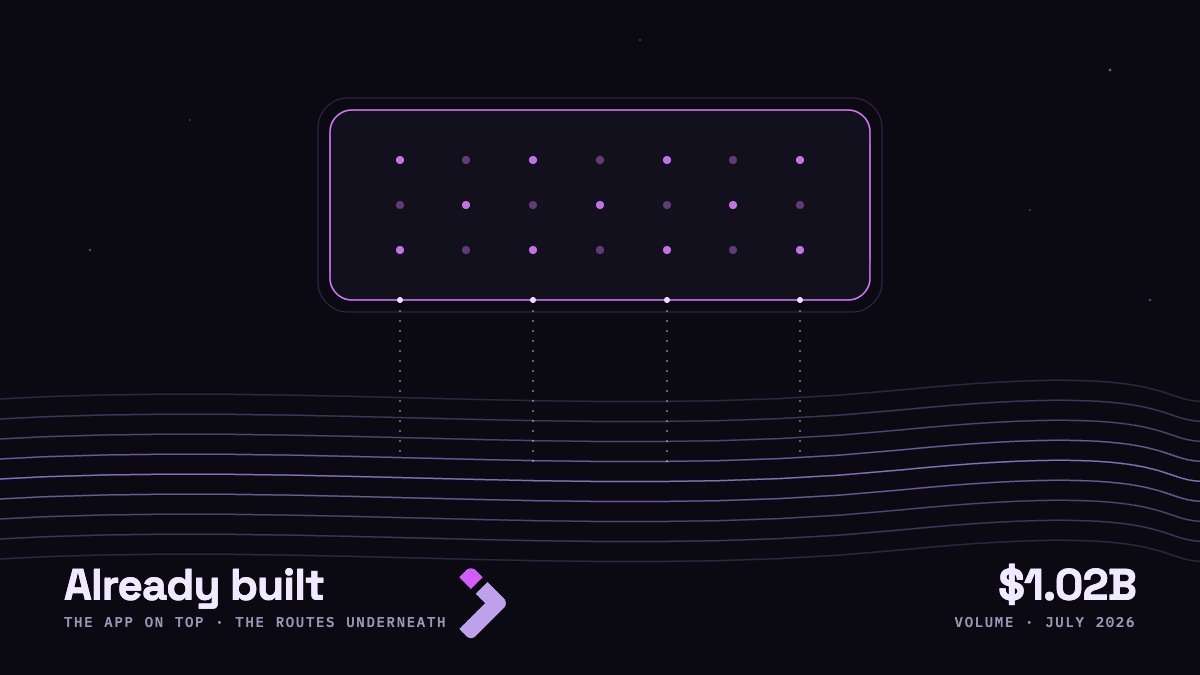
Jumper is outgrowing the “https://t.co/H96vB5K4t8 frontend” narrative.
It’s now spinning out as its own company while still running on https://t.co/OnX5Bw2ULC’s infrastructure.
That distinction matters.
LiFi is the infrastructure layer, used by 1,400+ businesses to execute onchain transactions.
Jumper is the consumer layer turning that infrastructure into a product people actually use.
And the numbers are getting interesting:
➱ $1.02B volume in July 2026
➱ $40B+ lifetime volume
➱ 127K+ wallets in January
➱ 100K+ monthly active users in September
One important caveat: volume ≠ revenue.
It measures the value flowing through Jumper, not what the company earns.
But the product keeps expanding:
Earn → Portfolio → Private Swaps → Jumper Advance → Perps → more coming.
The bigger play is becoming pretty clear:
Jumper wants to be the Super App for onchain finance.
Source : https://t.co/Zvv41rW77h
🥕@carrotfunding Fundamentals
What if getting funded wasn’t just about hitting a profit target?
CarrotFunding is a DeFi-native trader funding firm combining:
➱ Performance-based evaluations
➱ On-chain transparency
➱ Perpetual futures liquidity
➱ NFT-based reputation
Every Challenge is minted as an NFT that stores your performance on-chain.
The path is simple:
Buy → Hit Objectives → Get Funded → Get Paid
There are 2 Challenge types:
1-Phase
➱ 8% profit target
➱ 4% max daily loss
➱ 8% max loss
➱ No time limit
➱ No minimum trading days
➱ Can pass in as few as 2 trades if risk is managed properly
2-Phase
➱ Phase 1: 5% target
➱ Phase 2: 8% target
➱ 5% max daily loss
➱ 10% max loss
➱ No time limit on either phase
Understanding equity is critical.
Balance = account value based on closed trades / realized P&L.
Equity = Balance + Unrealized P&L.
CarrotFunding has 2 equity limits active at all times:
Maximum Daily Loss
➱ 2-Phase: 5% of equity
➱ 1-Phase: 4% of equity
➱ Resets at 00:00:00 UTC
Maximum Loss
➱ 2-Phase: 10% of starting balance
➱ 1-Phase: 8% of starting balance
Touch either limit → breach.
The Maximum Daily Loss and Maximum Loss work differently.
Daily loss:
Equity at 00:00 UTC × daily loss %
Example:
$100K 2-Phase account
➱ 5% daily loss = $5K
➱ Equity limit = $95K
Both realized and unrealized losses count toward the limit.
Maximum Loss uses the High-Water Mark (HWM):
HWM − Maximum Loss %
Example:
$100K starting balance → HWM reaches $106K
➱ 10% max loss = $10K
➱ Maximum Loss Limit = $96K
The limit trails upward with HWM but never trails back down once it reaches the starting balance.
🥕 The numbers matter
CarrotFunding offers 1-Phase and 2-Phase challenges across 5 account sizes.
2-Phase fees:
➱ $5K → $65
➱ $10K → $119
➱ $20K → $239
➱ $50K → $449
➱ $100K → $699
1-Phase fees:
➱ $5K → $75
➱ $10K → $129
➱ $20K → $249
The core idea is straightforward:
Hit the target without violating the risk rules → get funded → trade with no profit target → request on-demand payouts. 🥕
Cross-chain bridging gets complicated fast when you only see one route at a time.
That’s where Jumper’s route comparison comes in.
Users can compare available quotes before executing a bridge, rather than blindly choosing the first route presented.
You can review details including:
Amount of tokens received
Price impact
Slippage
Number of steps
Gas cost
Estimated bridging time
That matters because the headline exchange rate isn’t the whole picture.
A route can have a different number of steps, different gas requirements, different price impact, or a different estimated completion time.
Jumper’s documentation also explains that its broader routing system can compare different DEX and bridge options and present route information before confirmation.
So the useful part isn’t simply “Jumper bridges between chains.”
It’s being able to see the route and its trade-offs before you sign.
What I’m reporting here: functionality documented by @jumperapp official sources.
Source: https://t.co/2XOzDgxeVz
Been checking out the Republic inventory lately 👀
Some crates have Ore, while the mystery items are basically a roll of the dice. Could be VP, another crate, or nothing 😂
Just here to see what I end up pulling from the campaign.
#TheRepublic#Legion