Medicines cost a median 27% more in the Kurdistan Region than in federal Iraq
A study has compared around 70 medicines of the same brand and strength across both Baghdad and Erbil markets. Every one of them is more expensive in Erbil. Bought together, the full list costs 1,971,000 IQD in Erbil against 1,425,250 IQD in Baghdad, a difference of 545,750 IQD (38%).
The widest gaps fall on patients with long-term conditions:
- Mental health: The antipsychotic Reagila costs 163,000 IQD in Erbil against 86,000 in Baghdad for the 1.5 mg dose (+90%) and against 99,000 for 4.5 mg (+65%). Escitalopram 20 mg is 21,000 vs 12,750 (+65%), and Quelept 200 mg is 25,000 vs 18,250.
- Epilepsy: Depakine oral solution costs more than double, at 10,000 vs 4,750 (+111%). Eizam 1,000 mg is 37,000 vs 20,750 (+78%) and Convulex Retard is 19,000 vs 13,000.
- Blood pressure and heart: Tepresta 80/10 mg is 24,000 vs 13,000 (+85%), Arbiten Plus 80/12.5 mg is 17,000 vs 9,250 (+84%) and Nebilok is 13,000 vs 8,250. The blood thinner Xarelto costs 118,000 vs 99,000.
- Diabetes: Toujeo insulin is 90,750 vs 80,250, Jardiance 25 mg is 67,500 vs 59,000 and Glemax 4 mg is 12,000 vs 8,000.
- Everyday prescriptions: Urimax is 12,000 vs 6,250 (+92%), the contraceptive Zahra is 10,000 vs 5,750 (+74%), the antibiotic Cipro-Denk is 10,000 vs 6,000 (+67%) and children's Decozal nasal drops are 4,000 vs 2,750.
The single largest percentage gap is Sunya, at 55,500 vs 23,000 (+141%). The largest cash gap is the iron infusion Ferinject, which costs 87,000 IQD more in Erbil at 270,000 vs 183,000. Even the smallest gap in the list, Concor 10 mg at 16,500 vs 15,250, is still notably more expensive.
The Pentagon on Wednesday announced the conclusion of its Operation Inherent Resolve as it pulled out the last of its military equipment and personnel from the Erbil Air Base, saying they would continue providing assistance to Iraq as it takes over security.
https://t.co/wp52R3evRf
Notable: Based only on migration flows within the Kurdistan Region and between the Kurdistan Region and Kirkuk in 2024, using data from Iraq’s December 2024 census, Kirkuk had the largest net migration gain at +33,960, while Duhok had the largest net migration loss at −18,939.
Erdogan’s UN General Assembly speech is full of double standards and hypocrisies.
Turkey, a country responsible for thousands upon thousands of Kurdish deaths is lecturing the world about human rights.
Turkey, where Kurdish right to self-determination is openly denied is advocating for another Arab state, Palestine, not because it cares about the Arabs there but because it hates Israel.
If Erdogan is honest about his speech, then let’s start with a two-state solution in Turkey between the Turks and Kurds—Kurdistan-Turkey.
Until then, it’s all just noise.
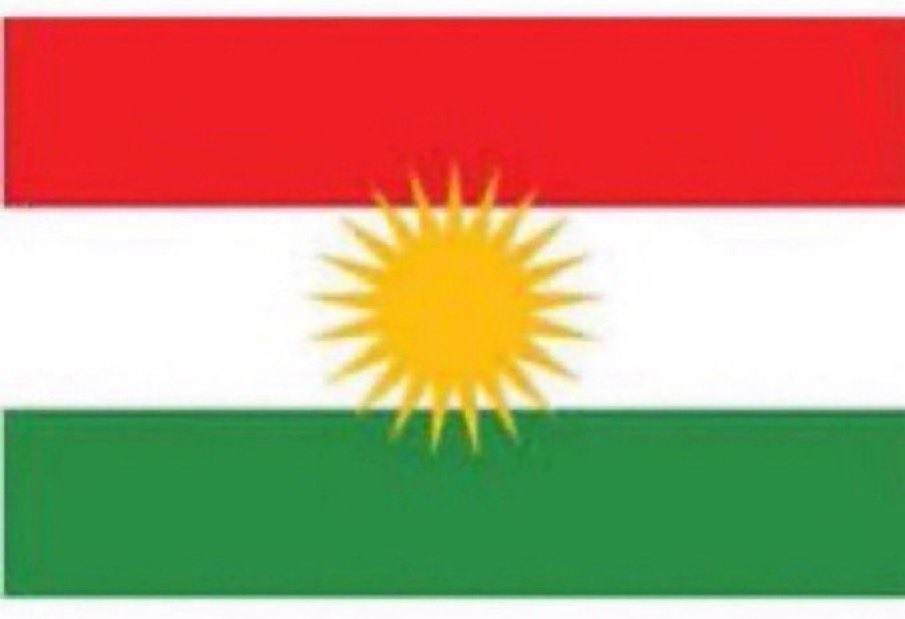
For context, the logo of the KDP Peshmerga’s former 80 Forces, now renamed Area Command 1, also remains exactly the same. Only the name has changed.
So this cannot even be called a rebranding, let alone a ‘unification’. It is essentially just a renaming. It is also worth noting that yellow is the KDP’s colour, while green is the PUK’s.
This is a useful benchmark for judging how substantive the unification really is: if they have not even bothered with a basic rebranding, it says a great deal about how much has actually changed beyond the name.
Lahur Sheikh Jangi yesterday claimed that a nephew of Rayan al-Kildani, leader of the pro-Iran Christian militia Babylon, was killed in last year’s clashes at his compound while fighting alongside PUK forces. But Rayan has no nephews, and none of his brothers is even married.
This is why testing such concrete claims is always useful in assessing how reliable these statements are.
Benjamin Hassin, an Israeli-Canadian Kurdish Jew convicted of murdering a taxi driver in Sulaimani, has been released after around 11 years in prison, following years of unusually high-level lobbying and fundraising on his behalf.
Hassin was born in Iraqi Kurdistan and later lived in Israel and Canada, holding both Israeli and Canadian citizenship. His father initially said he had returned to Kurdistan to visit his grandparents before deciding to join Kurdish forces fighting ISIS. Accounts differ even on this point: the KRG’s then representative for Jewish affairs, Sherzad Omer, said in 2017 that Hassin had moved to Kurdistan intending to join the Peshmerga, while his motives for returning have also been disputed, with various theories circulating in Kurdish social media.
In 2015, Hassin shot a taxi driver in Sulaimani after a heated argument. The driver died three days later.
Hassin and his family claimed the argument began after the driver heard him speaking Hebrew, realised he was Jewish or Israeli, and threatened either to kill him or hand him over to ISIS. Hassin said he shot the driver in “self-defence,” but this account was disputed from early on. Omer said claims that the driver had tried to kidnap Hassin or hand him to ISIS were never proven. A Kurdish court ultimately convicted Hassin of murder. A verbal threat made during a heated argument is also different from an imminent physical threat, and Hassin failed during his trial to establish that he faced such a danger. His self-defence claim was therefore rejected.
There were other reasons for scepticism. Hassin and his father also claimed he had been severely tortured in prison, including being beaten, suspended from a ceiling and having his fingernails pulled out. ZAKA, the Israeli rescue and recovery organisation that first campaigned for him, later questioned that account publicly, saying a visitor had found him in good health.
ZAKA's involvement then turned into a public dispute with the family. In 2017 the organisation helped raise around $120,000 from more than 2,000 donors for a proposed sulha, a customary reconciliation settlement, with the murdered driver's family. It refused to transfer the money to the private accounts provided by Hassin's representatives, saying it could not verify where the funds were going or whether the agreement existed in the form presented to donors. ZAKA said its name and humanitarian work had been exploited. Hassin's family angrily rejected the accusations.
The case nonetheless attracted an extraordinary level of outside intervention. Israeli minister Ayoub Kara became personally involved and said he had persuaded Kurdish authorities to delay proceedings while money was being raised. The Israeli Foreign Ministry was engaged, and Israel's military censor eventually allowed the case to be publicised so the family could raise funds. Eyal Siso, a former senior Israeli Foreign Ministry official, and the US lawyer Allen Lowy later worked on the case, and a 2025 fundraising campaign published a photograph of Lowy meeting KDP leader Masoud Barzani.
Hassin was sentenced to death in 2020. The sentence was later reduced, and a further campaign in 2025 sought around $250,000 to secure a reconciliation with the victim's family. That sulha was eventually reached, the death sentence was overturned and subsequent proceedings resulted in his release this week.
Palestinians have had many chances for statehood.
They’ve rejected all of them.
Yet there’s a global industry clamoring for Palestinian statehood.
#Kurds, far more populous than Palestinians, have long dreamed of a state, but never been offered one.
Yet global silence.
WHY?
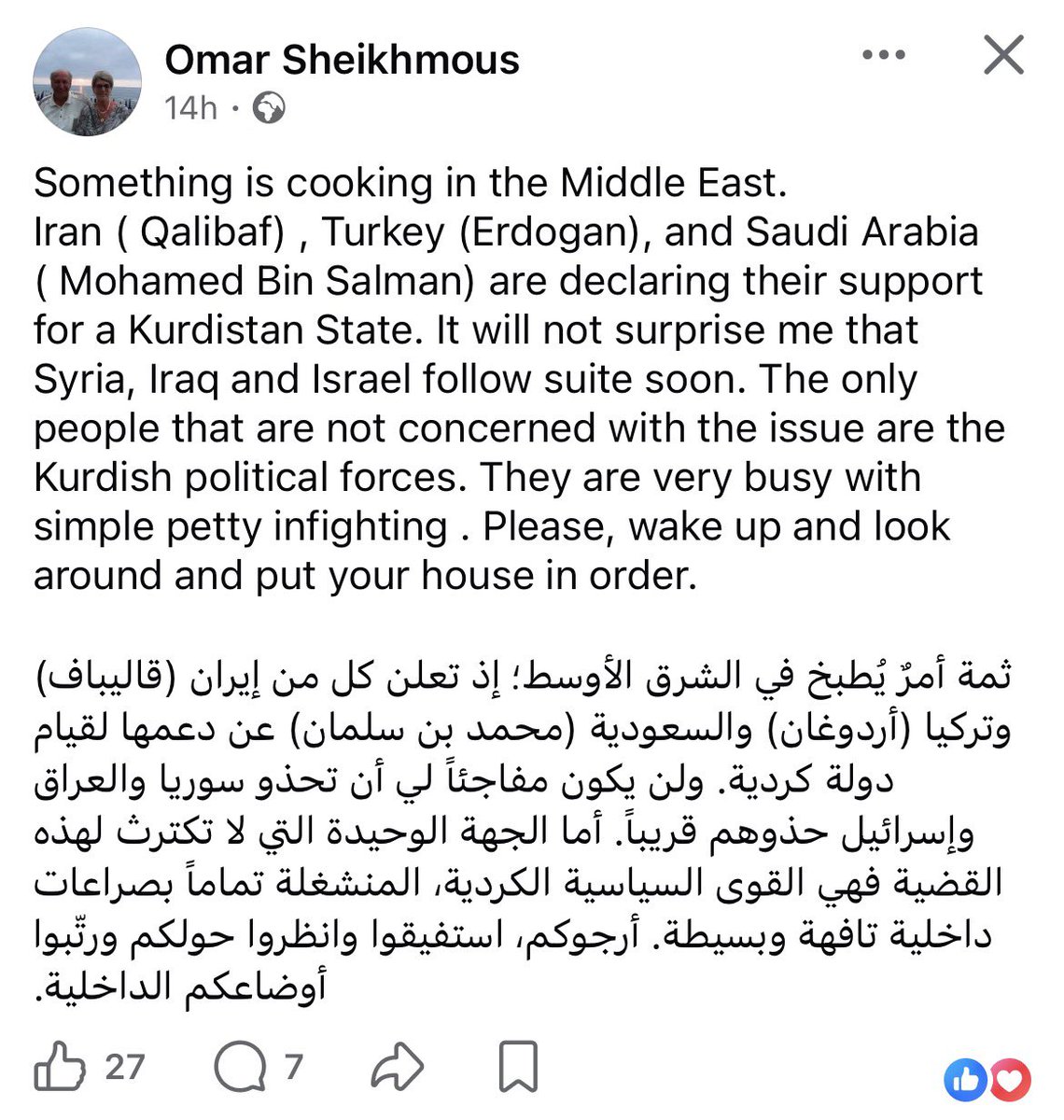
It is becoming alarming to see how many deepfake videos have circulated in the last few days showing politicians supposedly endorsing Kurdistan’s independence, such as Mohammad Bagher Ghalibaf, Saudi Crown Prince Mohammed bin Salman and Erdoğan, and how many people across Kurdish social media appear to believe them.
This is Omar Sheikhmous, one of the most veteran Kurdish politicians and a key founder of the PUK, falling for them and building an entire analysis around them. What is interesting is that there appears to be a kind of mass epistemic unpreparedness for deepfakes, not only among the Kurdish population but across many parts of the world.
For somebody well versed in AI literacy, these videos are often relatively easy to identify as deepfakes. All of these videos, for instance, were easy for us to spot as AI-generated. Yet they have apparently been shared extensively across large sections of Kurdish social media, with entire commentaries being built around them.
But there is also a second layer of verification. Even if someone knows very little about deepfakes and cannot identify the technical signs, how can a supposedly veteran politician or commentator not stop and cross-check whether such an extraordinary statement is actually true? If Erdoğan, Ghalibaf or Mohammed bin Salman had genuinely endorsed Kurdistan’s independence, it would be a major regional development reported across virtually all established media, with reactions from governments, political parties and other regional actors. The absence of that wider reporting should itself immediately raise doubts and prompt further verification.
There is already considerable evidence and literature showing that this is a much wider global phenomenon. For almost the entire history of audiovisual media, until very recently, video has been treated as evidence that something actually happened. So for many people, seeing a politician apparently saying something on video still automatically carries enormous credibility, especially when the clip is being reshared thousands of times on social media and prominent people are commenting on it. That creates the impression of multiple sources and independent confirmation, even though everyone may simply be responding to the same fabricated video.
It is fascinating to watch, but also alarming to see so many people sharing these clips as evidence and then building political commentary around events that never happened. Building your entire analysis and political thinking on fabricated evidence is obviously extremely dangerous and can ultimately do serious damage to the very cause you are trying to advance.
نشر التلفزيون الإيراني الرسمي لقاءا لوزير الخارجية عباس عراقجي مع المرشد مجتبى خامنائي ،، ولكن الفضيحة الكبرى حيث كان اللقاء مع صورة مجتبى على علبة كارتون تطايرت من هواء المروحة .
The Kurdistan Region's Grade 12 results have been announced, with 34% of students passing and 66% failing (more in the below post). Kurdistan Region media reported the figure as a fairly ordinary statistic.
Placed in comparative context against other countries with broadly similar Grade 12 or Baccalaureate examination systems, it is a strikingly low pass rate that should be drawing serious attention. Very few people appear to be questioning it, in the Region or in its media. This is partly because data is rarely placed in comparative context to understand its wider implications.
Across almost all countries where a comparison is reasonably valid, the KRG’s pass rate is by far the lowest. Importantly, the KRG’s 34% is after the resit exam, or second round, not simply after the first sitting.
The closest comparable case is Tunisia, where the final rate after resits was around 51%. Beyond that, Jordan is around 65%, Syria around 65%, Palestine 74%, Egypt 75%, Israel 77%, Qatar above 80%, Morocco 82%, Oman 83%, Kuwait around 84%, France 91%, and Germany, which remains reasonably comparable, around 95%.
The KRG’s rate is therefore remarkably low, yet it has triggered almost no alarm or serious discussion about how the pass rate can be this low.
Trump:
A friend of mine is a very obese person. He’s got a serious weight problem. He’s begging me not to mention his name because I’ll destroy his reputation.
He was taking some fat drugs. I said, "Are you taking this stuff?" "Yeah." I said, "It’s not working. You look like shit."
Trump randomly mocks Macron again:
I spoke to Emmanuel Macron, nice guy, and I said, "Emmanuel, you're going to have to triple the price of your prescription drugs."
"No, no, no, Donald. I will not do that."
I said, "Yes, you will, Emmanuel. We're paying like $130 for a pill and you're paying $10."
I said, "You will, Emmanuel. 100%. Because if you don't do it, I'm going to put a tariff on you of 100% on all your wines and champagnes that come into the United States."
And he said, "Donald, I would be delighted to do it. Please don't do that to me."
🚨 President Trump just shut down ABC’s story that he’s begging Iran to talk.
Trump said he doesn’t care if they sign a worthless deal.
Trump’s line: America already has the better hand near total control of Hormuz and an Iranian economy in collapse.
He called Tehran’s moves the last act of a regime running out of time.
Then he asked the question the networks won’t: when do the Iranian people rise up?