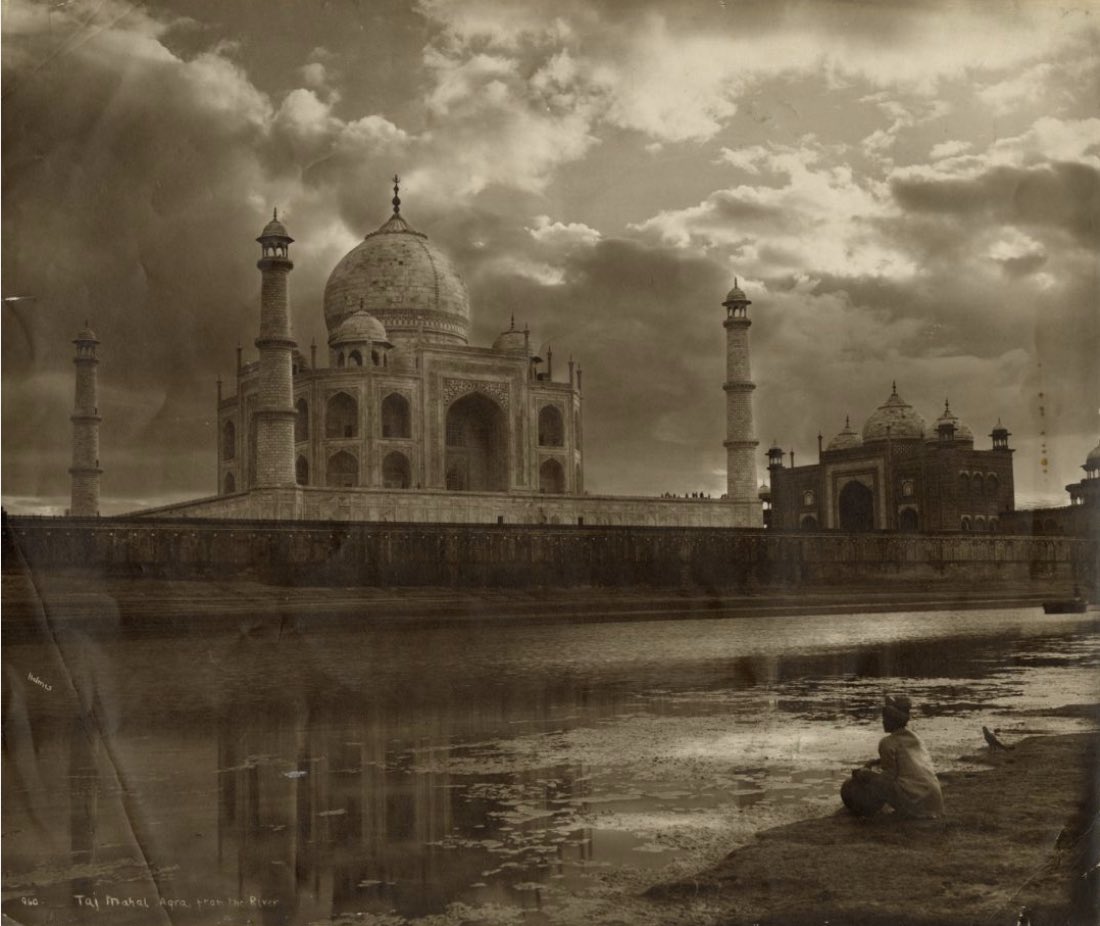
This is the view that emperor Shah Jahan and the imperial family would have of the Taj Mahal as they approached the monument only from the river.
At this time the entire Yamuna riverfront at Agra was a series of beautiful gardens
Randolph Holmes, DAG, early 20th c
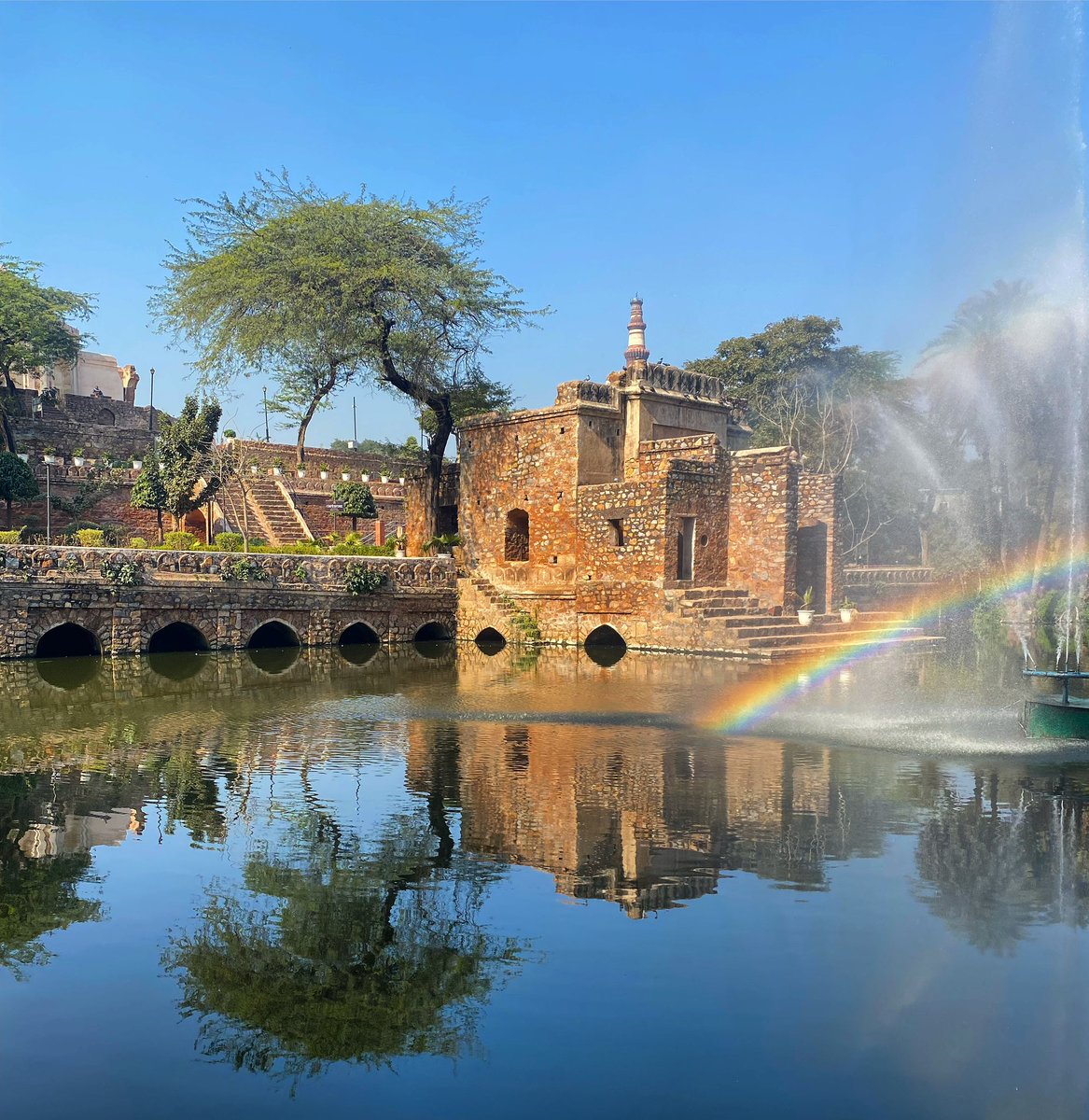
A posh residential colony in Hauz Khas called Mayfair Gardens – though it looks like any other residential area – hides a treasure.
Just ahead of the entrance gate is a beautiful Lodi era dargah complex.
The remarkable feature of the gateway of this dargah is the lovely fluted dome on it. The curious might want to venture in and would be greeted by a single aisle mosque with a big quadrangle. This mosque is locally known as Makhdumki. It is named after a saint, Makhdum Saheb, about whom not much is known except that he was a native of the town of Sabz in Kish.
The notable features, on the west facade of the prayer chamber, are a projected central mehrab, sloping buttresses and a balcony with arched cells. It belongs to the Lodi period (1451-1526 AD). The prayer chamber is internally divided into seven bays, the central one and those on the extreme ends being domed. Quranic ayats are inscribed inside the mosque and the medallions on the facade with Allah inscribed on them.
A painting made by Mazhar Khan in the 1840s for Metcalfe’s Imperial Delhi shows the presence of beautiful red sandstone lattice screens between these columns. None of them remain today. The inner side of the dome was also beautifully decorated with colourful floral designs. There were inscriptions on the ceiling but these have since been destroyed. They had Quranic ayats and some Persian verses. There is a sense of peace here, which remains undisturbed by visitors and maybe an occasional scampering squirrel.
#Delhitrilogy #forgottencitiesofdelhi
Babur was born in Ferghana, in what is now Uzbekistan. He ascended the throne in 1494 at the age of twelve, and by 14 had captured Samarkand; but by 16 he had lost the entire kingdom he inherited to the Uzbeks of the fierce Shaybani Khan. By his late teens he had become a wandering refugee...
Whatever happens, keep your turban on
Unusual image, of Maharaja Sajjan Singh of Mewar swimming with his sardars.
From a Six Senses Series Mewar 1880
Marg
The Khan Khanan’s Ramayan
‘This book.. is among the esteemed books of india. By order of Akbar.. naqib khan of qazwin translated the book into Persian from Sanskrit. This slave.. was allowed to have a copy made’
Abd Al Rahim’s Ramayan, freer collection. From Seyller in #Marg
Gone!! The Chhatri of Zahara Bagh, Agra
Visited Agra late March this year and clicked the photo of the magnificent chhatri of Zahara Bagh from Chini ki Rauza,
Sadly it has collapsed today (29/10/24)
@AbhijitBal@RajeshwariRW These figures mean little. Wages / wealth do not solely determine value to society (think oligarchs).
Official figures also do not factor the lower wages of the estimated 700,000 illegal Indian immigrants in the USA.
When factored, average Indian immigrant earnings plummet.
‘Indian influence was spread by merchants and sea captains, but also by monks. Religious conversion and economic expansion went hand in hand.’
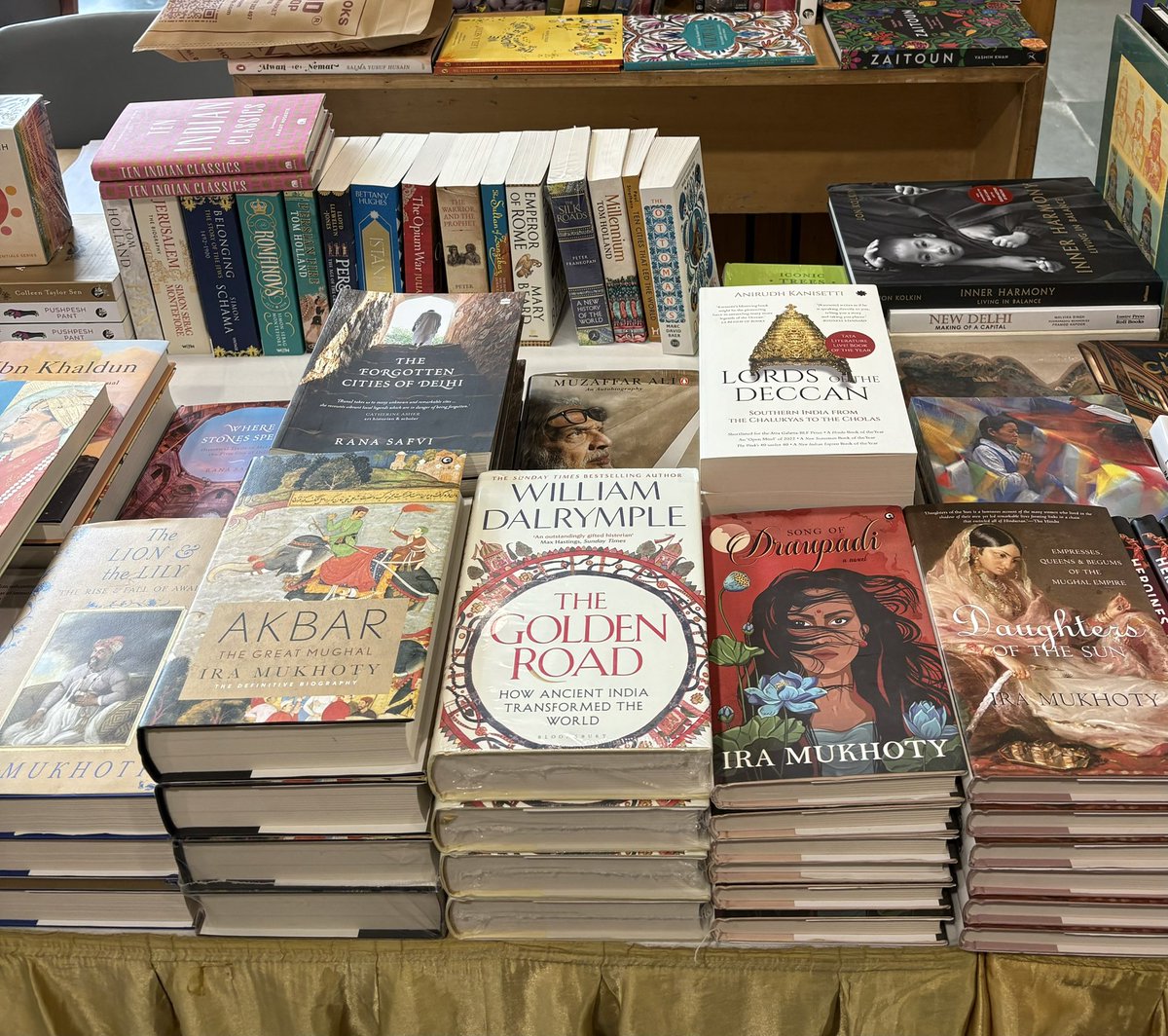
Ferdinand Mount reviews ‘The Golden Road: How Ancient India Transformed the World’ by William Dalrymple: https://t.co/A40NXVCA4l
The Timurnama, Mughal Empire of India.
Commissioned by Emperor Akbar about 440 years ago.
And housed at Khudabaksh library, Patna. @DalrympleWill@MinOfCultureGoI
It was India, not China, that was the greatest trading partner of the Roman Empire. During this era, sea travel was the fastest, most economical and safest way to move people and goods in the pre-modern world, costing about a fifth of the price of equivalent land transport.