More clues that blood vessels are a key component of changes taking place in Alzheimer's disease, this time we focused on white matter:
https://t.co/ACzW4SZlKo
Hey @PhDMarie I had so much fun speaking with you for this @PBtScience episode. Thanks for the opportunity to reflect on life in science and speak about some of my favorite things.
This new episode with @RBennett_PhD covers her research on how changes in blood vessels may contribute to #Alzheimers disease, mentors who shaped her career, major challenges she has overcome in #science, life outside the lab, outdoor adventures, & more.
https://t.co/7Kdps8KVCR
In Alzheimer's the presence of neurons with tau tangles is a close correlate for neuron loss BUT in new 2P longitudinal imaging work from the lab we show that neurons with tangles live while neurons without tangles die. I'm surprised, are you? @MGH_RI :
https://t.co/dc0yn9Qffg
In people w/ Alzheimer's, blood vessels are tortuous and irregular just like what we reported in tau models in 2018. In our new work, we show that there's a lot more perivascular tau than previously thought. Read about clear brains + vascular tau here: https://t.co/Bm3Ipwim6d
@hoppzor@UTHealthSA@CaitlynFastenau@GeroScienceAGE Nice work--I learned a lot reading the discussion! Are α-2,6 N-SA groups on proteins on the extracellular surface of microglia or are they internalizing proteins/lipis with α-2,6 N-SA?
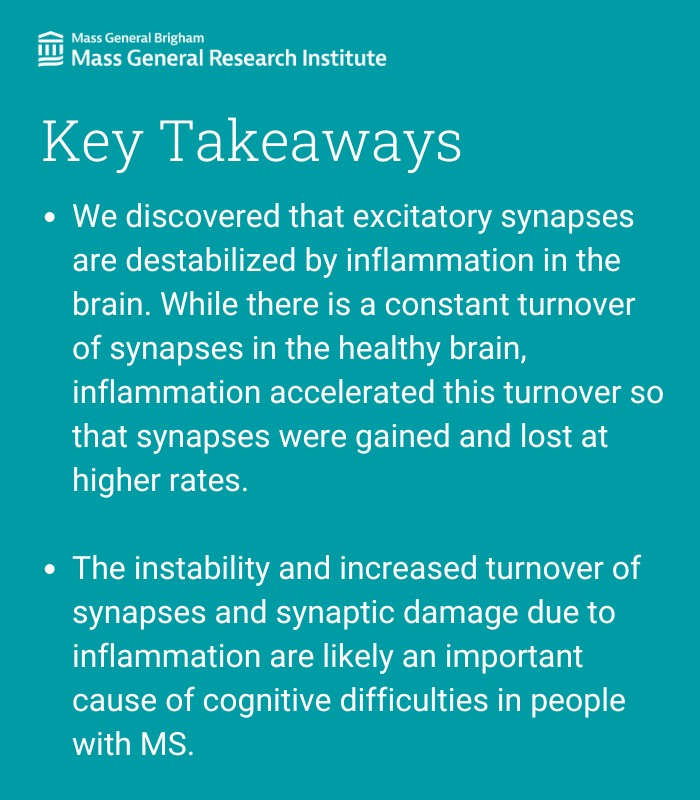
What causes cognitive impairment in MS and other neurodegenerative diseases? Colleagues Becky Gillani and Ted Zwang just published some SUPER(resolution) imaging work examining synapses. Neuroinflammation alters stability!
In a recent study published in the Journal of Brain, Behavior, and Immunity, researchers from @MGHNeurology and colleagues investigated MS and synapse damage from inflammation.
Read more: https://t.co/43nlyVmSYt @mghneurosci
Invisible tau and shunned neurons? A little teaser for work we have been doing with Brad Hyman and Ted Zwang. More to come soon (I hope)! https://t.co/Bxffm5bj39
snRNAseq studies deserve >1 publication to really break down ALL the data. Woodbury et al. examines microglia changes across brain regions and disease stages in AD, following up on our report from endothelial cells in the same donors. Happy reading! https://t.co/65xygc4aAP
@arambling_rosie @BevDavidsonCHOP I think this is a real game changer--awesome work showing that a gene therapy approach could help in AD. Nice job Rosie!
Combined immunolabeling for tau and blood vessels in thick tissues reveals accumulation reminiscent of CAA?! This preprint describes what we've been up to recently: https://t.co/hbSF8g3kWj
The new, improved peer-edited version of our work describing #endothelialcells across multiple brain regions and in #Alzheimers disease is up on J Neurosci!
https://t.co/6Lcbd6fvuK
Nice summary of our transcriptomics study! 👇I’m so excited that endothelial cells get their moment in the spotlight and looking forward to a continued dialogue about how we can use these data to improve brain vascular health and reduce #Alzheimersdisease
A new atlas of endothelial cell gene expression identified regional diversity in human brain, as well as large effects of #alzheimersdisease pathology. @MassGeneralNews https://t.co/vVRlT25n7c
Also, this is a first foray into the world of snRNAseq, R and pre-prints for me. It's been a crazy learning experience, I know there is a lot left to unpack. Also, I'm so thankful of and impressed by those of you who have paved the way for the rest of us. 🥰🙏3/3
New pre-print! Are endothelial cells from different brain regions all the same? How are they impacted by the temporal progression of AD pathology? We wanted to know and performed a giant snRNAseq study using 5 different cortical areas 1/3 https://t.co/C7zaTn4lXu