Unitree Unveils: GD01, A Manned Transformable Mecha, from $650,000 👏
The world's first production-ready manned mecha. It can transform. It's a civilian vehicle. It weighs ~500kg with you inside.
Please everyone be sure to use the robot in a Friendly and Safe manner.
JUST IN: A new McKinsey & Company report breaks down exactly what it costs to build a humanoid robot, and why the supply chain is one of the biggest bottlenecks nobody is talking about.
The typical humanoid bill of materials today: $30,000 to $150,000 per unit.
The long-term target to unlock mass-market demand: under $20,000.
That's a LOT of cost compression still required.
Here's where the money goes:
→ Actuators — 40-60% of total cost, and the PRIMARY performance differentiator
→ Sensing & perception — 10-20%
→ Compute & control — 10-15%
→ Structure — 5-10%
→ Battery — 5-10%
The uncomfortable truth: the most expensive component, actuators, also has the LEAST developed supplier ecosystem.
And here's the scaling dilemma nobody has solved yet. Suppliers won't invest in dedicated production lines because volumes are too low.
But volumes stay low because costs are too high. A classic chicken-and-egg problem.
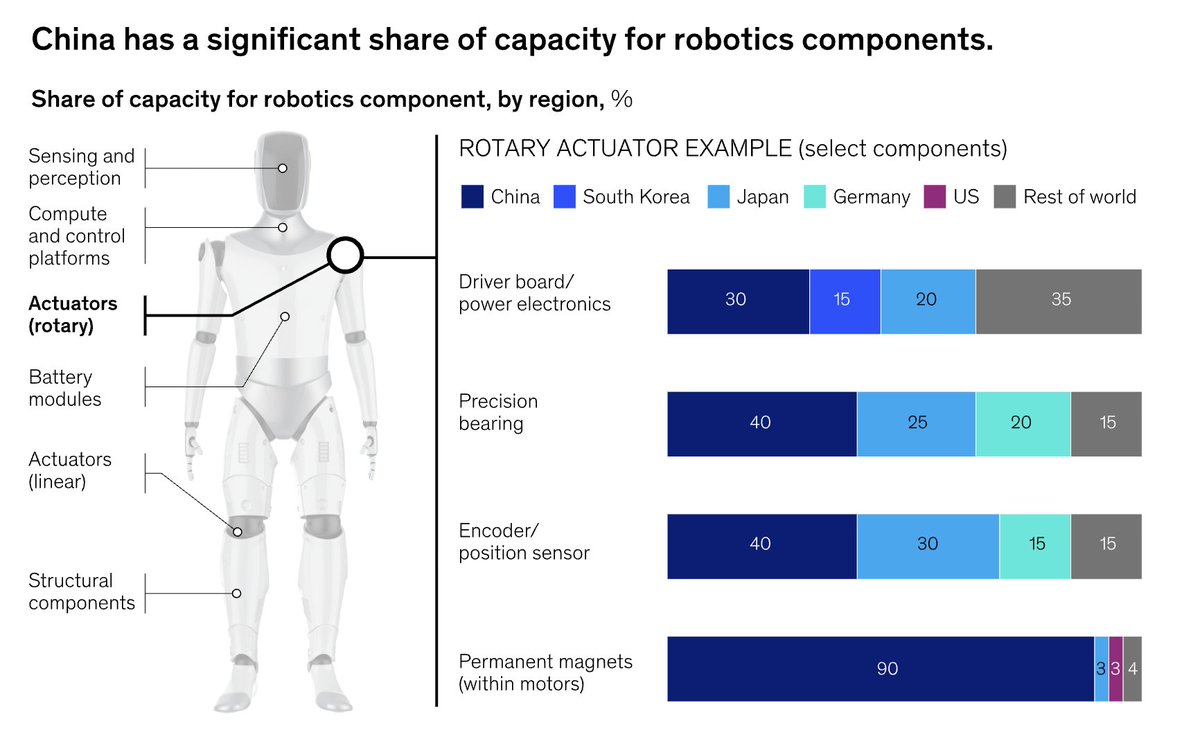
The one structural advantage? China. Its deep EV supply chain overlaps directly with humanoid components, motors, power electronics, permanent magnets, precision bearings.
That's why Chinese manufacturers have a significant head start on cost curves.
Western humanoid companies are racing to either vertically integrate or lock in co-development partners. Neither path is cheap. Neither path is fast.
Everyone is excited about the humanoid robot race. Not enough people are talking about the supply chain war underneath it.
That's where this gets decided.
P.S. It's good to see Schaeffler providing 'picks and shovels' in this humanoid race. 🇪🇺
McKinsey Report here: https://t.co/QvVJKAzSC3
~~
♻️ Join the weekly robotics newsletter, and never miss any news → https://t.co/GoA3ZuwoPB
Humanoid logistics sorters are starting real shifts in both the U.S. and China 🤖
Figure is entering Catalyst Brands’ Reno logistics center, inside the retail network behind JCPenney, Aéropostale, and Brooks Brothers.
RobotEra’s M7 is working at China Post’s Guangzhou logistics hub, feeding and sorting parcels on live lines.
This is the right first job for humanoids: repetitive, physical, structured, high-volume, and easy to measure.
Figure’s F.03 ran a 200-hour public sorting test and handled nearly 250,000 parcels.
RobotEra’s system is being used for parcel feeding, package orientation, and exception handling, with peak throughput reported around 1,200 parcels per hour.
The demand side is obvious.
China handled nearly 199 billion express parcels in 2025. Guangzhou alone processed about 21.9 billion parcels, more than enough to turn sorting into a brutal labor and throughput problem.
The U.S. has a different pressure point.
Parcel volume is smaller, but warehouse labor is much more expensive, so a robot that can work long repetitive shifts has a cleaner ROI story if uptime, maintenance, and deployment cost hold up.
The hard part is not the demo.
It is barcode orientation, soft bags, crushed boxes, recovery after errors, battery swaps, fleet coordination, and keeping the line moving when nobody is filming.
Sorting is still only one link in logistics.
The bigger test is whether these robots can move from conveyor work into loading, unloading, picking, exception handling, and eventually the last mile — where the environment stops being friendly.
That is the real question now.
Not whether humanoids can sort packages, but whether they can earn the next job after sorting.
The deeper you go into the semiconductor supply chain, the less believable it becomes.
> TSMC, a company on a small island, produces over 90% of the world’s most advanced chips
> TSMC relies on dutch company ASML for EUV lithography machines
> ASML depends on German Company Carl Zeiss, the only firm in the world capable of making mirrors precise enough for ASML’s requirements.
> The light source for ASML’s EUV machines is produced by a single company in San Diego.
> The photoresists used to print transistor patterns are produced by Japanese firms like JSR and Tokyo Ohka Kogyo.
> The ultra-pure quartz needed to make silicon wafers comes entirely from a single mine in Spruce Pine, North Carolina.
> The copper and rare-earth materials inside chips are mined and refined across Chile, the Congo, and China.
> The specialized gases used in chipmaking, like neon and fluorine, largely come from Ukraine and Japan.
> The design blueprints for these chips often come from American companies like NVIDIA, AMD, and Apple, which rely on software tools from U.S. firms like Synopsys and Cadence.
Remove any single piece and the whole system collapses.