Recent algorithm changes on X may be unfairly hammering Brave users. And there's a larger issue here about bad interactions between robots and privacy measures.
@nikitabier@brave
My friend Jay Maynard, who some of you may know as Tron Guy, just got permabanned off X for "inauthentic behavior". His appeal was swiftly denied.
Jay is not a spammer, scammer or engagement farmer; he is, in fact, exactly the kind of good citizen X says it wants. Jay asked Gemini for analysis, and now thinks he knows what happened.
Brave, as a privacy measure, randomly changes the identity presented to sites in order to avoid tracking by the ad vampires. Gemini suggested that some code at X interpreted this as spammy behavior using multiple browsers. If so - and this does seem plausible - everybody trying to protect their privacy with Brave is at risk.
This is a general problem, not just an X glitch or a Brave issue. Social media sites are increasingly relying for security on forms of heuristic AI that are prone to unacceptably high false-positive rates.
More specifically, platforms are increasingly treating a user's refusal to be tracked, fingerprinted, and categorized as a hostile act. When a site makes it impossible to connect via a privacy-focused user agent without getting flagged as a malicious bot, it stops being "security" and effectively becomes a retaliatory lockout for protecting oneself.
Worse yet, such system architecture provides no circuit breaker - humans are only rarely and exceptionally asked review for errors. Jay's appeal denial came back so fast that it was obvious no meat-brain ever saw it. He has filed complaints within the Minnesota Attorney General and the Better Business Bureau, because what else can he do? The robots have locked him out.
Badly designed robots and zeal to squeeze human oversight out of the system forces regular citizens to rely on state law enforcement or consumer protection bureaus.
Allow me to gently suggest to the people running X that unless you want politicians poking their noses into your business and imposing constraints on you that you are not going to like, you need to fix your security and appeal processes so running to the law isn't necessary.
@esrtweet@noor36758 You should check some of the existing packages. Someone already mentioned agent-shell, but there is gptel, eca-emacs and many others. Interesting to know you are also using opencode.
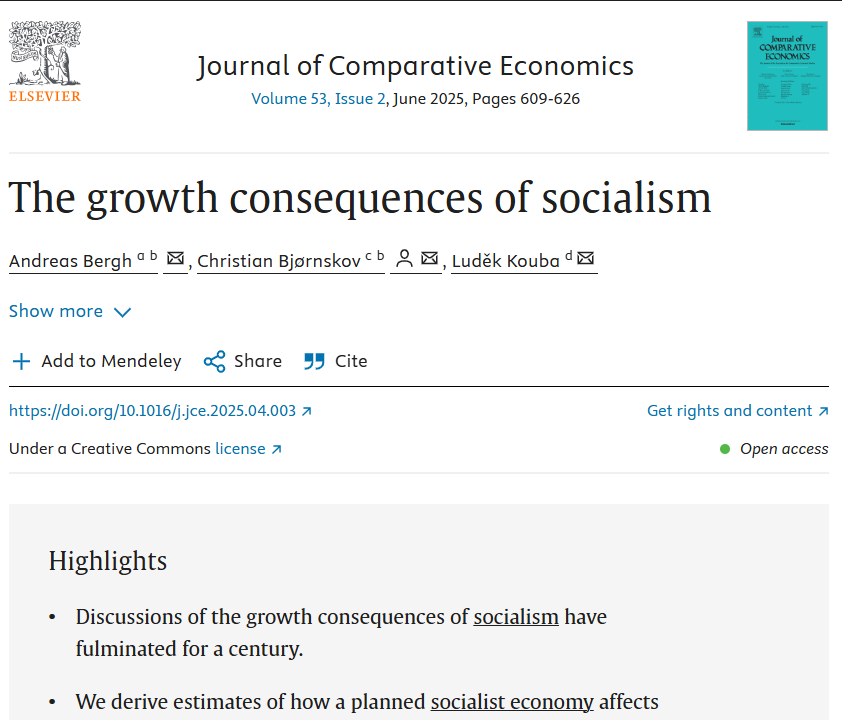
O socialismo real pode ter sido uma das piores experiências já realizadas pela humanidade.
Em um paper recente os economistas Andreas Bergh, Christian Bjornskov e Ludek Kouba analisaram os custos das experiências socialistas do século XX, sendo essas aquelas em que o Estado supostamente controlado pelos representantes do proletariado tomaram os meios de produção e substituíram o sistema de preços de mercado.
Os pesquisadores aplicam regressões de crescimento, utilizando efeitos fixos por país e por ano para controlar variações específicas. A especificação inclui variáveis de controle padrão, como taxas de investimento, gastos governamentais, volumes de comércio, tamanho da população e um indicador de democracia. O estudo utiliza o PIB per capita da base Maddison e das Penn World Tables, além de métricas de produtividade do trabalho.
De acordo com a análise dos pesquisadores, países em desenvolvimento que transitaram para o socialismo sofreram um declínio médio de 2 a 2,5% no crescimento do PIB per capita durante a primeira década da experiência. Em termos práticos, para uma economia em desenvolvimento, esse experimento ideológico representou uma perda de renda de aproximadamente U$ 400 por habitante apenas nos primeiros cinco anos de regime.
O problema central identificado não reside apenas na falta de capital, mas na destruição sistemática da produtividade total dos fatores. O estudo revela que as perdas na produtividade do trabalho são ainda mais acentuadas que as do PIB, chegando a 2,9% em alguns modelos. Isso ocorre porque, ao suprimir o sistema de preços, o regime elimina a bússola que coordena a escassez e o conhecimento disperso na sociedade. Sem incentivos para a inovação e com empresas focadas em extrair recursos do centro em vez de buscar eficiência, o desperdício se tornou a regra e os custos de agência dos trabalhadores se torna ainda mais proibitivo.
Esse abismo fica evidente quando olhamos para os experimentos naturais do século XX. Em 1950, a diferença de PIB per capita entre Taiwan e a China continental era de 83%; em 1990, após décadas de divergência sistêmica, esse hiato havia saltado para impressionantes 431%. No Europa, a Áustria e a Tchecoslováquia, que eram economicamente quase equivalentes em 1950, com apenas 9% de diferença na renda per capita, viram essa distância subir para 98% no momento da queda do Muro de Berlim.
Mesmo a Iugoslávia, frequentemente citada como um caso de sucesso, não escapou da tendência de divergência em relação a pares regionais. Em 1990, o hiato econômico em relação à Grécia, que enfrentou instabilidades políticas e ditaduras no mesmo período, era de 77%.
Assim, no caso do socialismo real como de outras experiências autoritárias, realmente a estrada para o Inferno estava pavimentada de boas intenções.
#socialism #economics #Economía #econtwitter #fintwitt
Saiu 1h atrás e tá maravilhoso
Nem assisti tudo ainda mas nos primeiros 2 minutos já explica que a gloriosa "indústria nacional" importa peça estrangeira no atacado, monta na Zona Franca de Manaus e vende com margem de lucro absurda pra você
@mitchellh People will stop using it when there is remote session persistence. I think 90% of people use of tmux/screen is for connecting to remote servers and not losing the session. Now people use it locally too for LLM agents, but it's essentially the same problem. Wezterm did it l.
Whose bright idea was this?
Definitely a SWs fan put this together.
Leia as science? 😳 (don’t make me laugh.) Put her at communications.
Luke shouldn’t even be on the bridge especially piloting.😱 put him in hydroponics raising Geraniums. 😏
Put the trash can bot at the helm; that’s what it did best.
Get Goldy to be ensign.
Obi should be the science officer.
Han as captain‽- meh!
The Wookiee seems the only one that is correctly placed.
Science is mostly a process of doing experiments to see what the results are. Frequently, experiments fail.
It would be silly to regard failed experiments as wasteful. That would be imposing a perfect-hindsight view on a process that's necessarily messy and uncertain because you didn't know the right answer in advance. If you did know the right answer, you wouldn't have needed to perform the experiment!
Somehow, many people who can easily follow this logic become confused when the failed experiments are investments and businesses. This distorts their thinking about overinvestment bubbles.
The free market is a discovery engine that is constantly trying to find its way to optimal profits - thus, optimal allocation of capital, because nobody wants to spend more money to make money than they have to.
Investors have exactly the same kind of knowledge problem scientists do. They perform experiments by putting their capital into business ventures, chasing the highest possible return on that capital.
Overinvestment bubbles happen when there's some kind of technological breakthrough that is obviously going to make some people lots and lots and lots of money.
Whether it's canals, railroads, network fiber, AI, or next decade's whizzy technology, investors are naturally going to pile into it seeking maximum returns. They're going to do lots of experiments, and they have to because nobody knows the exact right answers in advance.
Bubbles happen as a second order effect - speculators notice the pile-on, and buy in hoping to buy low and sell out well everybody is still excited. But when the bubble pops, speculators (not people who bought on sober market forecasts, even mistaken ones) usually end up taking the biggest hits.
None of this is wasteful, any more than scientific experimentation is wasteful. Overinvestment and bubbles are the inevitable cost of having a knowledge problem about what actually works.
I'm about to do something I think I've never done before, which is assert every bit of whatever authority I have as the person who discovered and wrote down the rules of open source.
After ten years of drama and idiocy, lots of people other than me are now willing to say in public that "Codes of Conduct" have been a disaster - a kind of infectious social insanity producing lots of drama and politics and backbiting, and negative useful work.
Here is my advice about codes of conduct:
1. Refuse to have one. If your project has one, delete it. The only actual function they have is as a tool in the hands of shit-stirrers.
2. If you're stuck with having one for bureaucratic reasons, replace it with the following sentence or some close equivalent: "If you are more annoying to work with than your contributions justify, you'll be ejected."
3. Attempts to be more specific and elaborate don't work. They only provide control surfaces for shit-stirrers to manipulate.
Yes, we should try to be kind to each other. But we should be ruthless and merciless towards people who try to turn "Be kind!" into a weapon. Indulging them never ends well.
A humble rant about free speech, Charlie Kirk, & 'cancel culture'
There's so much confusion about free speech in America -- because there are two different forms of it.
There's 'constitutional free speech', to prevent gov't tyranny through censorship, as codified formally in 230+ years of constitutional law around the First Amendment.
Then there's 'cultural free speech' -- a set of informal cultural norms, traditions, and practices to encourage people to express their true beliefs & values to each other, without fear of reprisals, ostracism, or other non-gov't forms of punishment.
Constitutional free speech is grounded in clear rights, laws, precedents, & principles, centered around retraining gov't from meddling in public discourse. We should strongly protect constitutional free speech, and be very wary of gov't censorship -- whether directly, or through gov't collusion with Big Tech, social media, or AI companies.
However, cultural free speech is much more complicated, nuanced, and subject to renegotiation -- which is what we've been seeing over the last ten years, and especially in the last week.
Civilized people accept thousands of informal restraints on cultural free speech. For example, we use the power of informal social rewards and punishments to discourage
- kids from lying
- spouses from dissing each other
- journalists from acting like propagandists
- teachers from indoctrinating students
- companies from violating traditions and trust
- people from burning our flag
- sociopathic trolling on social media
- comedians from making false & incendiary claims
- politicians from demonizing their opponents to incite political violence among their supporters
All of these are restraints on 'cultural free speech', and they could be seen as micro-versions of 'cancel culture', but they're widely supported, and they're not directly related to gov't censorship or First Amendment law.
Yes, the First Amendment helps establish and reinforce the social norms around cultural free speech, and cultural free speech helps reinforce the willingness of citizens, politicians, & judges to protect our First Amendment rights.
But I see a lot of people, on both Left and Right, confusing the two forms of our civilization's commitment to free speech.
The tricky thing about cultural free speech is that it requires a high degree of public consensus and social trust. It requires political partisans to respect some basic grounds rules when dealing with each other, including a degree of mutual respect and civility. It requires a mutual détente that minimizes the use of 'cancel culture' tactics.
Those ground rules around cultural free speech were seriously damaged by the Left's response to Trump's rise in 2016, by their treatment of fellow citizens during the Covid pandemic in 2020-2023, and by their demonization of everyone on the Right, for the last 10 years, as 'fascists', 'racists', 'sexists', 'Islamophobes', 'transphobes', & 'existential threats to democracy'.
And the assassination of Charlie Kirk last week has utterly nuked the ground rules around cultural free speech in America.
Leading Leftists repeatedly incited the assassination of the Right's leading advocate for cultural free speech, and then millions of Leftists celebrated, condoned, and defended his assassination, and demonized his views after his death. So, the Right is no longer willing to 'play nice' with the Left.
That's what we're seeing. Not an attack on the First Amendment. But a long-overdue renegotiation between Left and Right of the norms and practices around cultural free speech. Given these special circumstances, and what they have revealed about the Left's true beliefs, values, and goals, many of the previous civilized norms around cultural free speech have been suspended.
The burden is on the Left to apologize -- publicly, repeatedly, & profusely, with genuine remorse -- for their decade-long attacks on cultural free speech.
If the Left can take a good hard look in the mirror, do some serious soul-searching, and tone down its rhetoric for the next few years, then maybe -- just maybe -- the Right can eventually forgive them, and we can re-establish a stronger, better, more honorable form of cultural free speech in America for the coming decades.
Until then, the Right should still vigorously support and defend constitutional free speech. But there is no compelling reason for the Right to continue to respect norms of cultural free speech that the Left abandoned ten years ago.
@esrtweet I still miss your long form blog posts. For some time I went to your blog to see if it was up again. I even started wondering if you were ok. Then I found you here. Maybe Devon can get you inspired to write some longish form posts again?
O que pacifica um país não é prender um presidente, tampouco soltá-lo. Enquanto torcedores, de um lado, acusam e, de outro lado, comemoram, milhões de brasileiros só querem viver sua vida em paz, esperando que alguém os anistie dos problemas que ainda são muitos e dos quais estamos falando menos do que deveríamos. A Justiça brasileira, com liberdade, cumpriu o papel que lhe cabe em um Estado Democrático de Direito, que nós lutamos para conquistar e que devemos continuar lutando para manter sempre que for ameaçado, por quem quer que seja. É hora de virar essa página e escrever um novo capítulo na história do Brasil. O que pacifica um país é atacar os problemas, e não uns aos outros. É andar para frente e não deixar ninguém para trás. Quem tem que sair da prisão é o Brasil, preso em uma polarização que nos divide e nos atrasa.
pra resolver exploração de menor na internet:
"regulação" é pretexto pra censurar discurso político
proibir menor de idade nas redes sociais é loucura. vcs não tinham orkut/facebook com 16, 17 anos? controle de criança e adolescente é função DOS PAIS, não do Estado
proibir monetização de canais com menores é menos pior, mas ainda sou contra. pra que eu vou punir um moleque ganhando dinheiro e ajudando a familia jogando videogame no youtube por exemplo
sabe como resolve exploração e sexualização de criança na internet? é simples, basta aplicar a lei que já existe. parem de querer criar lei, criar regulação, criar mecanismos cada vez mais abstratos e genéricos quando o problema é que nem a lei que já existe o Estado consegue aplicar integralmente
o tal hitalo ja ta com as redes bloqueadas. cade a nova lei, a nova regulação que permitiu isso? não precisou? pois é. o problema é que vcs tavam concentrado em ser garoto propaganda do alexandre de moraes perseguindo quem falou mal do lula 8 anos atrás. se tivesse todo mundo preocupado com quem comete crimes de verdade, é isso que ia ser mais combatido. mas vcs tão mais preocupado em denunciar "fascista" na internet e defender que "cadeia não resolve o crime", mas regular a internet, ah isso sim vai resolver 👍