I DID IT!! I'm so happy 🥳🎉🥳🎉🥳
Bronze to Mythic using an algorithm I wrote to make 100% of drafting and deckbuilding decisions. Coming in at Mythic rank 106 with the following stats:
record: 105-54 (66%)
trophies: 7/23 (30%)
i have seen enough proof now that using a coding agent is a deep skill
it's confusing because the people you see heavily using them produce horrible results
but that's because it's a skill! you can get better and the ceiling seems pretty high - this is very exciting to me
"Algebrica" is a free and open mathematical knowledge base. All entries are progressively being released in Markdown format on GitHub for anyone who wants to study mathematics freely and openly.
Alongside the texts, the individual SVG illustrations are also made freely available. They are minimal, mathematically accurate, and designed to be easily reusable in notes, lecture material, or educational resources. Since they are vector-based and code-driven, they can also be modified or improved simply by editing the source.
Another step toward making the knowledge base more open, transparent, and genuinely useful over time.
I’ve been doing this since September and would strongly recommend.
In fact, this has become so much a part of my workflow that I explicitly have a design system as part of my “skill-builder” and often build skills towards web-app artifacts in which they are “zippable to share”.
@FredKSchott@thdxr FWIW this is the main reason I adore neovim.
If you have an idea, just ask Claude code / Codex to set up your editor to do exactly that.
I have a hot key to open PRs -> select to checkout locally and review the diff. So I can go-to-def, see diagnostics, etc. while reviewing.
Also live today: ARC Prize 2026 - 3 tracks, $2,000,000 in prizes available!
Get involved:
• Play a Game: https://t.co/Cd7ANx2mdT
• Build Agents: https://t.co/Pj6qEXUCBD
• Win Prizes: https://t.co/marRtnu9Jn
I'm dying for pi-mono-style minimal library that handles the hard parts of email (auth, syncing with local state, etc.) and gives me an opinionated way to add agentic loops on top of that. I want to build my own agents and logic and guardrails, I don't trust vendors right now.
We've entered into an agreement to join OpenAI as part of the Codex team.
I'm incredibly proud of the work we've done so far, incredibly grateful to everyone that's supported us, and incredibly excited to keep building tools that make programming feel different.
New blog post: how to efficiently calibrate LLM uncertainty using semantic entropy as a reward signal. The calibration gap here is the difference between the confidence reported by the model and its accuracy. https://t.co/qo2M8Xlh8U
I wonder if I’ll eventually shift to the app instead of just sshing to my machine and attaching to the tmux session.
I kind of doubt it, but I’ll try this out
AI eliminated the natural barrier to entry that let OSS projects trust by default. People told me to do something rather than just complain. So I did. Introducing Vouch: explicit trust management for open source. Trusted people vouch for others. https://t.co/6mY8yIcvGx
The idea is simple: Unvouched users can't contribute to your projects. Very bad users can be explicitly "denounced", effectively blocked. Users are vouched or denounced by contributors via GitHub issue or discussion comments or via the CLI.
Integration into GitHub is as simple as adopting the published GitHub actions. Done. Additionally, the system itself is generic to forges and not tied to GitHub in any way.
Who and how someone is vouched or denounced is up to the project. I'm not the value police for the world. Decide for yourself what works for your project and your community.
All of the data is stored in a single flat text file in your own repository that can be easily parsed by standard POSIX tools or mainstream languages with zero dependencies.
My hope is that eventually projects can form a web of trust so that projects with shared values can share their vouch lists with each other (automatically) so vouching or denouncing a person in one project has ripple effects through to other projects.
The idea is based on the already successful system used by @badlogicgames in Pi. Thank you Mario.
Ghostty will be integrating this imminently.
Wrote up about my personal journey from AI skeptic to someone who finds a lot of value in it daily. My goal is to share a more measured approach to finding value in AI rather than the typical overly dramatic, hyped bait out there. https://t.co/SpiIy7DEc9
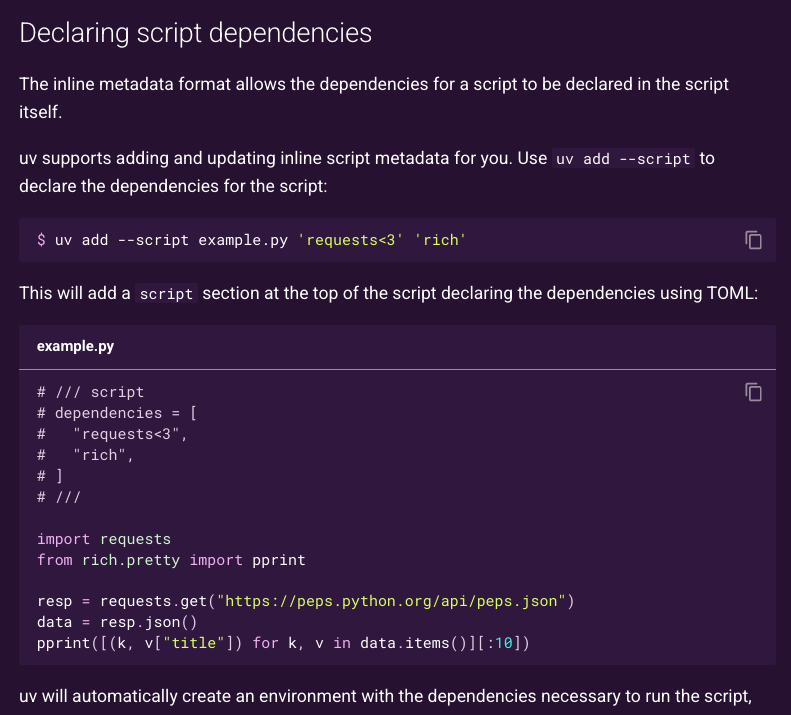
Hey @AnthropicAI and @trq212, a quick request for the skills you package: set these up to use @astral_sh's uv with script specification for dependencies. This way you don't have to worry about skills with conflicting dependencies nor having claude try to install things.
Andrej has such a well-regularized and calibrated world model, and his speech decoder is not excessively RL trained allowing for high mutual information with the WM. Very cool
My flight has free starlink wifi, and it’s fire!
No lag on copilot or Claude code. Easy streaming YouTube with no lag.
Really hope this becomes the norm.
I love hand-crafting release notes. I've always been against most automated changelog tooling. I think changelogs are a boundary point where humans read what other humans should write. It's a social experience as much as it can be on the internet.
But the Ghostty 1.2.1 release notes were started by AI. This is a first for me, and I'm sharing my full session here. I hand-reviewed and edited almost every part of the changelog afterwards, but I still think it was a success with a promising future.
I prompted the agent to use `gh` to inspect PRs and issues within a milestone, and past release notes (all 100% human written) and to generate a draft based on all of that.
It did a decent job and saved me some real time.
The descriptions themselves, the ordering, and subtle syntax was not great. I think a lot of this can be improved through prompting. I think I can reach a point where this can become a slash command for me.
I'll always hand review and edit the resulting work, because like I said, I think release notes are a human experience. And I want the release notes for my projects to be in my voice. But this helps get everything going, and importantly it helps with the rote stuff (commit/contrib counts, list of changes, etc.).
Full session: https://t.co/G6w14zVNev