I’m gonna get roasted for being a corporate robot for saying this, but I love Cursor’s company values:
Just do the thing
Delete the product
Don’t talk about the weather
They’re ambitious and weird and actually influence my work. Plus, I remember them without having to look them up. I can’t say that about any other company I’ve worked at.
Introducing Cursor for iOS.
Build from anywhere by launching always-on cloud agents. Or remotely control agents running on your computer from the app.
Composer 2.5 is 75% off in the app now through July 5.
Everyone is writing about agent loops right now. Including us at Cursor, because they're so powerful. But here's a prediction: a year from now, nobody will be talking about them.
Not because they weren't useful. Because they'll work right out of the box. Batteries included. No instructions necessary.
Feels a lot like prompt engineering two years ago. It was incredibly important. People wrote courses on it. Now you just talk to your agent like a normal person.
That's the strange thing about AI right now. You learn something critical, get huge gains, and before long it's the new normal and something else is the bottleneck. So the alpha isn't what you know. It's how fast you learn it, and how easily you can let it go.
It’s using tools to look up the answers to this specific benchmark rather than doing any real reasoning itself. It’s the difference between you being able to do calculus vs being able to copy from the student next to you.
If the work you’re doing with models has been already done exactly somewhere else, then the ability look up and copy is valuable. If any part of your work is novel work, this misrepresents the models reasoning abilities.
A lot of engineering teams I talk to have reached the point where AI is writing almost all their code. You might think: mission accomplished. AI transition complete.
But there's another big shift underway. Coding is moving from your laptop to running 24/7 in the cloud. Many leading teams, Cursor included, are already deep into the transition. Even sitting close to it, the pace still amazes me. The ground shifts every few months now.
Been a while since I've posted here, but I'm back!
I recently joined @cursor_ai as Field CTO, and today is a big day for the team. Incredibly excited for what we'll build with the SpaceX team. Stay tuned.
SpaceX has exercised the option to acquire @cursor_ai in an all-stock transaction with the goal of building the world’s most useful AI models.
For the past few months, SpaceXAI has been jointly training a model with Cursor, which will be released in Cursor and Grok Build soon.
We look forward to working closely with the Cursor team to advance our frontier AI capabilities
Composer 2.5 is genuinely insane.
I'm replacing claude with cursor and i'm not looking back.
Need cursor credits because this is my daily driver now... this is how i'm building everything going forward.
With the Cursor SDK, you can build your own agents with Composer 2.5. It's now available in Python and TypeScript.
This long weekend, Composer usage is 90% off in the SDK. We're excited to see what you build!
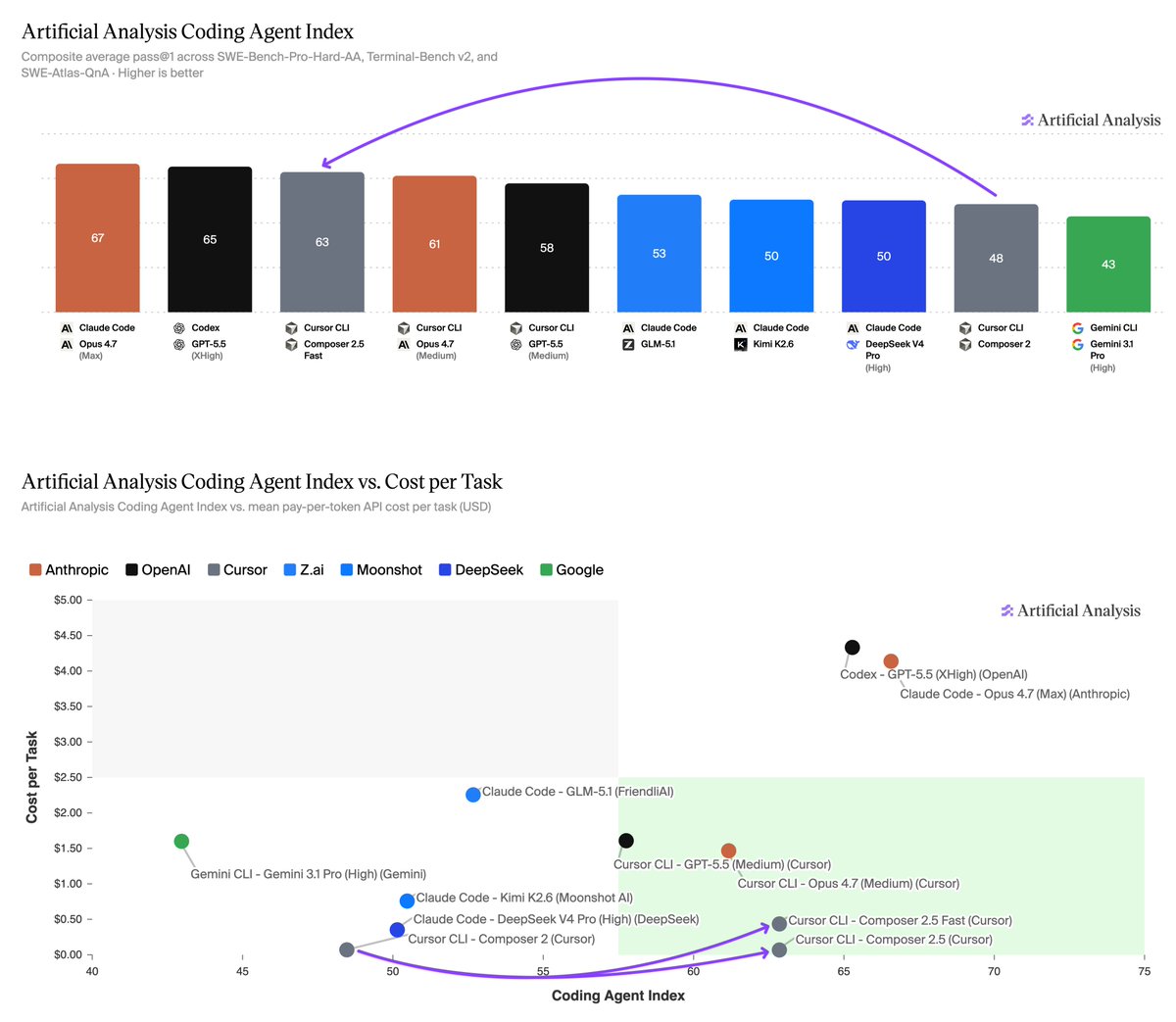
Cursor's new Composer 2.5 takes third on the Artificial Analysis Coding Agent Index and is ~10-60x lower cost than the higher-effort Opus 4.7 and GPT-5.5 variants above it. This release puts Composer among the leading coding agent models, something that wasn’t clear for past releases
@cursor_ai has released Composer 2.5, the latest model in its Composer line. Composer 2.5 scored 62 on our Coding Agent Index, a 14 point gain over Composer 2 (48). This puts it in third place of our tested agents, behind only Claude Opus 4.7 (max) in Claude Code (66) and GPT-5.5 (xhigh reasoning) in Codex (65). These cost $4.10 and $4.82 per task respectively, ~10x the cost of Composer 2.5 Fast ($0.44) and ~60x the cost of Composer 2.5 standard ($0.07).
Key results for Composer 2.5 in Cursor CLI:
➤ Cost-quality Pareto frontier: At $0.07 (standard) and $0.44 (Fast) per task, Composer 2.5 is cheaper than every other agent scoring above 60 on the Index. Medium-effort peers cost $1.24–$2.21 per task; higher-effort variants land 3-4 points above at $4.10–$4.82
➤ Per-benchmark gains vs Composer 2: +35 points on SWE-Bench-Pro-Hard-AA (12% → 47%), +2 points on Terminal-Bench v2 (64% → 66%), and +3 points on SWE-Atlas-QnA (69% → 72%). At 47%, Composer 2.5's score on SWE-Bench-Pro-Hard-AA is comparable to Claude Opus 4.7 (max) in Claude Code
➤ Among the fastest coding agents: Composer 2.5 Fast runs at an average wall time of 6.7 minutes per task, the third-fastest agent on the Artificial Analysis Coding Agent Index, behind only Claude Opus 4.7 (medium) in Claude Code (5.8m) and GPT-5.5 (medium) in Cursor CLI (6.2m)
➤ Fast mode enables better responsiveness at 6x pricing: Fast runs 30% faster than standard Composer 2.5, but is ~6x the cost per task ($0.44 vs $0.07). Token pricing is 6x higher for Fast: $3.00/$15.00 vs $0.50/$2.50 per million input/output tokens
Model details:
➤ Base model: Continued training on @Kimi_Moonshot's open weights Kimi K2.5 as with Composer 2, with Cursor reporting ~85% of total compute from its own additional training and reinforcement learning
➤ Pricing: $0.50/$2.50 per million input/output tokens for the standard variant; $3.00/$15.00 for the Fast variant (the default in Cursor)
➤ Available exclusively in Cursor: both Cursor IDE and Cursor CLI, an externally accessible API is not available
Congratulations @cursor_ai and @mntruell on the impressive release!
just used composer 2.5 for the first time and it’s ridiculously good.
can only assume people are incentivized to hype other models because this is incredible.