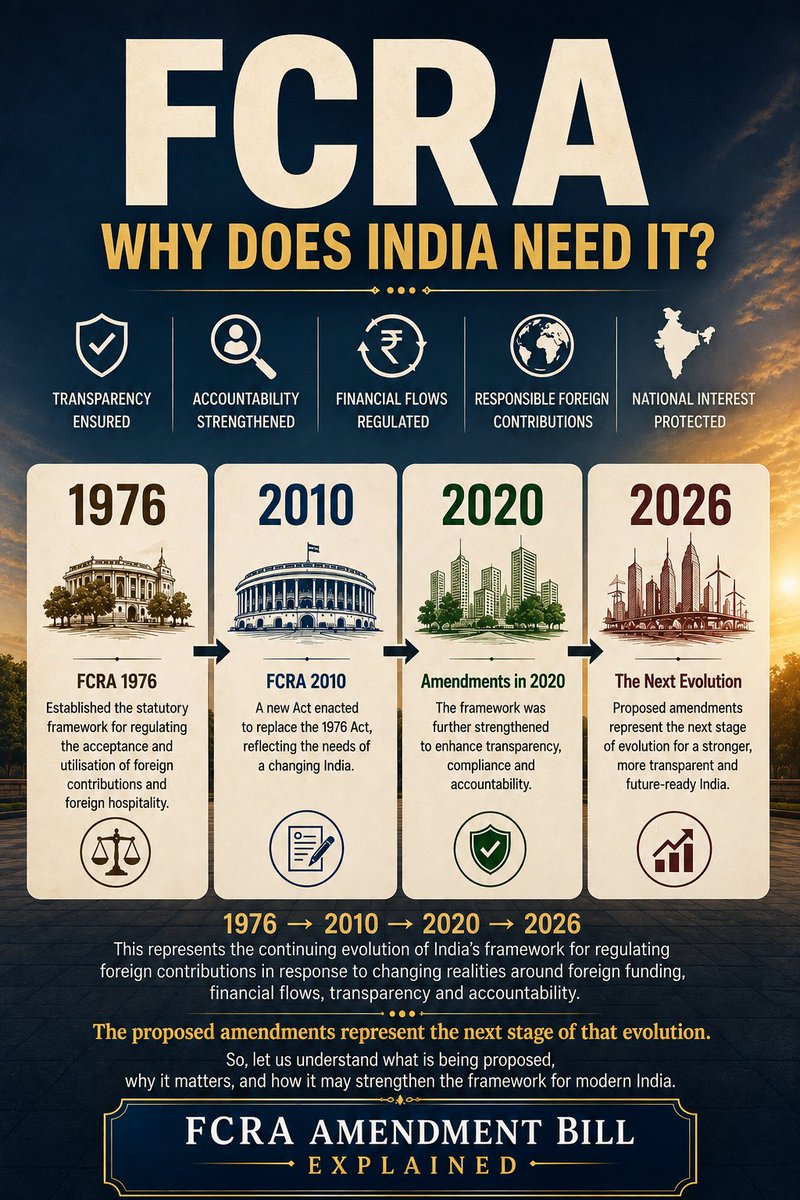
FCRA | WHY DOES INDIA NEED IT?
Foreign contributions have long required a regulatory framework in India.
The FCRA 1976 established the statutory framework for regulating the acceptance and utilisation of foreign contributions and foreign hospitality.
As India evolved, so did the framework.
In 2006, during the UPA government, a Bill was introduced in Parliament to replace the 1976 Act. It eventually became the FCRA 2010, enacted in 2010 and brought into force in 2011.
The framework was subsequently strengthened through amendments, including significant changes in 2020.
1976 → 2010 → 2020 → 2026
This represents the continuing evolution of India’s framework for regulating foreign contributions in response to changing realities around foreign funding, financial flows, transparency and accountability.
The proposed amendments represent the next stage of that evolution.
So, let us understand what is being proposed, why it matters, and how it may strengthen the framework for modern India.
FCRA Amendment Bill | Explained.
Next: 1 | Designated Authority
#FCRA #FCRAAmendmentBill #ForeignContributions #PolicyExplained #KnowTheLaw #Governance #Transparency #Accountability #NationalInterest #LegislativeReforms #IndiaFirst #Parliament #PublicPolicy #NewIndia #AtmanirbharBharat
@Amockx2022 Are yaar, ek hi 0 kaaphi he... Ye 00% kya he?
And, don't you want to decimate BJP offline too, just online is enough or what?
Forget the popularity part, we have seen that over the period of the last decade and more... The numbers speaks man... Grow up...
Seven years ago, on this day, Articles 370 and 35(A) became history, marking a decisive new chapter in the journey of Jammu and Kashmir as well as Ladakh.
Since then, the lives of the people of J&K and Ladakh have witnessed wide-ranging transformation. Infrastructure has expanded, opportunities in areas such as education, healthcare, entrepreneurship and sports have grown. Be it the women or the marginalised communities, those who were denied their basic constitutional rights for decades have been empowered thanks to the full application of the Constitution of India.
5th August this year assumes even greater significance as this is the year our nation commemorates the 125th birth anniversary of Dr. Syama Prasad Mookerjee. His lifelong commitment to national unity continues to inspire generations. What he envisioned decades ago found historic fulfilment on 5th August 2019.
We reaffirm our commitment to the progress of Jammu and Kashmir as well as Ladakh and to ensure that every citizen has the opportunity to dream big, achieve and contribute to the making of a Viksit Bharat.
#Article370Abrogation
Reaffirming our commitment to the progress of Jammu and Kashmir as well as Ladakh, abrogation of Article 370 has ensured that every citizen has the opportunity to dream big and contribute to the making of a 'Viksit Bharat'
#Article370Abrogation
Q : Students are protesting in Ranchi too
Rahul Gandhi : One sec, one sec
Q : Sir, Jharkhand...
Rahul Gandhi : We are not taking any more questions
Coward @RahulGandhi , son of Maino couldn't take one question on Jharkhand paper leak.
August 5, 1669. A date written in the sacred blood of Assam's greatest heroes.
Ten thousand brave warriors of Assam charged into the fierce Mughal cavalry, knowing they were outnumbered.
In just one day, all ten thousand laid down their lives. They chose death over dishonour.
Alaboi Ron was not just a battle; it is the heartbeat of our freedom.
Salute to the immortal martyrs of Alaboi.
‘The Point is the Sheer Level of Misinformation He's Peddling’: Political Commentator @Iyervval on US Lawmaker Calling India’s FCRA Bill a ‘Clear Attack on Christianity’
‘The bill is very clear. It is actually in line with American legislation on this, where you can either be a lobbyist or you can be a think tanker,’ Abhijit Iyer-Mitra explains to RT India.
Republican Congressman, Riley Moore, had earlier claimed that proposed amendments to the FCRA would allow the Indian govt to takeover ‘churches and religious charities.’