🗞️ In early 2028, we plan to launch seven spacecraft tiles that will meet in orbit to form a single spacecraft. Then they’ll rearrange and become a different one.
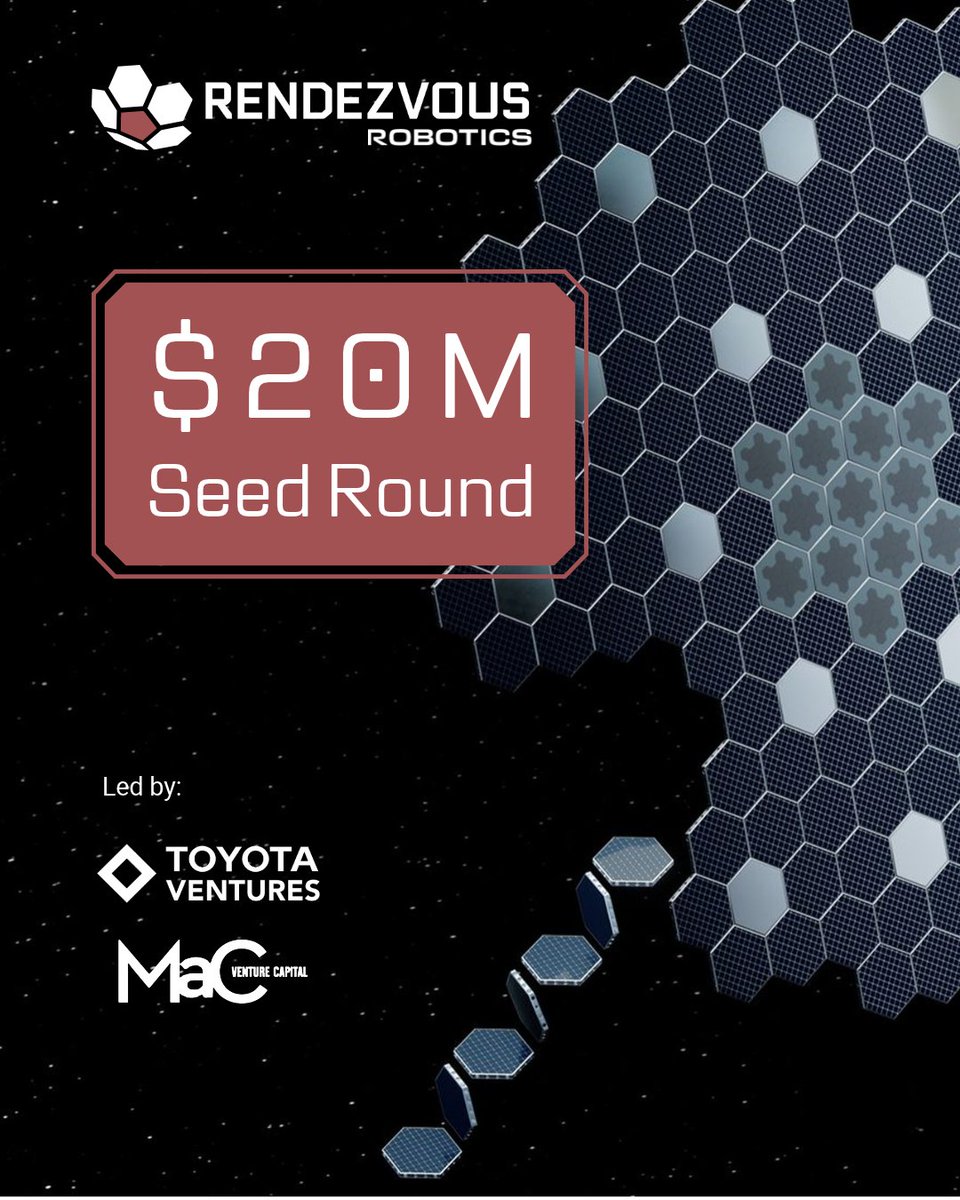
That’s just the beginning of what we’re building. As @payloadspace first reported Wednesday, Rendezvous Robotics has raised a $20M oversubscribed seed round to help make it happen.
Thank you to @MaCVentureCap and @Toyota_Ventures for co-leading this round, with support from the University of Michigan Investment Office, and new investors @AsteraInstitute, @IndustriousVC, and @NextViewVC, along with continued support from @Aurelia_Foundry, @ATXVenture, and Mana Ventures. We’re grateful to all of you for believing in our vision that spacecraft should be able to grow and adapt after launch, with more options than the configuration they left Earth in.
To our team in Golden: thank you for everything you’ve put into getting us here. This is a moment worth celebrating, even with plenty of hard work still between us and orbit.
So, let’s take a sip of champagne. 🥂 Then let’s get back to work. 🛰️
➡️ Release:https://t.co/I9pSDNI4xW
"The team is the perfect recipe for success."
Chris Abshire, Partner at @Toyota_Ventures, shares why they invested in Rendezvous Robotics and the potential he sees for manufacturing spacecraft at scale.
Thank you, Chris and the rest of the team at Toyota Ventures, for your confidence in our team and what we are building.
🔊 Worth a listen. Sound on.
#AssembleInOrbit #BuildInSpace #SpaceStartup #VentureCapital #ModularSpacecraft #Autonomy
“What if everything goes right?”
That's the question Michael Palank, Managing General Partner at MaC Venture Capital, asks when evaluating ambitious startups.
Mike shares what convinced MaC to co-lead Rendezvous Robotics' $20M seed round: spacecraft that no longer have to be designed to fit inside a rocket, and a team with the experience to build them.
Thank you to Mike and the MaC team for believing in what we're building. Take a listen. 👇
#BuildBeyondTheRocket #SpaceInvestment #VentureCaptial #SpaceStartup #ModularSpacecraft #AssembleInOrbit
Space missions need more power, more computing capacity, and larger antennas. Yet we’re still designing spacecraft around what fits inside a rocket fairing. That limits performance and what a spacecraft can do once it’s in orbit.
@rdvrobotics builds spacecraft that assemble themselves in orbit, deliver more capability, AND adapt as mission needs change.
Always a pleasure talking with @rmpodnar at @Via_Satellite about what we’re building and why it matters.
Link to full article: https://t.co/jOIg0lETgr
“Having to fit every satellite into a rocket is a ridiculous constraint that we cannot tolerate going forward.”
Our CEO, @joe_landon saying the quiet part out loud. Read the full article in @Via_Satellite ➡️ https://t.co/oHDpCf9zWq
Rendezvous Robotics (@rdvrobotics), the CO-based startup developing self-assembling spacecraft, announced $20M in fresh funding today to support an in-space demo launching NET April 2028.
Across the industry, satellite manufacturers are developing sats that require football-field-sized solar arrays and large-aperture antennas—neither of which fit comfortably inside available rocket fairings.
For many, the solution to this size mismatch looks like origami. But Rendezvous Robotics is taking a different approach—developing technology to allow future satellites to launch in pieces that can self-assemble in space.
Read more about the company's long-term plans, from Payload reporter @Douglas__Gorman. Link below.
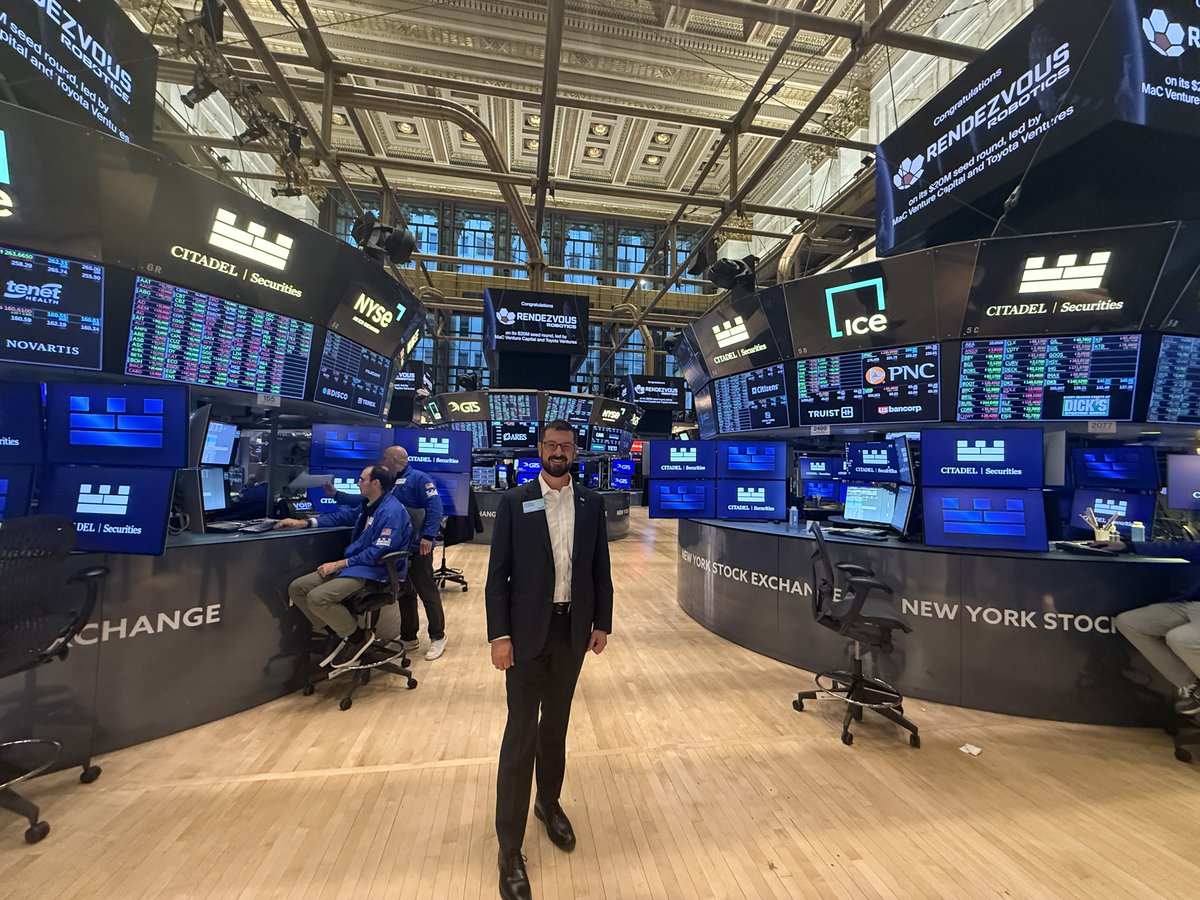
Yesterday I visited the @NYSE to celebrate our $20 million seed round, led by @MaCVentureCap and @Toyota_Ventures, and I talked with NYSE TV about how @rdvrobotics is changing the way spacecraft are built.
Seeing our logo on all the trading floor screens was so cool!
What if spacecraft could assemble themselves in orbit? MaC Venture Capital is proud to co-lead @rdvrobotics $20M round alongside @Toyota_Ventures, advancing a new approach to building satellites in space. https://t.co/6si4x4D2zz
@rdvrobotics has raised a $20M Seed round co-led by @MaCVentureCap and @Toyota_Ventures. Our spacecraft launch as a flat stack of tiles that autonomously self-assemble in space so we can finally start building the satellites we need, not the ones that fit into rockets.
Payload: https://t.co/6lqmQP5Xli
At the International Academy of Astronautics (IAA) Academy Day this morning at #IAC2026, Dr. Anthony Brown of @UniLeiden presented ten years of the @ESAGaia mission. Gaia is a space observatory that surveyed the sky from Sun-Earth L2, 1.5 million km from Earth. This photo shows the sky map from Gaia's first data release in 2016, which charted 1.14 billion stars. The current catalogue holds 1.81 billion stars, and the fourth data release arrives in December 2026 with 66 months of observations.
🔭 More on Gaia: https://t.co/oM4FYHLG66
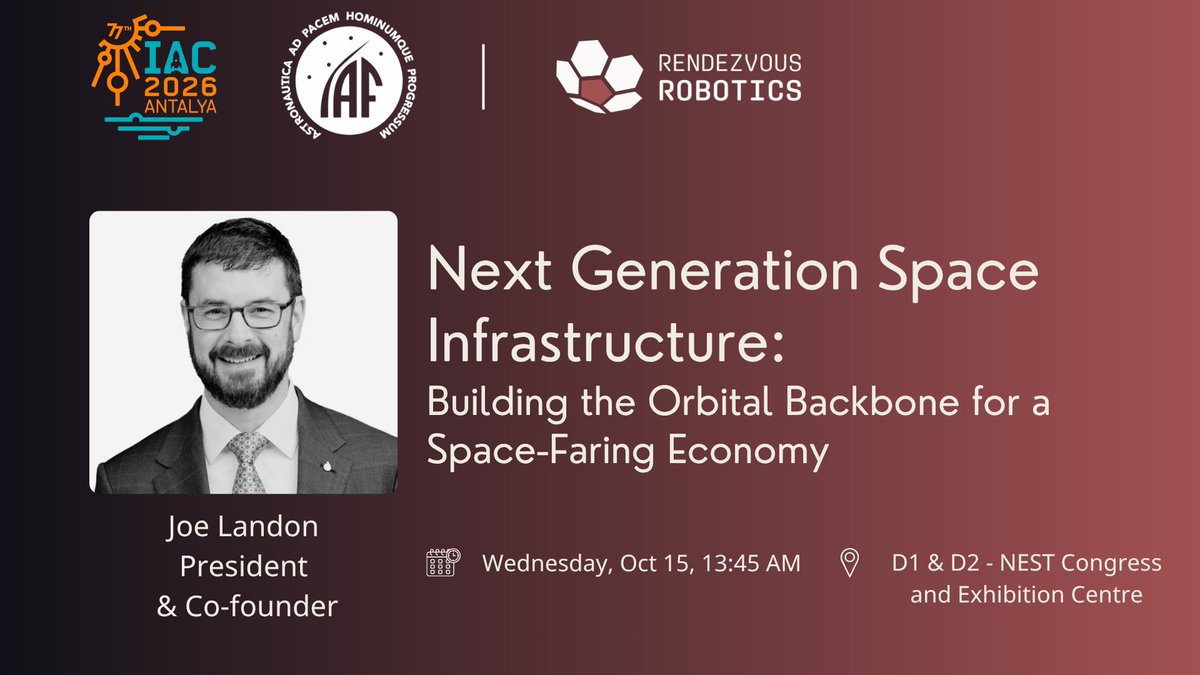
At #IAC2026, I’ll be moderating the “Next Generation Space Infrastructure” plenary and digging into what we need to build in space to support the space economy. It’s a future we are building at @rdvrobotics, and I’m looking forward to hearing how others are approaching it.
Oct. 7 | 13:45
If you’ll be there, let’s connect. 📷