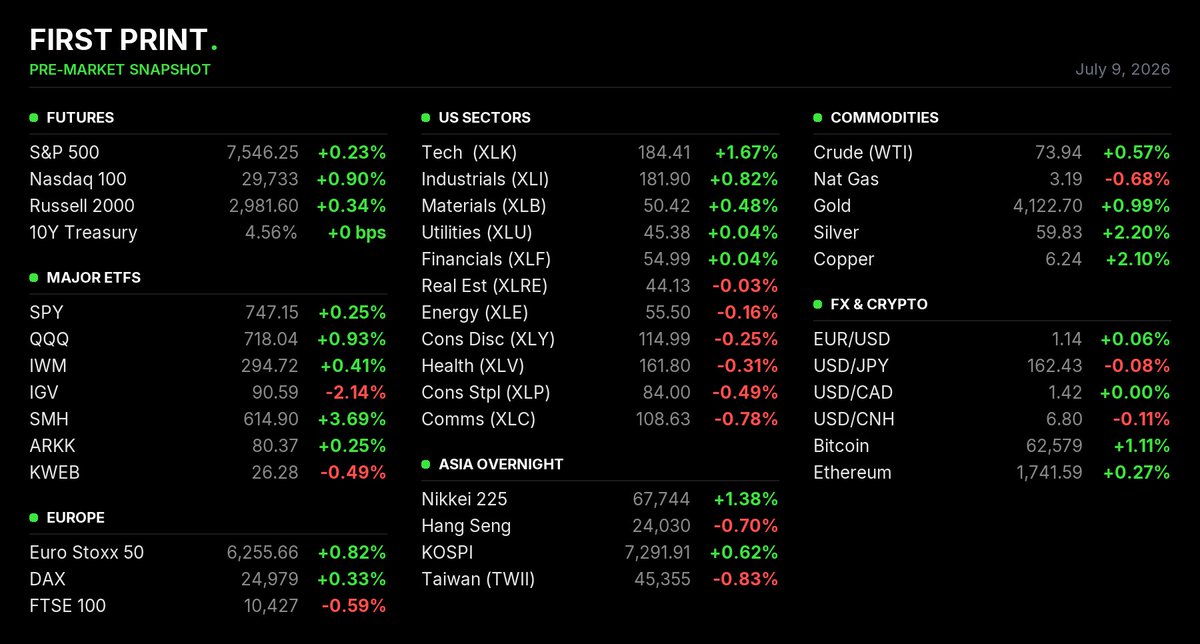
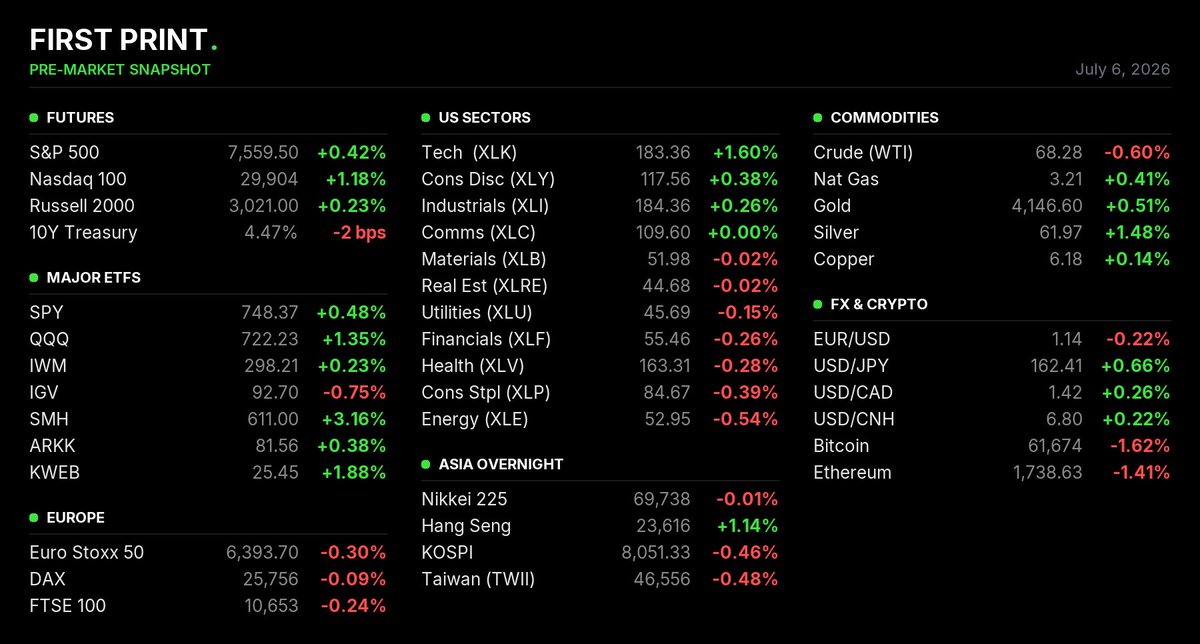
Where do $NVDA bulls defend the positioning reset? A Truist investor survey shows the name falling to 6th in mega-cap rankings, its lowest since April 2025, while $META and $AVGO hit new highs.
TD Cowen reit Top Pick after hosting CEO Huang and CFO Kress. Only ~20% of the business today supports frontier models. Low-mid teens % from diversifying enterprise verticals. The shift from selling chips to operating AI factories spanning GPUs, CPUs, networking, and storage with a revenue-sharing model for startups is underappreciated. At <20x 2027 EPS, material undervaluation.
Compute remains in shortage, legacy GPU rental prices rising, cloud deals signing at premiums. But $META's custom 'Iris' chip enters production in September, developed with $AVGO in six weeks of testing, computing power targeted at 14 GW next year. Each hyperscaler-designed chip represents a marginal share shift.
Full breakdown in today's First Print.
Semis momentum unwind extending pre-mrkt with SMH breaking below early June lows into next week's ASML and TSM prints. Iran ceasefire declared "over" with crude +5-7% and 10Y near 4.60%. KOSPI down another 5.4% overnight.
- $AVGO reit OW (JPM): Google TPU v9 on track for CY28 ramp, 400G SerDes working
- $NVDA reit Buy (BofA), PT $350: 18x forward P/E 7-year low, implies unjustified 30-35% EPS cut
- $AAPL iPhone Tracker (Bernstein): May sell-through +2% YoY, China -16%, first iPhone 17 contraction
- $PYPL init UW (BARC), PT $42: guest checkout collapsed from 44% to 16% of Visa e-comm
- $XYZ init OW (BARC), PT $100: 13%/17% Square/Cash App GP CAGRs through 2028, ~40% headcount cut
Detailed sell-side commentary, buyside positioning, and market themes. Read it all in First Print.
Is the memory cycle finally turning two-sided? $MU -5%, $WDC -7%, $SNDK -5% pre-mrkt after the KOSPI dropped 5% and Asia memory fell 8-11% overnight. Samsung's Q2 prelims landed with ~1% revenue upside and OP 6% above St, but investor feedback points to elevated expectations in a "not good enough" tape.
The structural AI capex bull case still holds with 35-40% earnings growth modeled for 2027E. But the question is rotating from how much pricing upside to how durable the cycle. Preference shifting toward DRAM and legacy memory over NAND, module makers least preferred. Volatility expected as positioning unwinds.
Detailed sell-side commentary, buyside positioning, and market themes. Read it all in First Print.
Semis bid pre-mrkt after Tech Momentum's first back-to-back 10% down days on record. Memory pricing accelerating into Q3 with Samsung negotiating DRAM ASP hikes up to ~20% QoQ and $MU DRAM ASP forecasts now at +44%/+20%/+13% QoQ for Q2/Q3/Q4'26, up from +37%/+13%/+11%. A SemiAnalysis report flagged that NVDA's Kyber NVL144 rack architecture has been delayed by more than 12 months to 2028 on PCB midplane manufacturability issues.
- $MSFT reit OP (Wolfe), PT $525: FY'27 capex raised to $270bn on memory inflation, negative FCF expected
- $AAPL channel checks (Edison): iPhone sell-through in China down ~5% YoY in June quarter
- $TSM reit Buy (Citi), PT NT$3,800: 30-day catalyst watch, 2026 growth target raise expected at July 16
- $AMD reit Buy (GS), PT $640: 2027 EPS $14.50, ~13% above St on server CPU and MI450 ramp
- $MU catalyst watch (Citi): DRAM ASP forecasts raised to +44%/+20%/+13% QoQ, ~60% uncovered by LTAs
Detailed sell-side commentary, buyside positioning, and market themes. Read it all in First Print.
Into next week the calendar is thin until ASML and TSM on July 15-16. TSMC is negotiating 2027 price hikes of 5-10% on advanced nodes with CoWoS capacity raised to 140k monthly by 2026.
What's sitting with PMs:
- Whether hyperscaler capex guides uptick. Consensus expects AMZN to raise above $215bn from $200bn, while META and GOOGL lean toward unchanged. META Compute adds a wrinkle, if Meta is building a cloud business on its infrastructure, that's either CY'27 optionality or a signal the marginal capex dollar needs a revenue line (i.e., have overbuilt).
- Whether the semis drawdown is a dip to buy. SOX at $13.3k testing the lower band of a $13k to $14.6k range, packed with quant and passive flows. NVDA and AVGO are the laggards unlikely to rebound materially in Q3.
- Whether software can sustain the bid. Sector is -14% YTD with fund managers underweight. DDOG and SNOW showing AI-driven acceleration but consistency is lacking. FDS printed a clean ASV beat at +7.1% but reaffirmed rather than raised, drawing negative feedback.
The HF that built the table isn't adding back transaction, reorg, and other non-core charges. You can debate whether this is the right approach or not, but their thought is for a serial acquirer those recur every year ($164mm in 2025 alone). The cash conversion is poor which is how they justify it.
Hedge funds were happy to see the 40% $BSP IPO pop because they’ve been wanting to short Bending Spoons since the prospectus hit @luke10ferrari
The stock trades at 10.2x EV/Sales on $2.6bn of pro forma revenue for a 6% organic grower (Q1'26), with growth propelled by taking price against a declining user base. NRR has printed below 100% in every period disclosed (94% in Q1'26). Bears frame the strategy as aggressive repricing of low-switching-cost products, a bet that subscriber inertia outlasts the churn it creates. The long tail is the asset with 48% of subscription revenue coming from customers tenured 5+ years, on a base that shrinks every year it is disclosed. Third-party estimates show Evernote revenue +39% since acquisition on downloads -64%, and WeTransfer revenue up ~5.5x on flat downloads.
$CSU (3.6x EV/Sales) and $ROP (5.7x) buy stickier B2B vertical software and both have derated 40%+ from their highs on AI-disruption risk, bears argue consumer apps are more exposed. $MTCH is not an acquirer but has a similar profile (payers -5% YoY, ARPU +10%) at ~40% margins and trades at 3.4x. $PLTK, the closest listed acquirer of aging consumer apps, sits near 1x, down 87% from its 2021 IPO. Endurance International ran the same model in web hosting and went private in 2020 below its 2013 IPO price.
The market is underwriting the M&A engine at a premium, and the engine has to keep scaling. Aggregate deal value went from $194mm in 2023 to $1.92bn in 2025 and $2.01bn in Q1'26 alone. Bears point to a shrinking universe of assets large enough to move a $2.6bn revenue base, and note the playbook is unproven at this scale: AOL, Vimeo, and Eventbrite make up ~50% of pro forma revenue, have been owned for less than 8 months, and AOL alone cost more than every 2023 and 2024 acquisition combined. $BSP paid a blended ~2.5x EV/Sales for revenue the market now values at >10x inside $BSP.
The HF that built the table isn't adding back transaction, reorg, and other non-core charges. You can debate whether this is the right approach or not, but their thought is for a serial acquirer those recur every year ($164mm in 2025 alone). The cash conversion is poor which is how they justify it.
$FDS printed FQ3 ASV growth +7.1% YoY vs St +6.5% and buyside survey +6.7%, up from +6.7% in FQ2. Reaffirmed all F'26 metrics rather than raising. HF feedback uniformly negative on margin trajectory and terminal value concerns, with some debating a 6x scenario. Stock -2% pre-mrkt.
- $NOW u/g Buy (Guggenheim): 5.9x EV/NTM recurring revenue, US federal spending overhang removed
- $CRM u/g Buy (Guggenheim): 3.7x RR multiple prices in perpetual decline despite durable cash flow, -41% YTD
- $PANW reit top pick (BTIG), PT $380: Cortex XSIAM ~$600mm ARR growing 100%+ YoY, Chronosphere $300mm+ run-rate
- $TSM raised CoWoS capacity (UBS): 250k wafers/month by end-2027 vs 150k previously, NVIDIA Rubin key 2H26 catalyst
Full read in today's First Print.
Where does the $MU thesis stand after the Strategic Customer Agreements?
Jefferies frames them as a structural model shift: 3-5 year take-or-pay deals, $22bn of customer commitments already locked, ultimately covering ~50% of sales versus ~25% today. IR reaffirmed memory demand above supply through 2027 into 2028, with agentic AI, KV-cache, and Storage Next as incremental demand layers on top.
The bear knocks are real. Apple's pricing negotiations are active, a US consumer lawsuit alleges DRAM price-fixing, and the stock reversed from down 6% to up 12% yesterday, a move the buyside reads as crowding-driven not fundamental.
The bull case on the other side: checks point to DRAM and NAND both rising more than 20% QoQ in Q3'26. Korea's ~$3.1T AI investment plan is read as supportive since new capacity doesn't arrive until ~2033 and the planned 15GW datacenter buildout consumes memory internally. JPM models $12-20T of cumulative revenue opportunity for memory suppliers from Korea's plan alone.
The LTA overhang flips the contested question: is this a peak-cycle trade or a structurally re-rated business with durable earnings? That debate is live into July earnings.
Full setup in today's First Print.
Where does the AI capex trade go from here?
The MAG7 just logged its worst monthly performance against the Russell 2000 ever, underperforming by ~15.7% in June. Software -13%, MAG7 -12%, comm services -11%. Meanwhile health care, industrials, utilities, and financials are all higher MTD. The broadening-out rotation is real, but the institutional debate has hardened into a single question that is becoming heard for the first time: who blinks first on the capex race?
The overhangs are stacking
- OpenAI potentially delaying its IPO. Enterprises publicly pushing back on AI spend
- $COIN CEO flagging a move to cheaper AI defaults after 91% of employees never hit usage caps
- Falling H100 spot pricing
- Rising memory costs
- Open-source gaining traction
The counter is that AI adoption is still concentrated in coding and free chatbot users. These fears have flared repeatedly over the last two years, typically after massive $SOXX runs and when positioning is very elevated. CNN Fear and Greed has been flashing fear, a reading historically associated with the start of more bullish turns. Hedge funds have net sold tech three consecutive weeks.
The "who blinks first" debate and where it resolves in today's First Print.
The week's defining tension: whether the AI/memory momentum trade is structurally sound or a crowded fast-money positioning story waiting to crack.
The week's institutional debates:
1. MU multiple vs. fundamentals
- Start of week: buyside underwriting ~$200 CY27 EPS with debate squarely on the multiple investors would underwrite, not the numbers, with the stock closing down 5 of the last 6 quarters as a sell-the-news pattern
- What moved it: MayQ revenue/EPS of $41.5bn/$25.11 blew past consensus $35.7bn/$20.49, AugQ guided to $50bn/$31.00 (~22% above Street), 16 strategic customer agreements covering ~40-50% of revenue disclosed with ~$22bn in customer deposits, and management signaling supply cannot meet demand even by CY28
- Where it sits now: the CY27 supply debate is settled to the upside per the briefs; the open question is the magnitude of multiple re-rating, with one camp arguing a normalized mid-50s% margin justifies a mid-to-upper-teens P/E against the current single digits
2. Momentum crowding: air pocket or structural break
- Start of week: AI Winners +9.9% and SOX +8.9% over the prior four sessions, with WDC at 78 RSI and SNDK at 71, signaling an overbought complex
- What moved it: KOSPI fell ~10% Tuesday, hedge funds recorded their largest single-day momentum degross on record (long-sold more than 5std of US AI Winners and Semis), and total de-grossing since May reached ~-5% of US gross market value, the longest and largest on record
- Where it sits now: gross and net exposure to US high momentum remain in the 99th percentile on both 1Y and 2Y lookbacks; high-beta momentum has logged 8 moves of -6% or worse YTD with the basket bouncing the next session in 6 of 8 instances, read as crowding-driven rather than fundamental
3. MAG7 as source-of-funds vs. dip-to-buy
- Start of week: MAG7 drawdown the dominant positioning story, Russell at ~18-month highs versus MAG7, net flows into the cohort dropping sharply, MSFT vs. QQQ at ~8-year lows
- What moved it: two DeepMind departures to Anthropic, Nadella's WSJ comments on AI-power concentration, GOOGL and AMZN down ~5% in a single session (their largest drops since February), and the token-economics debate keeping software under pressure
- Where it sits now: buyside surveys show positioning heavily skewed short OpenAI, Anthropic is the overwhelmingly preferred AI IPO, and the emerging read is that buying MAG7 dips no longer feels like a no-brainer for the first time in years
$QCOM investor day kicks at 2:15 PM ET. The institutional debate: can QCOM credibly expand into the AI accelerator opportunity?
The numbers circulating: data center and CPU/agentic markets adding ~$20bn to the model, extending the framework toward ~$65bn revenue and ~$25 EPS over five years. A combined non-handset opportunity of ~$25bn by FY31 implies ~$70bn revenue with handsets falling to ~50% of mix. Custom chip-design talks with ByteDance, built on AlphaWave Semi technology, sharpens the narrative going in.
Full breakdown in today's First Print.
Where do $MU bulls defend into the print?
The buyside bogey sits as high as $38bn revenue and $22.00 EPS for FQ3, versus st at $35.6bn and $20.57. FQ4 bogey near $28.00 EPS versus st $25.60. UBS is at Street-high PT $1,625, embedding an EPS pathway above $100 and $400bn+ FCF through CY'29 as LTAs lock in DDR pricing; they raised CY27/28/29 EPS to $155/$167/$117 (from $133/$122/$77), now trading on ~15x NTM P/E.
The bear case is simpler: $MU has closed down 5 of the last 6 quarters on a "sell the news" pattern, RSI sits near 70, the implied move is the largest in a decade at ~10%, and short interest, though climbing to its highest since January '25, is still only ~3.3% of float. Positioning is crowded long, even after today's sell off.
Management's ability to message the evolving LTA strategy is the real variable. Fundamentals are seen as objectively strong. The question is whether the tape rewards them for it or sells the headline again.
KOSPI -10% overnight is cracking the AI-Winner/memory complex: NDX futures -2.6%, MU -6%, MRVL -8%, SNDK -8%. Anti-momentum bid in software and legacy tech. MU prints Wed AMC into the largest implied move (~10%) in a decade, full set-up in today's First Print.
- $MU reit Buy (UBS), PT $1,625: EPS pathway above $100 and $400bn+ FCF through CY'29 as LTAs lock in DDR pricing
- $CBRS reit Buy (UBS), PT $300: pure play on fast inference, 10x EV/Sales on CY'29 ~$11bn sales, OpenAI/AWS moat
- $IBM u/g Overweight (JPM): Trump commendation and OpenAI partnership integrating frontier AI into enterprise security
- $GLW reit Hold (Truist), PT $205: Photonics MAP ramp drives focus toward ~$40bn annualized sales target by end-2030
Detailed sell-side commentary, buyside positioning, and market themes. Read it all in First Print.
$MU prints Wednesday into a crowded long, with the semis-over-software rotation driving the tape and software sentiment weighed by Nadella's push toward user-controlled models.
- $MU reit Buy (UBS), PT $1,625: robust AI demand and LTAs extend upcycle, DRAM pricing potentially +50-100% on contract
- $ACN reit Buy (UBS), PT $275: Middle East guidance impact seen as discounted secular, $4.175bn cyber M&A lifts FY26 inorganic to $9bn
- $SNOW reit Buy (UBS), PT $370: AI pass-through revenues ~1% of mix vs ~15% for Databricks, growth guide viewed as clean
- $COHR increasingly constructive (JPM): investors over-focus on CPO, doubled $4bn OCS SAM seen as conservative, GM path above 42%
- $ASML catch-up trade emerging (WFC): CY27/CY28 WFE forecast $198bn/$216bn above consensus, AMAT remains top pick
Detailed sell-side commentary, buyside positioning, and market themes. Read it all in First Print.
Largely quiet summer week ahead, except for the big $MU print. The memory trade is among the most crowded and expectations are very high given all the strong pricing checks floating around and secular improvement in the narrative.
This week's First Print has all the details.
Past week in review. Geopolitical de-escalation unlocked a risk-on tape, but the rotation underneath told a more nuanced story:
Memory and storage structural tightness
- $MU +8%, $SNDK +7% pre-market Monday on Iran deal; $WDC +9%, $STX +7% Tuesday as the HDD shortage thesis extended
- HDD shortage expected through CY28, hyperscaler inventory at 1-2 weeks, vendors targeting $25-30/TB vs sub-$15/TB today
- Buyside models $MU FQ3 EPS near $23.70 vs consensus $20.02, CY27 EPS near $178 vs consensus $118; DRAM ASP peak now pushed two quarters later to FQ3/May'27
- SK Hynix shipping 12-high HBM4E samples at 16Gbps Thursday; Kioxia capex running ~10% below FY23 peak despite the upcycle, reinforcing supply discipline
IT services disintermediation: thesis to print
- $ACN -14% Thursday: FXN revenue +3% YoY vs buyside +4.1%, bookings $19.3bn vs ~$21bn bogey, FY guide cut to +3.5% midpoint
- CTSH, INFY, IBM, EPAM all down in sympathy; desks now modeling negative organic growth for the cohort next year
- Multiple de-rated to 15-year lows; the bear case on AI compressing services economics settled to the downside
MAG7 as funding source
- Cohort relative to equal-weighted S&P at two-month lows, flat for nine months; average Mag6 valuation at fresh 15-year lows vs the index
- MSFT -3.7%, META -4.5%, AMZN -3.14%, GOOG -2.7% in Thursday's session alone as semis and receivers captured the rotation
- Reports Microsoft weighing hosted DeepSeek for Copilot Cowork re-amplified the tokenmaxxing debate that has dominated software sentiment all week
SPCX and capital supply overhang
- Options launched Tuesday with strikes $25-$380 and maturities to December 2028; stock at one point carried a market cap larger than MSFT
- S&P 500 financing spreads at 18-month highs driven by leveraged ETF growth; Vanguard VOO crossed $1tn this month
- Broadcom backing a $35bn Anthropic AI-chip order; data center financing $58bn YTD vs $34bn at same point last year