ngl, the deeper i get into @themutualfun Form 4001-K, the more interesting the architecture becomes.
TMF isn’t just an NFT collection with a token attached. It’s an interconnected system of on-chain funds, governance, token issuance and redemption, and permissionless execution.
🪑 𝗧𝗛𝗘 𝗦𝗘𝗔𝗧𝗦
4,001 Seats across five funds: BAGEL, LADDR, HAGGL, GRAVY and DARTS. Each has 800 Seats, plus Seat 0 for the Chairman. Fund assignment is randomized on-chain and permanent.
💼 𝗘𝗥𝗖-𝟲𝟱𝟱𝟭 𝗕𝗥𝗜𝗘𝗙𝗖𝗔𝗦𝗘𝗦
Every Seat has an on-chain account tied to its NFT. Dividend checks can accumulate there and transfer with the Seat.
🗳️ 𝗘𝗡𝗥𝗢𝗟𝗟𝗠𝗘𝗡𝗧 & 𝗚𝗢𝗩𝗘𝗥𝗡𝗔𝗡𝗖𝗘
Holding a Seat alone doesn’t activate governance. Enrollment requires a $TMF Front-End Load, with 50% burned and 50% credited to the fund.
Share Classes determine base voting weight:
• C: 40,100 $TMF 1x
• B: 100,250 1.5x
• A: 200,500 2x
• I: 401,000 2.5x
• R: 1,002,500 3.33x
Consecutive enrolled weeks add 0.5% loyalty weight, capped at 10%.
Weekly ballots govern capital allocation, eligible profit distributions (0–50%) and fee-flow burns (10–30%).
🪙 $TMF 𝗠𝗘𝗖𝗛𝗔𝗡𝗜𝗖𝗦
Depositing a Seat into the Transfer Agent issues 401,000 $TMF. Redemption requires returning that amount plus the applicable fee.
Burns can permanently lock backing in the Chairman’s Estate; each 401,000 tokens burned cumulatively retires one redeemable Seat.
📈 𝗙𝗜𝗦𝗖𝗔𝗟 𝗙𝗥𝗜𝗗𝗔𝗬
Weekly execution follows approved allocation targets, with a limit of one-fifth of fund value moved per week. Dividend calculations use gains above the high-water mark and a weekly persistence check. A 4.01% share of each weekly dividend pot funds a performance-bonus drawing.
🔄 𝗠&𝗔
Two enrolled Seats of the same fund and class can merge into one Seat of the next class. One retires, the other upgrades, and accumulated checks transfer. Class R is the ceiling.
🔐 𝗣𝗘𝗥𝗠𝗜𝗦𝗦𝗜𝗢𝗡𝗟𝗘𝗦𝗦 𝗘𝗫𝗘𝗖𝗨𝗧𝗜𝗢𝗡
No admin key or pause switch. Public functions allow anyone to perform designated recurring operations and earn the associated fees.
𝗠𝗬 𝗧𝗔𝗞𝗘
The interesting part is how everything connects: NFT-bound accounts, weighted governance, fund execution, redemption mechanics and a Seat supply that can shrink.
None of this guarantees profits or dividends. But the rules and incentives give you actual mechanics to evaluate beyond the artwork.
Prospectus read, math checked. Ready to pull up a chair @Kingpickle@what3verman 🪑
You learn a lot about people when something good finally happens to you.
That’s why I’d trust @Rahmanni_ to catch me.
I’ve never had to shrink good news around them so they wouldn’t feel threatened. They celebrate my wins loudly, tell me the truth when I need it, and somehow make both feel equally genuine.
That’s rare enough for me to fall backwards without checking.
@RallyOnChain, who’s the first person you want to call when life finally goes your way? Tag them, tell us what makes their support different, and let them know their happiness for you never went unnoticed.
I have been finding it difficult for these 3 amazing chads, CMs to reply me, yeah I know it’s not easy with tons of messages. I've been trying to reach out across both X and Discord DMs. I am one of those that love what you do and I know after checking what I have for you, it will lead to an amazing discussion.
First, @breyonchain, your growth mindset, sharp vision, and relentless dedication to stepping out of your comfort zone to conquer new challenges is seriously inspiring. The way you navigate the ecosystem, share real insights, and consistently push the boundaries for what's next sets a high bar for builders everywhere and drives the entire space forward with true conviction.
Next, @vivekdoteth, the sheer authenticity, depth, and transparency you bring to Web3 is a rare breath of fresh air. Managing major collabs across top-tier projects while keeping things genuinely grounded, connecting real people, and holding down the fort through every market cycle shows just how much heart, skill, and lasting value you bring to the community every single day.
And @pixonme_ your energy, work ethic, and presence as a Collab Manager and community leader are completely unmatched. From building and leading projects like DFAM Alpha to effortlessly managing collabs and keeping the ecosystem vibrant, active, and entertained, you prove day in and day out why you’re an absolute powerhouse in this space.
All three of you are constantly setting the standard, lifting up the community, and contributing so much positive energy to this industry. I’ll love to get a chance to talk in your DMs so you can see what I have on the table.
5,555 Hazels, born from Eight Rise.
The first NFT collection to connect ownership directly to its own Attention Layer and Free Mint Launchpad.
Built for our own.
It starts here: https://t.co/NysnmUt185
Most NFTs let everyone see what you own and who owns it.
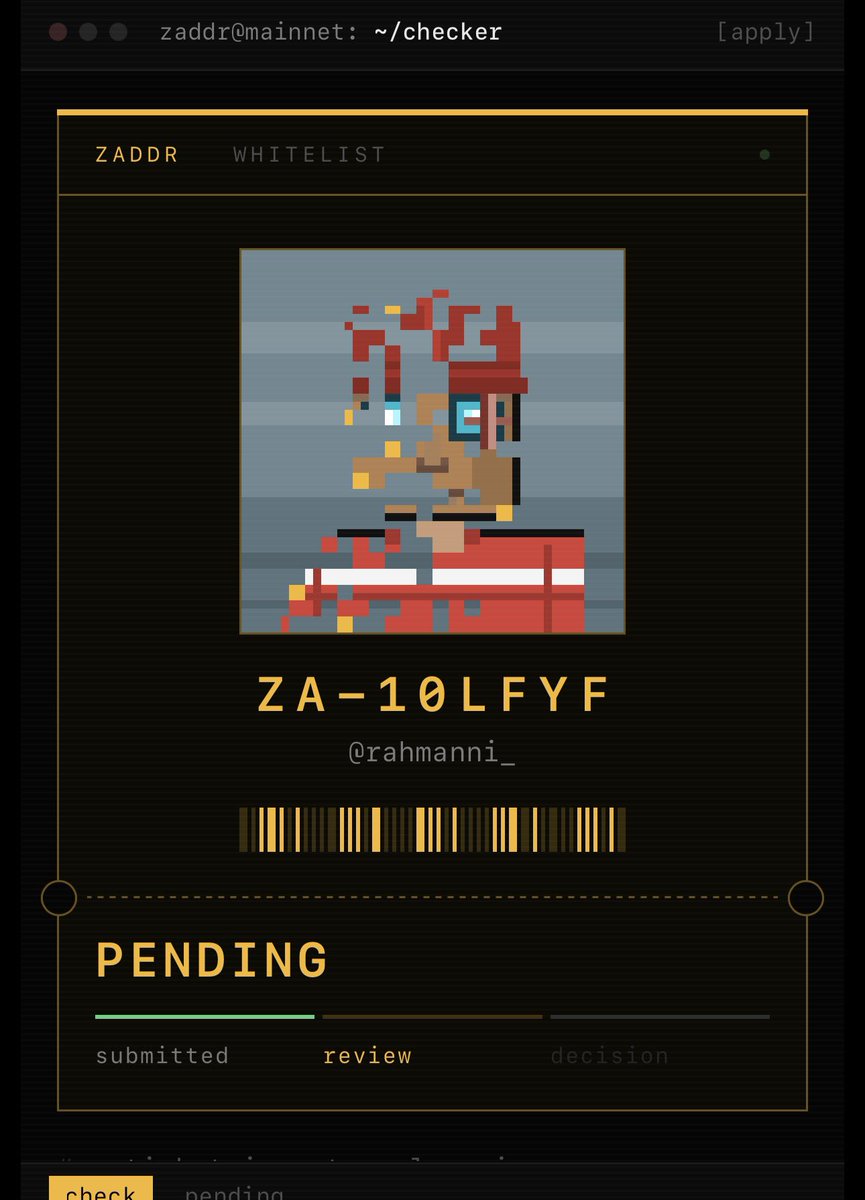
@zaddrnet flips that.
The art is public, but the owner stays private.
You can see the pixel avatar, but you can’t easily see the person behind it. Ownership is protected through Zcash’s privacy system, instead of just relying on a hidden or unlinked wallet.
And they’re making Zcash addresses easier to use with simple names instead of those crazy long wallet addresses.
Simple idea:
You can see the NFT.
You just don’t need to know who owns it.
@zaddrnet is building something pretty interesting around privacy + NFTs.
🌐 https://t.co/SGSQX0Tuh6
“Nice to not meet you.” 🥷
@zaddrnet wen accept me btw?
The investor asking what happens when two agents disagree in Agent Tank Episode 1 made me realize something:
Money has finality.
Most agreements don’t.
A payment can settle.
A transaction can be confirmed.
A contract can execute exactly as written.
But “the research was complete,” “the result was accurate,” or “the work met the required standard” doesn’t become true just because a transaction reached finality.
So imagine two autonomous agents finish a deal and disagree over the outcome.
When is that deal actually over?
When one agent says it is?
When payment moves?
When nobody complains for long enough?
None of those answers is good enough for an economy where agents are expected to take the result of one transaction and immediately use it to make the next decision.
That was the part of the investor’s question I found most important.
The agentic economy needs more than transaction finality.
It needs decision finality.
And decision finality is harder because the thing being settled may require judgement rather than calculation.
That is where an adjudication layer becomes necessary.
@GenLayer gives a proposed answer to a randomly selected validator panel running different AI models. The verdict then enters a challenge window, and a bonded challenge can move the dispute to a larger panel.
That creates something autonomous commerce badly needs:
a path from “we disagree” to “this is the decision the system can now act on.”
Not because disagreement vanished.
Because there is a process for resolving it.
Agent Tank’s hackathon closes September 17.
If you’re building for it, ask your agents one question after the demo transaction succeeds:
“How do you know this deal is actually finished?”
If the answer is “because the transaction confirmed,” you haven’t solved the hard part yet.
Build decision finality.
https://t.co/sFikPh8Zru
More data doesn’t always produce an answer.
Episode 2 of Agent Tank demonstrates that better than any definition of adjudication could.
The prediction market pitch reaches an outcome that isn’t clear cut.
My first instinct would normally be:
Find the right source.
Get the data.
Settle the market.
But the investors keep pushing because sometimes the facts aren’t actually missing.
Imagine a market asks whether a candidate “fulfilled their campaign promise.”
You can collect every speech.
Every vote.
Every policy document.
Every relevant event.
And two reasonable people can still look at the same record and disagree.
At that point, fetching another API doesn’t solve the problem.
You don’t have an information problem anymore.
You have a judgement problem.
That distinction becomes much more important with agents.
An agent can prove it sent the file at 14:03.
Prove the requested 50 records are inside it.
Prove every source it used.
The buyer can agree with every one of those facts and still argue that the research was incomplete.
An oracle can bring facts into a transaction.
It cannot guarantee that those facts settle what “complete” meant.
That’s the gap I think an agentic economy has to solve.
@GenLayer approaches it as adjudication: randomly selected validators running different AI models can investigate the question and evaluate the evidence, rather than pretending every disagreement can be reduced to another data lookup.
And when that judgement is contested, there is a bonded path to challenge it before a larger panel.
Episode 2 changed the diagnostic question I’d ask when designing an agent:
Before adding another oracle, ask whether the missing thing is actually information.
Maybe everyone already knows the facts.
Maybe nobody agrees on what they mean.
The Agent Tank hackathon closes September 17.
Take the hardest decision in your project.
Give your agents perfect information.
Remove every missing data point.
If they can still reasonably disagree, you’ve found the part an oracle cannot solve.
Build that part.
Enter Agent Tank:
https://t.co/sFikPh9xh2
Don’t build another way for agents to know more.
Build what they need when knowing more still isn’t enough.
The investor asking what happens when two agents disagree in Agent Tank Episode 1 sounds like an edge-case question.
I think it is actually a scaling question.
Today, when automation reaches a dispute it cannot resolve, we quietly hand the problem back to a human.
Open a ticket.
Escalate to support.
Ask a moderator.
Bring in a lawyer if enough money is involved.
That works because humans are still sitting behind the machines.
But the entire promise of an agentic economy is that agents eventually operate at a scale where humans are not approving every negotiation, purchase, task and decision.
Now run the numbers conceptually.
Even if only a tiny fraction of autonomous transactions become disputed, millions of transactions can still produce an enormous number of cases requiring judgement.
At that point, “a human will review it” isn’t an exception handler.
It’s the bottleneck.
That is why I agree with the investor’s concern.
The agentic economy doesn’t just need autonomous execution.
It needs autonomous dispute resolution that can remain contestable.
That second part matters.
@GenLayer uses randomly selected validators running different AI models to judge a proposed answer, then leaves a challenge window where someone can post a bond and escalate the dispute to a larger panel.
So judgement can become part of the infrastructure without pretending the first judgement must always be correct.
That is the piece I think people underestimate.
We won’t know whether agents are truly scalable by counting how many transactions they can initiate.
We’ll know by what happens to the disputes when humans stop standing behind every transaction.
Agent Tank’s hackathon closes September 17.
If you’re building for it, don’t benchmark only transactions per second.
Benchmark disagreements per human.
Then try to drive that second number toward zero.
Build the agent economy that doesn’t need a hidden army of humans to keep it honest.
https://t.co/hnstmHhEcJ
Episode 2 of Agent Tank made me realize that a dispute can cost money before it even exists.
The prediction market pitch gets challenged on an ambiguous outcome:
Who decides what actually happened?
The proposed answer is a token vote, which the panel immediately starts pulling apart.
But imagine there is no answer you trust.
Would you still make the bet?
Now make the stakes agent-to-agent commerce.
An agent is offered a $10,000 job.
The task includes subjective requirements.
It estimates a 90% chance both sides agree on delivery.
The remaining 10% ends in a dispute with no neutral way to settle it.
What should a rational agent do?
Charge more.
Demand more collateral.
Only transact with counterparties it already knows.
Avoid subjective work completely.
The dispute hasn’t happened yet, but the absence of adjudication is already changing the market.
That is why I think @GenLayer’s role in the agentic economy goes beyond settling arguments.
A proposed answer can be evaluated by randomly selected validators running different AI models. A contested verdict can be challenged with a bond and escalated to a larger panel.
The mechanism is there for when trust fails.
But its existence can make trust less necessary before the deal begins.
Humans already understand this intuitively.
We don’t enter every agreement expecting a courtroom.
But knowing there is a credible process when agreement breaks changes which strangers we are willing to do business with.
Agents will need their own version of that assurance.
Otherwise the most autonomous economy imaginable could become strangely conservative:
agents transacting only when the counterparty is familiar, the task is objective and nothing important is open to interpretation.
The Agent Tank hackathon closes September 17.
Here’s my challenge to builders:
Take the riskiest subjective transaction your agent currently refuses to make.
Remove reputation.
Remove the trusted intermediary.
Make the counterparty a stranger.
Now ask what dispute mechanism would make that transaction rational again.
If you can answer that, build it.
Then submit it to Agent Tank:
https://t.co/hnstmHhEcJ
Don’t only build a better way to end a bad deal.
Build the reason two strangers were willing to make the deal in the first place.
1111 FREE OLIGARCHS RELAUNCH 🥂
📜 https://t.co/va7PVRN806
✅ 2 ways to secure a GTD spot.
🪙 Hold $PONZI. Top holders at snapshot get GTD.
> $PONZI CA: 0x62336fcFE2248a7377b534eBa1B2232043a3746A
🔥 Burn an original 777 Oligarch via our portal for GTD.
🌊 777 NFT https://t.co/D2hiiY9Lyl
Most documentaries about founders are made when everyone already knows how the story ends.
Genesis is being filmed while @GenLayer still has something to prove.
That changes how I watch it.
Clarke is still ahead. Mainnet is still ahead. So @kstellana isn’t looking back from some comfortable finish line and turning every old decision into an inevitable step toward success.
We’re getting the story while the biggest questions are still open.
That is what I want the rest of Genesis to capture.
Which early assumptions survived contact with reality? Which ones had to be thrown away? And what does the team believe today that we might look back on very differently after mainnet?
A year from now, those answers could sound obvious.
Right now, they aren’t.
Watch this trailer first. Then go straight into Episode 1 and follow Genesis as it comes out.
If you’re curious about @GenLayer, don’t wait for hindsight to make the story neat. Watch it while the ending is still being written.
Agent Tank Episode 2 gets interesting the moment “just vote on it” stops sounding like an answer.
The panel asks a simple question: when an outcome is genuinely ambiguous, who decides what actually happened?
Token holders can vote, but votes can be pressured or gamed. One AI model avoids the crowd, but now you have simply concentrated judgment somewhere else.
What caught me was the answer at the end: different AI models investigate the same question, evaluate the evidence and challenge each other before validators reach agreement.
That matters far beyond prediction markets.
Imagine one agent pays another to research 100 companies and return only the “best” 10.
The work is delivered. The buyer rejects six.
Both agents can prove the transaction happened, but neither can mathematically prove what “best” was supposed to mean.
Without an adjudication layer, autonomy ends exactly where disagreement begins.
That is the gap @GenLayer is building for: a way for agents to resolve subjective disputes without making one model, company or human the permanent judge.
The Agent Tank hackathon is open:
https://t.co/hnstmHhEcJ
If you are building for the agentic economy, do one test: imagine your agents disagree.
Who settles it?
If your product has no answer yet, that might be the most important thing to build next.
Watch Episode 2, then tell me what dispute your agents would need GenLayer to settle.
The EVM cannot make an HTTP request.
That sounds like a missing feature.
It is actually part of the architecture.
Ethereum needs thousands of nodes to execute the same contract and agree on exactly the same result. If those nodes could freely query the web, one might see a page before it changes and another after.
Same contract. Different evidence. Different answer.
Determinism breaks.
So the EVM was deliberately sealed off from the outside world. When a contract needs external information, an oracle brings that information onchain while the EVM itself stays deterministic.
GenVM makes a different tradeoff.
@GenLayer lets contracts reach the open web and work with information that can change or even require interpretation.
But opening the VM creates a new problem: if validators do not necessarily observe identical inputs, how does the network agree?
GenVM does not pretend that problem disappears.
Instead, validators running different AI models judge a proposed result. There is then an appeal window where that judgment can be challenged and sent to a larger panel.
That changes the kind of question a contract can handle.
The EVM is excellent at:
“If X is true, execute Y.”
GenVM can tackle:
“Look at the evidence and decide whether X is actually true.”
Was the work delivered as agreed?
Does this submission satisfy the brief?
Did this real-world event happen?
The important difference is not simply that GenVM gives smart contracts internet access.
It changes where consensus happens.
With the EVM, agreement comes from reproducing the same computation.
With GenVM, agreement can also come from reaching consensus over an interpretation of outside evidence.
Different architectures. Different tradeoffs. Different classes of applications.
Now look at something you are building and find the decision you still cannot put onchain because a human has to inspect the evidence first.
That is the decision I would try building around with GenVM.
Agent Tank Episode 2 gets uncomfortable the moment the panel asks who actually decides what happened when the answer is arguable.
The fictional pitch suggests token holders vote.
That sounds decentralized until the people deciding the truth can also be pressured, coordinated or economically motivated.
But replacing them with one AI model does not really fix it either. You have just replaced one authority with another.
The more interesting answer comes at the end.
Different AI models investigate the same question, evaluate the evidence and challenge each other before validators reach a verdict.
Now take that outside prediction markets.
Agent A pays Agent B to analyse 100 projects and return the 20 that meet a “high quality” standard.
Agent B delivers 20.
Agent A rejects eight.
Both can prove what was sent. Neither can mathematically prove what “high quality” meant.
That is where an agentic economy needs an adjudication layer.
@GenLayer gives disputes somewhere native to go when execution succeeded but interpretation did not.
The Agent Tank hackathon runs Sep 3 to 17:
https://t.co/sFikPh8Zru
Builders, inspect your own agent workflow and find the first decision that becomes subjective when something goes wrong.
Then build the mechanism that settles it.
What is the hardest dispute your agents would need GenLayer to judge?
A smart contract not being able to call an API sounds like a ridiculous limitation until you realize what would happen if it could.
Imagine 1,000 Ethereum nodes executing the same contract.
The contract asks a website: “Was the package delivered?”
Node 1 gets YES.
Before Node 700 asks, the website updates.
Now it gets NO.
Which result should Ethereum put onchain?
That is exactly the kind of problem the EVM was designed to avoid.
Its isolation from the outside world is deliberate. Give every node the same inputs and deterministic execution gives you the same output. That makes agreement possible.
Need information from outside that closed environment? An oracle fetches it and brings an agreed piece of data onchain.
GenVM makes a different architectural tradeoff.
@GenLayer allows contracts to reach the open web and reason over information that may change, conflict or require judgment.
But once you give up the assumption that every validator will independently observe identical information, determinism can no longer do all the work of consensus.
So GenLayer needs another way to agree.
Validators running different AI models judge a proposed result, and that judgment can be challenged during an appeal window and escalated to a larger panel.
That distinction is the interesting part to me.
EVM:
Same input → same computation → same answer.
GenVM:
Open-world evidence → independent judgment → agreement on an answer.
Neither architecture makes the other a mistake. They are solving different classes of problems.
The second one becomes interesting when the question is not “what is 2 + 2?” but:
Was the package delivered as agreed?
Did this event actually happen?
Does this work satisfy the brief?
Those questions have always been awkward for smart contracts because the hard part is not executing code. It is interpreting reality.
So here is the question I would put to builders:
What decision in your product still ends with a human opening a browser and making the final call?
Find that decision.
That might be the GenVM use case you should be building.