🎉 BEAST3D is a NeurIPS 2026 Oral!
Can a moving animal's 3D shape predict what its neurons are doing, better than tracked keypoints? On average, yes.
BEAST3D is a self-supervised vision transformer that reconstructs animals in 3D from unlabeled multi-camera lab video. 🧵
🤖Robots need world models for visual planning, but they don't need to imagine every frame.
Introducing DreamCan: Sparse Visual Planning for Long-Horizon Robot Manipulation.
Project: https://t.co/0yEO3e7XwR
Code: https://t.co/qqsP6bYxSg
Paper: https://t.co/HALcug4TXb
Maiwen v0.2.0-beta.3 is here 🚀 The successor to Maieusis—now a native plugin for Codex & Claude Code. Turn your dataset + literature into research questions worth asking, with prior-work checks, data feasibility checks, and reviewable plans. https://t.co/mJPQLfrKjX
Excited to share Halcyon, our latest research on multimodal pretraining!
Building strong text-to-image generative models is simpler than we think!
Blog: https://t.co/HOrwIJIHTf
Models: https://t.co/xBPJkEAOPU
Paper: https://t.co/8kROIz1c7L
Beyond keypoints, 3D motion captures richer signals of neural activity.
BEAST3D learns powerful 3D representations directly from unlabeled multi-camera videos, bridging 3D vision and neuroscience.
Excited to see BEAST3D selected as a NeurIPS 2026 Oral (top 0.3%). Huge kudos to @realPPWang for leading this amazing work!
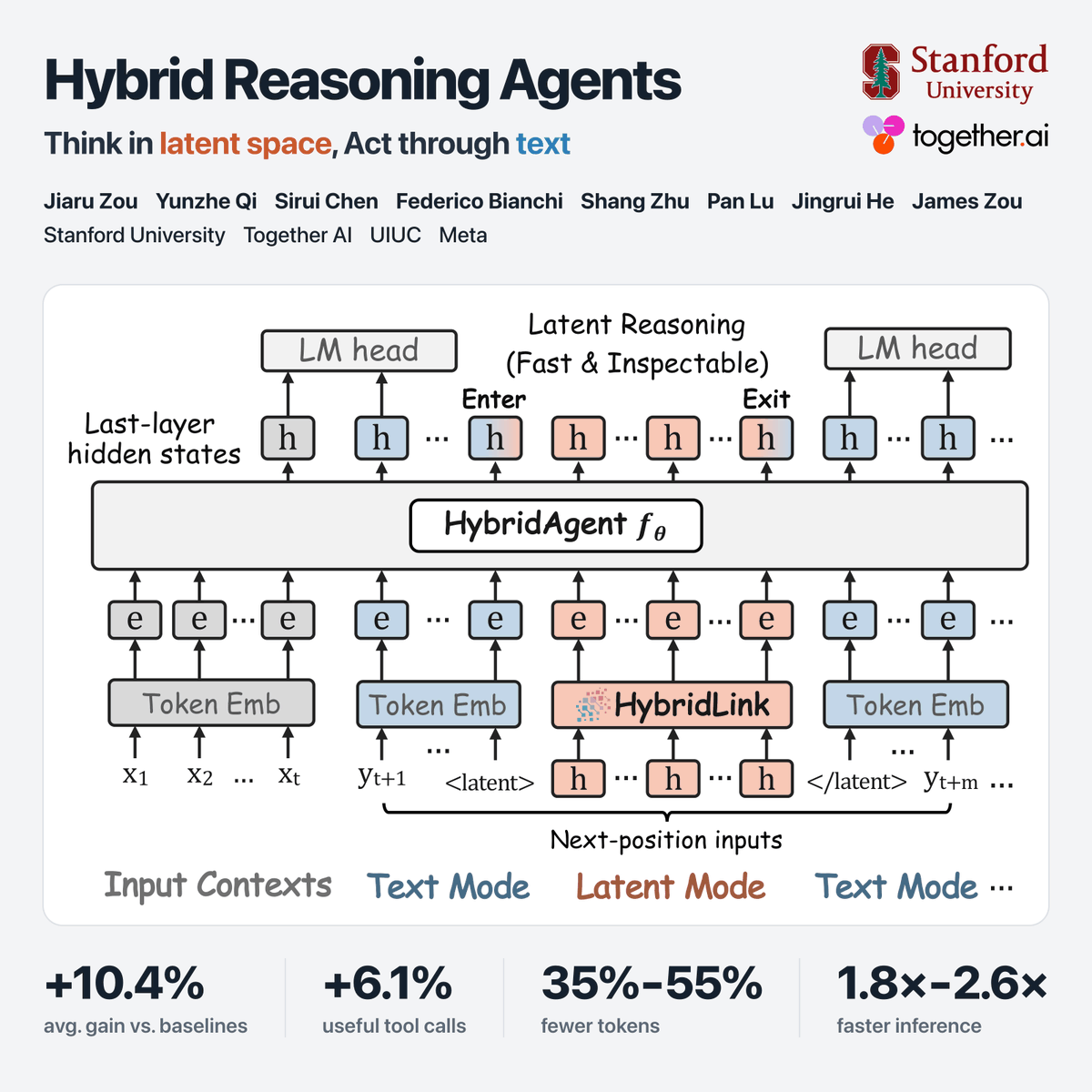
Your LLM agent has to think out loud, token by token, before it can search, run code, or act in the world.
We humans don’t. We ponder in silence and speak when it matters.
Human language was never meant to be the limit of machine thought.
Introducing 🌗Hybrid Reasoning Agents
- Think in latent space, act through text
- Two modes, one unified multi-turn flow
- No black box, fully readable latent thoughts
- Any LLM can become a HybridAgent
🎉 BEAST3D is a NeurIPS 2026 Oral!
Can a moving animal's 3D shape predict what its neurons are doing, better than tracked keypoints? On average, yes.
BEAST3D is a self-supervised vision transformer that reconstructs animals in 3D from unlabeled multi-camera lab video. 🧵
We also predict neural activity from the 3D point cloud. Bits per spike, BEAST3D vs 3D keypoints:
Mouse facial motor nucleus: 0.39 vs 0.29 (p = 0.01)
Chickadee hippocampus: 0.11 vs 0.07 (not significant)
Our 2D BEAST features score the same, but aren't tied to body locations.
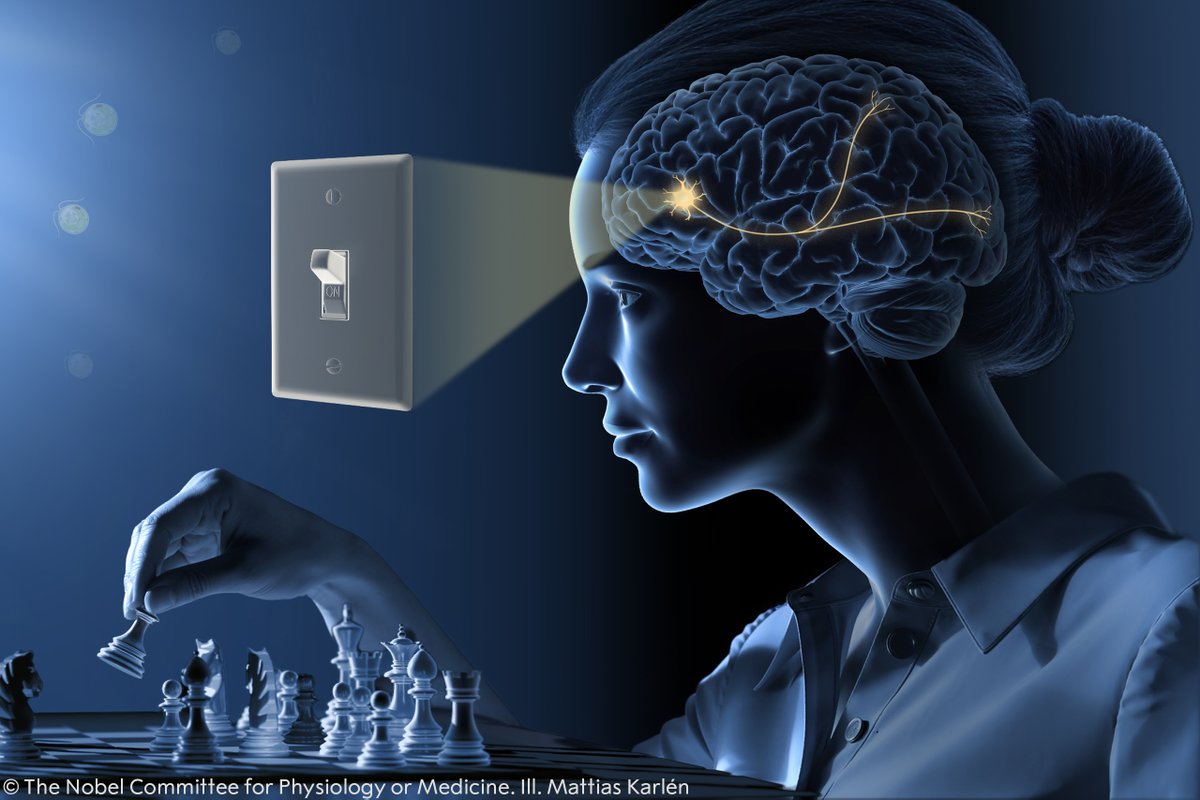
To understand how the brain forms memories, feelings and behaviours has long been a dream for researchers.
Karl Deisseroth, Peter Hegemann and Georg Nagel have been awarded the 2026 #NobelPrize in Physiology or Medicine for discoveries leading to optogenetics, which makes it possible to switch on, or off, the activity of individual nerve cells in a living brain.
This method is now being used in laboratories around the world to reveal the brain’s mysteries.
What is the role of academic computer vision research in the age of increasingly powerful large models? Is GPT-6 Astra a step change? How can a researcher have an impact today in academia?
These are the questions I ask myself as I head off to ECCV 2026, a conference I’ve attended since 1992. One of my papers this year is VIGA, a method that takes an image as input and outputs a 3D Blender scene that represents that image. This is a classical inverse-graphics task and VIGA was the first method to solve it using an agentic approach.
The idea is now several years old and the first version of the paper was rejected. This delayed publication significantly. After it was accepted at ECCV, it was quickly surpassed by people using Claude Code for the same purpose. Today GPT-6 Astra blows away all previous results. But we still head off to ECCV to tell the community about our invention that is now fully out of date.
The way academic work often progresses is that one reads recent papers, notices that they have limitations, comes up with a new idea, explores this, publishes it, etc. Any published paper I read today is based on ideas that are at least a year old. And those ideas were based on the literature of the time, which was also a year old. That means that any paper I see at ECCV is likely two years out of date. In AI today, two years means your work is likely irrelevant.
At CVPR this summer I noticed that many authors have not gotten the message. They continue to work on “old” problems that have a long history. This history is based on assumptions about how the “vision problem” will be “solved”. The truth is that it is being solved in a very different way and many of these problems are no longer relevant. Another group of papers focuses on very niche problems where large models likely fail because of insufficient data or lack of business interest. The impactful papers were largely from industry and had long author lists and massive data+compute behind them. These papers were also out of data, describing systems that had been released months before, but at least they served to provide the community with more complete documentation and analysis of commercial systems.
So what should academics do? First, we need to put aside the tools we’ve used for years and start from scratch. Every project should start by trying really hard to solve the problem with existing tools. I would like to see every paper begin with a detailed experimental analysis of how existing models perform and why they fail (if they do). This gives the kind of insight we need today. Then, assuming current models fail, the solution should provide some fundamental insight that will outlive the next release of such models.
Reviewers today still focus on technical novelty. This pushes people to focus on tweaking architectures rather than clearly moving the field forward. Papers need to be judged based on their novel insight and not their novel technical contribution. This is a real shift in thinking but it focuses us on what matters - progress of the field.
If we want there to be a “field” of computer vision, then it can’t become a marginal backwater, focusing on esoteric problems. If you haven’t tried using Astra (or whatever comes next) to solve your problem, then you have not done your homework. This omission should be seen as negatively as not having a previous work section.
Concretely, I think papers should include a new section analogous to “Related Work” where that related work is current models and how they perform on the task. Reviewers should start asking for this and expecting authors to be able to articulate their insights about the limitations of existing large models.
I'm interested in your thoughts.
Just released Maieusis v0.1.0 — an open-source AI system that turns scientific datasets into families of questions that are both valuable and actually answerable with the data.
https://t.co/3JNGfoNjOO
Good science starts with good questions. But data does not come with the right questions attached.
Many AI-for-Science systems can already build analysis pipelines once a question is specified. The harder problem comes earlier: asking questions that are ambitious and original, yet genuinely answerable with the dataset you have. Existing hypothesis generators often remain broad or vague, without confronting what the data can actually support.
Maieusis is built for this upstream task through two mechanisms:
• PaperBank learns reusable question-forming patterns from published papers — the moves that turn observations, tensions, and data cues into sharp questions, rather than the papers’ results.
• Each question family enters an isolated Question Owner–Dataset Planner dialogue that refines the question, produces an explicit analysis plan, and checks whether it can be operationalized without changing its scientific meaning.
The output is a Scientific Question Dossier: refined variants, a plan or evidence-backed rejection, claim ceilings, controls, and resource estimates.
These guarantees come from architecture, not clever prompting. Deterministic verification and independent review gates operate across trace extraction, pattern induction, question generation, and dataset planning. Intermediate artifacts are checked before proceeding, and the planner runs in a capability-limited sandbox.
Maieusis is designed for any scientific field and empirical dataset. We started with neuroscience because that is where I can properly judge the generated questions.
We tested it on the IBL Brain-Wide Map (@IntlBrainLab) and NLB MC_Maze. We consider several generated questions high-value; a few aligned with directions our own lab had already been considering. Multiple families produced accepted planning dossiers after independent review.
See all 12 question families and 24 variants:
https://t.co/TVQHwamiSf
Try it:
pip install "maieusis[mcp,pdf,openai,anthropic]==0.1.0"
maieusis init
Citation: Xu, Y. & Doiron, B. (2026).
https://t.co/OkhtcvJLWu
Huge thanks to my advisor @BrentDoiron.
We welcome both domain scientists and AI-for-Science researchers to test Maieusis on real datasets, improve the system, and co-author scientific papers documenting its use across fields. If your work depends on empirical data analysis — in any field — please reach out.