A Nigerian youth corps member can work for an entire month and still not earn enough to fill the fuel tank of an ordinary car.
Think about that. 30 days of work, yet a full tank of fuel remains a luxury.
Even garri, once the cheapest refuge of the poor, is becoming unaffordable to the very people who depend on it for survival.
This is the devastating reality of poverty in Nigeria.
You cannot keep celebrating economic statistics when ordinary citizens cannot afford the basic necessities of life.
An economy that looks good on paper but leaves its people hungry is a failed economy for those people.
Nigeria needs a fundamental reset.
One of the greatest tragedies of Nigerian society is how we have managed to turn honest labour into a source of shame.
In London, Germany, the Netherlands, Canada and other developed societies I have visited recently, a cleaner is not automatically considered inferior. A carpenter is a professional. A plumber is a skilled worker. A construction labourer is a productive member of society.
People earning minimum wage are not automatically stripped of their dignity.
You can meet a cleaner driving a beautiful car, living in a decent home and raising children with confidence. Not because every cleaner abroad is wealthy, but because society has built systems that give ordinary workers a better chance at a decent life.
Now come to Nigeria.
A cleaner is often treated as someone who has failed in life. A security guard can be insulted by someone whose only achievement is having more money. A carpenter is looked down upon until his services are urgently needed. Domestic workers are sometimes treated as though poverty has cancelled their humanity.
We have created a society where the dignity of a human being is increasingly measured by the size of their bank account, the car they drive, their job title and the people they know.
And this is destroying us.
The same Nigerian who respectfully greets a cleaner in London may return to Lagos or Abuja and humiliate someone doing exactly the same job.
What changed? The occupation or our mentality?
There is something fundamentally troubling about a society where the people who clean our hospitals, construct our homes, maintain our roads, protect our buildings and repair our infrastructure can work tirelessly and still struggle to afford the most basic necessities of life.
Meanwhile, we celebrate unexplained wealth and sometimes give more social recognition to people who produce absolutely nothing of value.
This is one of the contradictions we must confront if we genuinely want to build a civilized nation.
Civilization is not measured by the number of billionaires a country produces. It is also measured by how ordinary people are treated, how fairly productive work is rewarded and whether someone can earn an honest living without surrendering their dignity.
A country cannot develop sustainably when young people would rather appear wealthy than become productive because society respects the appearance of success more than the value of work.
The cleaner is not inferior to the banker. The carpenter is not inferior to the engineer. The labourer is not less human than the politician.
Their responsibilities, skills and earnings may differ, but their human dignity must never differ.
Nigeria must become a country where honest work pays enough to sustain a decent life, where vocational skills command respect and where no child grows up believing that becoming a cleaner, mechanic, farmer or artisan makes them a lesser human being.
The real disgrace is not earning a living by cleaning toilets. The real disgrace is building a society where someone who cleans toilets honestly cannot live with dignity, while someone who steals public money is celebrated.
Until we correct this mentality, we will continue producing a generation that worships wealth instead of productivity.
Is our biggest problem poverty, or have we also developed a culture that disrespects the very people whose labour keeps society functioning?
Look at the football pitch for mechanical engineering students at Eindhoven University of Technology in the Netherlands, which I visited today.
This is a public university.
This is how fake products are distributed at scale in Nigeria.
Someone goes to NAFDAC with a sample product and pays to obtain a NAFDAC registration number for that product. Once the process is completed and the NAFDAC number is issued, they reduce the quality of the product. Some even go to China to manufacture fake versions of the original products at scale and distribute them across the Nigerian market.
Almost every product in the Nigerian market today seems to have a fake version in circulation.
Selling fake products should be treated as a capital offence. People who knowingly manufacture and distribute dangerous fake products are putting lives at risk.
NAFDAC needs to do far more. The level of regulatory failure, negligence, and lack of effective enforcement is deeply concerning.
What do you think about this 50 year roadmap for the South East?
Aba - Manufacturing.
Make it the factory of Africa.
Onitsha - Trade & Logistics.
Build Africa’s most efficient commercial and distribution hub.
Nnewi - Engineering & Industrial Production.
From spare parts to machines, automobiles and advanced manufacturing.
Awka - Technology & Skilled Talent.
Build the engineers, technicians, software developers and craftsmen our industries need.
Enugu - Education, Research & Innovation.
Turn it into a university city where knowledge becomes companies, patents and industries.
Ebonyi - Agriculture, Food Processing & Solid Minerals.
Stop exporting raw produce and minerals. Process everything here.
Owerri - Technology, Creative Economy & Hospitality.
Build a city that attracts young talent, startups, entertainment and tourism.
Umuahia - Agriculture, Biotechnology & Agro-industry.
Research what we grow. Improve it. Process it. Export it.
Then connect ALL of them with rail, reliable power, broadband, highways and a single regional market.
I am becoming convinced that the version of democracy Nigeria copied from America simply does not work for Nigeria and after decades of dysfunction, pretending otherwise is becoming intellectually dishonest. It has created chaos and strong tribal division.
We created an enormously powerful presidency, weakened the regions, centralized almost everything in Abuja and built an unbelievably expensive political structure around sharing federal revenue.
Then we wonder why politics has become a fight to capture Abuja.
Go back to the era of regional government.
When M. I. Okpara was Premier of the Eastern Region, the East had its own parliament and substantial responsibility for its own development. Agriculture, industrialisation, education and economic development were not things everyone sat around waiting for Abuja to deliver. Okpara’s government pursued farm settlements, industrialisation and economic development as deliberate regional policy.
The North had Ahmadu Bello. The West had its own regional leadership. The regions had greater political and economic significance, and their leaders had to think seriously about how to develop their own economies.
That system was certainly not perfect the First Republic itself suffered severe political crises and ultimately collapsed in 1966. But there is something fundamental we should learn from its architecture.
Nigeria needs to stop running a political system designed as though 230 million people with enormous ethnic, cultural and economic differences are one homogeneous society waiting for instructions from Abuja.
The American presidential model may work for America. That does not mean Nigeria must worship it forever.
I would rather see us seriously debate a return to a parliamentary and genuinely federal system: stronger regions, greater fiscal responsibility, less concentration of power in one presidency and leaders whose political survival depends more immediately on maintaining the confidence of Parliament.
Our current structure has had decades to prove itself.
At some point, repeating the same political experiment and expecting a fundamentally different Nigeria stops being patience. It becomes a refusal to learn.
Singapore is particularly instructive not because it rejected democracy, but because it developed a parliamentary system with unusually strong state capacity, long-term planning and institutional continuity. Its political system has also been dominated by the PAP for decades, with critics pointing to significant constraints on political competition and some civil liberties.
Nations do not become prosperous because they copy a political system. They become prosperous when they build institutions capable of making difficult decisions, executing long-term plans and holding leaders accountable for results.
Today, we inaugurated the professors and universities that will lead Educare’s first major research project in Nigeria.
Here are our lead researchers:
PROF. ZEPHRINUS CHIDUBEM NJOKU
Department of Science Education
Director, Institute of Education
University of Nigeria, Nsukka
PROF. J. GBENGA ADEWALE
Professor and Former Director, Institute of Education
University of Ibadan, Nigeria
Former President, Educational Assessment and Research Network in Africa (EARNiA)
Ex-Officio, Educational Assessment and Research Network in Africa (EARNiA)
PROF. JONATHAN SALIHU MARI
Professor of Science Education and Curriculum Studies
Department of Science Education
Ahmadu Bello University, Zaria
Our coordinating researcher from Educare is from Technology University of Eindhoven in the Netherlands.
Our goal is ambitious but clear: to standardize assessments across all year groups in Nigeria, with critical thinking, problem-solving, and practical application at the core.
We want to help build an assessment system that goes beyond testing what students can memorize to measuring what they can understand, apply, analyze, and solve.
If Nigeria is to become truly sovereign and prosperous in the years ahead, we must not only consume research and knowledge produced elsewhere. We must lead and own serious research projects capable of shaping our education system, our economy, and ultimately, our society.
This is the beginning.
“Abia State Governor, Alex Otti, is proof that good governance is possible. He can easily win a second term without much campaigning. Look at what the man is doing in Abia State. This is an example that anyone in politics who is not making an impact is doing so by deliberate choice.”
—Apostle Johnson Suleman
“No more sitting on the fence. I, Pastor Joshua Suleiman and my family, will be supporting Peter Obi. He’s the only one amongst them who doesn’t have a hand in destroying this country.” —PST. Joshua Suleiman.
Nigeria must be OK!
2027: “I Won’t Spend Nigeria’s Resources on Holidays Abroad” — Peter Obi Cites Development in National Security, Tourism, Transportation https://t.co/k0WRC0T5dm
Peter Obi knew that a season will come in his life that he would want to be president. So he prepared for that since by maintaining his integrity and character.
The season came, the enemies came to him and found nothing in him.
Peter Obi is a man who saw tomorrow and prepared for it.
May we be like Peter Obi.
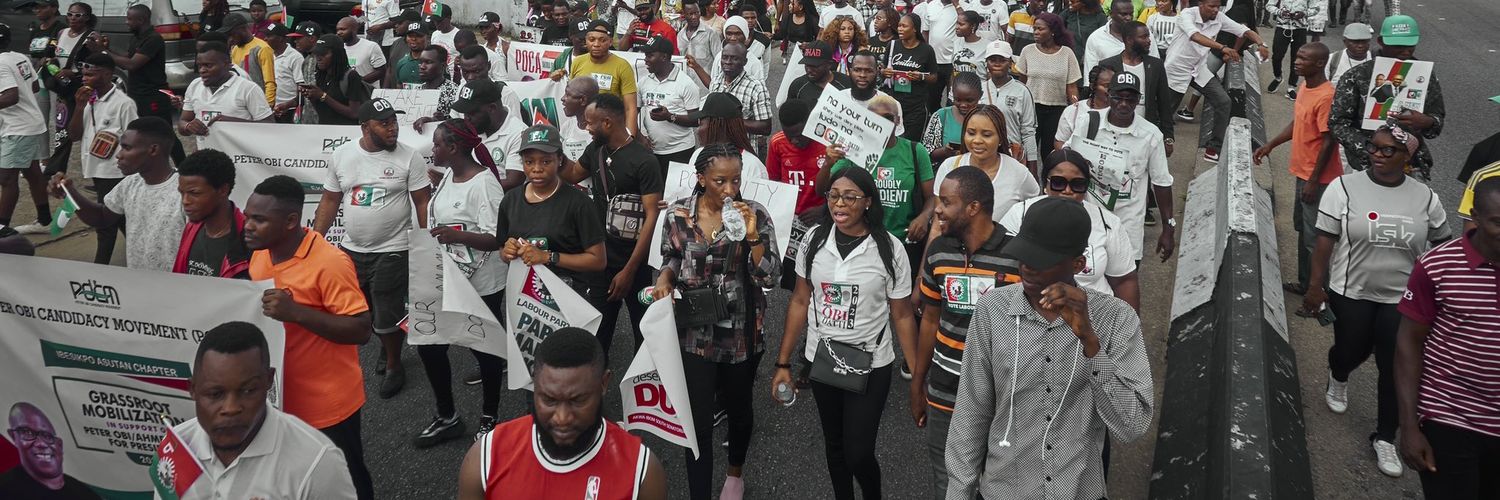
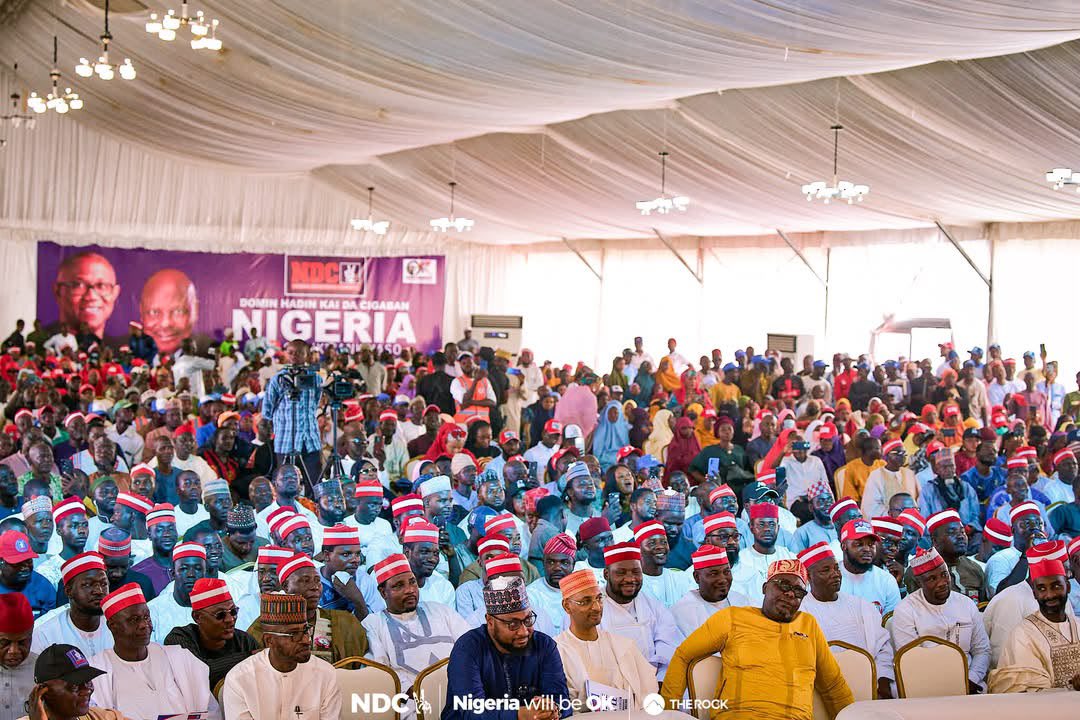
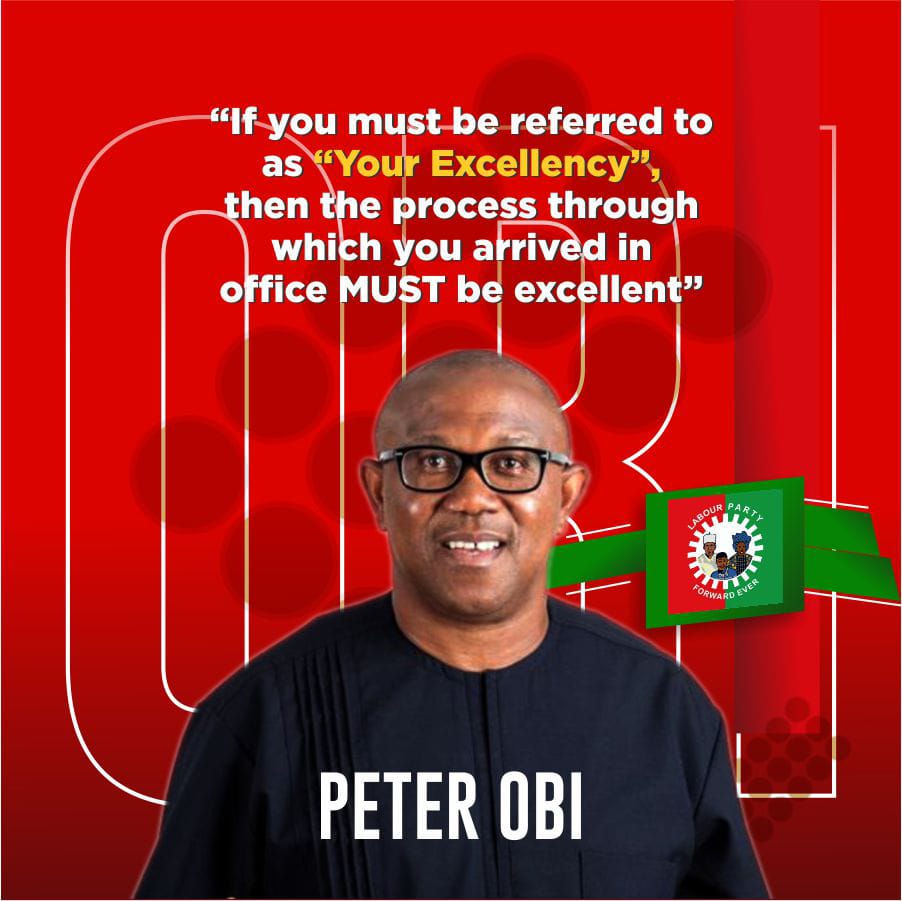
Today, I joined our presidential candidate, His Excellency Peter Obi, alongside other NDC candidates and party members at the Obi–Kwankwaso Town Hall Meeting in Kaduna.
The gathering provided a valuable platform for Nigerians to engage directly with the candidates, ask questions, and share their views on the issues that matter most to their lives and communities.
In my remarks, I expressed appreciation to the NDC leadership, fellow candidates, and the many Nigerians who attended. I highlighted the urgent need for a renewed focus on security, quality education, and meaningful opportunities that enable ordinary citizens to improve their lives.
I also emphasised the importance of building a Nigeria where every child has the opportunity to succeed and become somebody, regardless of family background, wealth, or connections. - RMK
This is not the time to convince any informed Nigerian. But if there's any politician in Nigeria that has been consistent positively over the years it's Mr Peter Obi.
You will be an enemy of Nigeria if you vote otherwise!
The semiconductor industry is one of the largest and most important industries in the world today. Unfortunately, Nigeria and Africa as a whole has little or no stake in it.
These are the kinds of conversations we need to start having.
This is the industry that powers AI and will shape the future of our children.
So, I thought for a while, how can a Nigerian especially the informed once that ve witnessed APC's horrible regime of 12yrs still asked to be convinced about Mr Peter Obi's candidacy especially while he's contesting against APC & NDC presidential candidates
Setting the record straight:
International Mathematical Olympiad (IMO), Pan African Mathematical Olympiad (PAMO), European Girls' Mathematical Olympiad (EGMO), ISTEM in Rome 2026.
Misconception number 1: The International STEM Olympiad (ISTEM) that students went for in Rome is different from the IMO in China that Nigeria couldn't go to.
The IMO and PAMO are the most prestigious Mathematical Olympiads that Nigeria sends teams to. The selection process for this two is mostly the same as in the past Nigeria has fielded the same teams to IMO and PAMO. The National Mathematical Centre Kwali Abuja (NMC) is the government body in charge of registering a team for these Olympiads. Why do we need a government agency you might ask? This is because this competitions are the academic equivalent of Olympics and you have to participate as a country, not an individual. Countries have only 6 slots for the team. This is part of the reasons why it is more prestigious than these recent Olympias like ISTEM. Over the years, different private organisations have used the name Olympiads to denote their competitions. There questions are a far cry, in terms of difficulty, compared to the traditional Olympiads which require proofs. Also, unlike traditional Olympiads where contesting is on a national level, some of the new Olympiads are open to anyone to participate in as an individual provided you register on time and you have the money (which is usually significant).
Misconception number 2: This year, Samuel Famiroju was among the people that qualified for the IMO in China but could not go due to funding.
Samuel qualifying is false. The NMC organises a 3-4 stage Nigerian Mathematical Olympiad. This is totally different from what Alex Onyia organised with the South East Mathematics Olympiad or what Nigerian Tulip International College organises in collaboration with NMC (an Annual Mathematics Contest). The latter is the contest Samuel is believed to have won which is not involved in the selection process for the Nigerian IMO team. The selection process involves State Rounds and National Rounds. In the past, NMC has organised the contests and sent teams to various Olympiads (like PAMO this year in Ivory Coast) but funding issues threaten that now. While Samuel Famiroju did not qualify, here are some of those that did - Agbo Adoga, Ikenna Enwere and Damaris Oyerinde. The last two also went for the PAMO (as eluded to earlier, PAMO and IMO have virtually the same selection process in Nigeria)
Misconception number 3: Alex Onyia did not select Samuel Famiroju because he is Yoruba.
While I do not agree with the tag of best mathematician in the country Alex ascribes to his student, he held a transparent competition to select the students he went with to Rome. He has consistently said this. Those of us who followed the competition saw the winners emerge and Samuel Famiroju was not part. Alex has also never stated that his competition is only for Igbos, he said it is open to any student in the South East provided they are in the appropriate grades.
Misconception number 4: Ambassadors College sent a student to ISTEM in France earlier this year, 2026.
This is flat out incorrect. First of all, there was never any ISTEM in France earlier this year. The competition the student went for is EGMO. Special Maths Academy (SMA) (@SpecialMaths) has always publicised how the Special Maths Contest will be the main selection criteria for the EGMO. EGMO, just like the IMO and PAMO is not open to private individuals. To pull this off, we had to work with National Mathematical Centre, to get consent, as required. There will be another Special Maths Contest to select students for next EGMO in Croatia, so stay tuned.
Share this post to defeat the disinformation flying around.
@FrankEra_ Because he plays for us, we don't really rate him as we should.
Trust me, if he was playing for some other club you and I will be here saying our board should break the bank for him regardless if he only scored 2 goals...He deserves more credit and applause from the fans ❤️❤️