Jefferies' Mohit Kumar says we have spent more on AI than on anything in the last 500 years, and he sees the Dec 8 to 9 Fed meeting as the turning point for markets
"We have spent more on AI than we have spent on anything ever in the last 500 years"
"Even now the market is pricing in almost three hikes from the Fed. I do not think they will be delivered"
"My base case is that is the peak in hawkishness"
He expects the next CPI print, due the day after the Fed decision, to come in at negative 0.1% month on month $SPY $QQQ $TLT
If the hawkish peak lands in December, the AI trade's biggest macro headwind starts to fade
via @BloombergTV, featuring Jefferies chief European economist Mohit Kumar
The Fed Hiked Into a Supply Shock.
The Bond Market Will Force the Cuts.
The Federal Reserve follows the credit market, and the credit market speaks through the two-year Treasury. In 2007 the two-year peaked more than a year before the first cut. In 2019 it peaked in November 2018 and was 1.89 per cent when the Fed cut in July. In 2024 it peaked in October 2023 and had fallen to 3.61 per cent when the Fed moved in September. The policy rate follows the two-year.
That market is turning. The two-year closed at 4.61 per cent on 25 November, down from a 2026 peak of 4.92 per cent. The 10-year has fallen to 4.85 per cent from 5.31 per cent. The curve slope is only 24 basis points, against a long-run average of 85 to 100. If inflation rolls over, a 4 per cent 10-year and a 3 per cent two-year is the natural configuration.
The Fed has done the opposite.
The September quarter-point hike was a mistake, because textbook policy looks through energy supply shocks. Now it may hike again in December. Christopher Waller wants a half-point and Alberto Musalem expects several increases.
Then the data will turn. After the December meeting, the month-on-month CPI print will be negative. WTI has already fallen to $82.24 from $114.58, Brent to $91.80 from $138.21, and the 3-2-1 crack spread from $78.92 to about $31. Saudi Arabia lifted October output 26 per cent to 10.56 million barrels a day and cut Asian prices to a six-year low.
The market is ignoring what happens when Saudi Arabia fights for market share. After 2014, WTI fell from $107.95 to $26.19, and weak energy prices lasted for years. The credit market is ignoring the noise and watching the commodity complex. The Fed will be forced to cut, and Wall Street will then proclaim what just happened.
*HASSETT: ONE WOULD HOPE WARSH REEVAULATES FED'S MODELS
*HASSETT: INFLATION IS NOT ACCELERATING AT ALL
*HASSETT: INFLATION MAYBE A LITTLE BIT ABOVE TARGET
President Trump is reportedly set to attend the groundbreaking of $TSM new semiconductor factory in Arizona, on December 4.
The project is part of TSMC’s massive U.S. chip manufacturing expansion with total planned investment now reaching $265B.
CNBC's Joe Kernen challenges Steve Liesman on the utility of providing guidance around the Fed's reaction function in the current volatile environment: What's the right balance? A debate ensues.
FED'S WILLIAMS SAYS 2027 WILL BE A YEAR OF LOWER INFLATION AND THAT WHAT HAS DRIVEN INFLATION UP RECENTLY HAS BEEN UNUSUAL FACTORS, WITH THE FED HAVING WORKED VERY HARD TO GET INFLATION DOWN AND MADE PROGRESS
The Fed should look to the data before raising rates again: Mortgage rates are 7.28%, homebuilder confidence is at its lowest level since 2012, and household debt delinquencies are rising. We need a stable dollar and sound monetary policy, not more unnecessary pressure on borrowers.
https://t.co/k6K2oGm2zK
AI is changing everything, and after last week, that includes the usual relationship between earnings and stock prices. Hopefully, this is just another hallucination—and it ends soon.
🚨BREAKING: JPMorgan Chase chief Jamie Dimon says he plans to "make an example" of the UK government by finding ways to offset the bank tax increase by cutting its spending, hiring or investment in Britain
He wants politicians to "understand the trade-offs of unfair penalties"
The Rogue Fed’s War on Trump
Dallas Fed trimmed-mean PCE is 2.3%. Services inflation is 3.2%, below its six-decade average of 4.7%. Energy is fading. Supercore is below its long-run average. Bernanke, Gertler and Watson showed in 1997 that tightening into an oil shock does the real damage. Blinder warned the same in the 1970s.
The Fed ignores all of it. Waller wants 50bp. St. Louis’s Musalem wants 100bp more by spring. New York’s Williams has pivoted to blaming AI. It is anecdote, not analysis, with the goalposts moved at every meeting.
This is not monetary policy. It is politics. Chairman Warsh came to shrink the Fed’s footprint, end forward guidance and restore discipline. The institution is fighting back, hiking against the evidence to defend its turf and undercut the President who appointed him.
Who gets hurt? America. Workers who lose jobs, families locked out of homes, small businesses squeezed by credit costs. History will not be kind to this Fed. Andrew Jackson took on an unaccountable central bank and won. Where is he when we need him?
The S&P 500's forward 12-Month P/E ratio has moved down to 17, its lowest level in over 3 years.
So why are we seeing panic selling today?
As @cullenroche once said:
"The stock market is the only market where things go on sale and all the customers run out of the store."
CITI WARNS U.S. INTEREST RATES ARE UNSUSTAINABLY HIGH, SEES FED CUTS IN 2027
Citigroup warns that financial markets are signaling that current U.S. interest rates are "unsustainably high", as falling equity valuations and risks to AI investment threaten economic growth.
The bank argues the Federal Reserve is unlikely to aggressively raise rates into a stock-market selloff, despite persistent inflation concerns.
Citi's rate outlook:
🔸 December 2026: 25-basis-point hike expected.
🔸 Early 2027: Fed holds rates steady.
🔸 Later in 2027: Rate cuts begin.
Citi believes tightening financial conditions, weaker AI investment and easing energy prices could eventually outweigh inflation risks, pushing the Fed toward a more dovish stance.
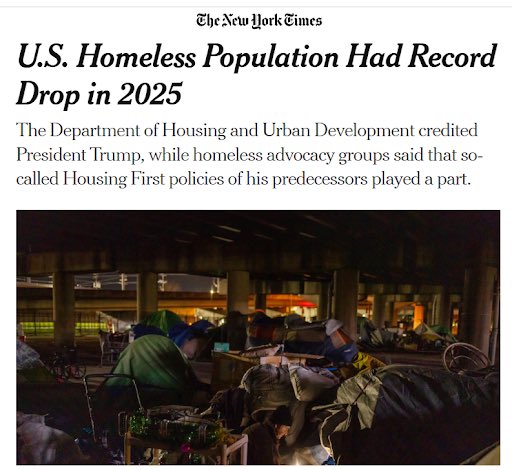
If President Trump’s economy only benefits the rich, why is homelessness falling?
Almost 50,000 fewer people in 2025, with at least another 25,000 projected in 2026.
A booming economy and welfare work requirements are making a difference.