The problem I have with Buddhism is that every old dharma teacher looks the same: powerful in mind and spirit, but frail in body.
I want the embodied version of Buddhism—one that unites spiritual insight with AI, information theory, physics, biology, health/medicine, and evolution. These fields all point to the same truth: the body is an energy system. It's not meant to be still. It's meant to move, pulse, vibrate, and express.
The old Buddhists are so unhealthy because in their quest to sit quietly with suffering they are trashing their bodies.
Our bodies are energy systems, constantly in motion, literally vibrating all the way down.
As soon as you get the insight of the mind from Buddhism, stop sitting and start moving.
nearing the end of a four-day meditation retreat under the guidance of ajahn geoff and the bhikkus of metta forest monestary—currently at ~12 hours of sitting (4th jhana via anapanasati) will add ~6 more before I leave tomorrow. endless gratitude. namo buddhaya 🪷
@Zoo3y this body is just a momentary wind passing thru a hollow rotting log rest in the present moment this way with no other concern beside the practice eventually you'll abide in a place beyond pleasure and pain
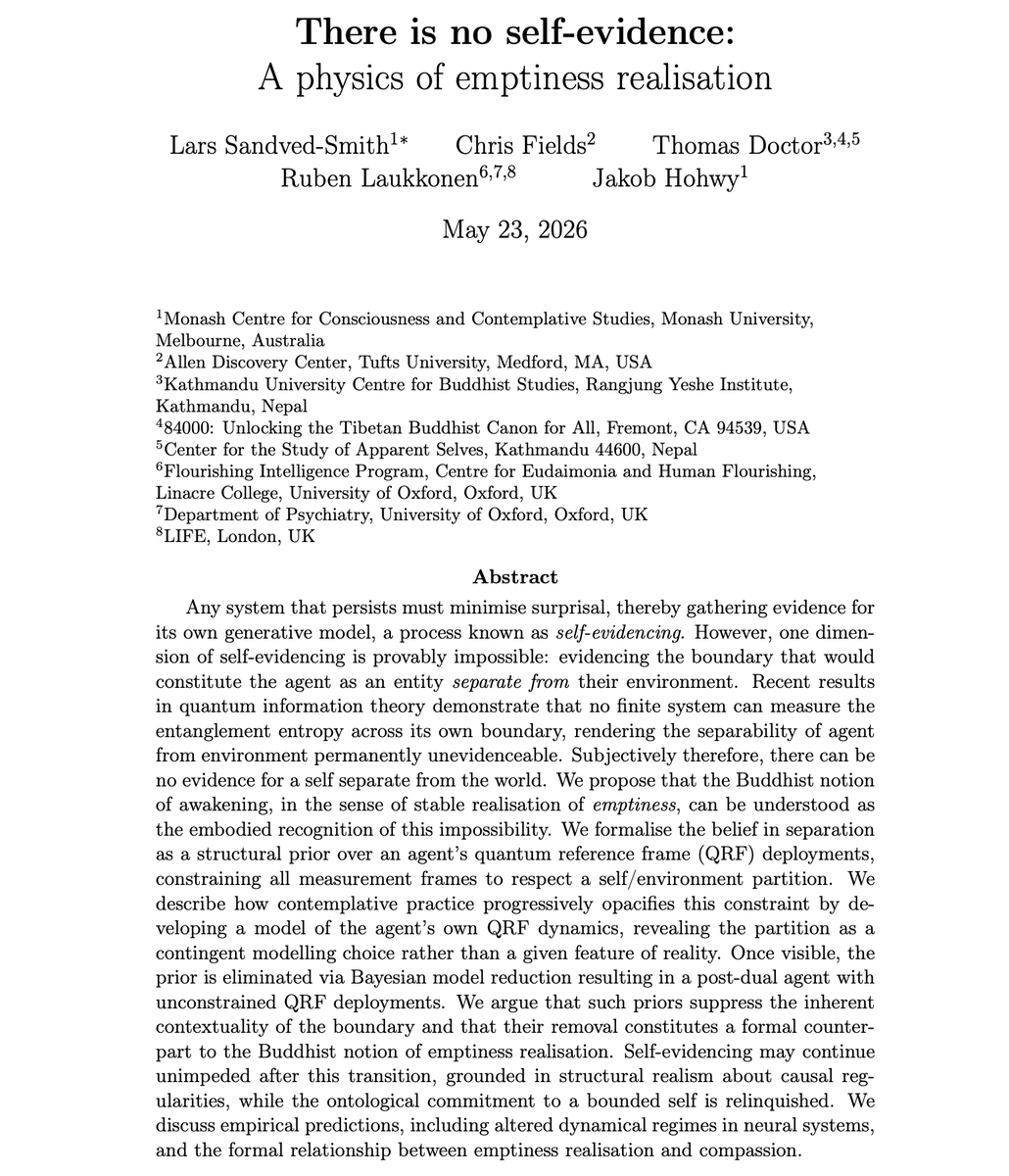
If you’re into predictive processing and meditation, this paper pushes the Overton window. From the quantum formulation of the free-energy principle, we show that an agent cannot define its own boundary from within. The realization of this irreducible indeterminacy is a principled definition of awakening. Ultimately, this extends to the separability of any object in experience, formalizing emptiness and engendering a “post-dual agent”.
Any persisting agent must minimize surprise by gathering evidence for its generative model. But all evidence available to the agent arrives through its boundary with the world. To prove that this boundary really separates “self” from “world”, the agent would need to step outside the boundary and measure the whole self-world relation. A finite agent cannot do this, as a scissor can't cut itself.
So the self-world boundary can be useful, predictive, and necessary for action, but it can never be known as an ontological fact from within. Meditation, on this view, progressively reveals the self-world split as a modelling prior rather than a structural feature of reality. This naturally shifts the weighting of self (inside boundary) and other (outside boundary), since both are seen to be inferences rather than grounded realities by virtue of an indefinable boundary. A more even-handed and compassionate orientation can arise.
A highly principled finger pointing at the moon!