There should be a law that requires journalist to only report on topics they've witnessed first hand where they provide concrete, verifiable evidence of findings. Opinions are a dime a dozen. They shouldn't get paid for this. #Blockchainforjournalists.
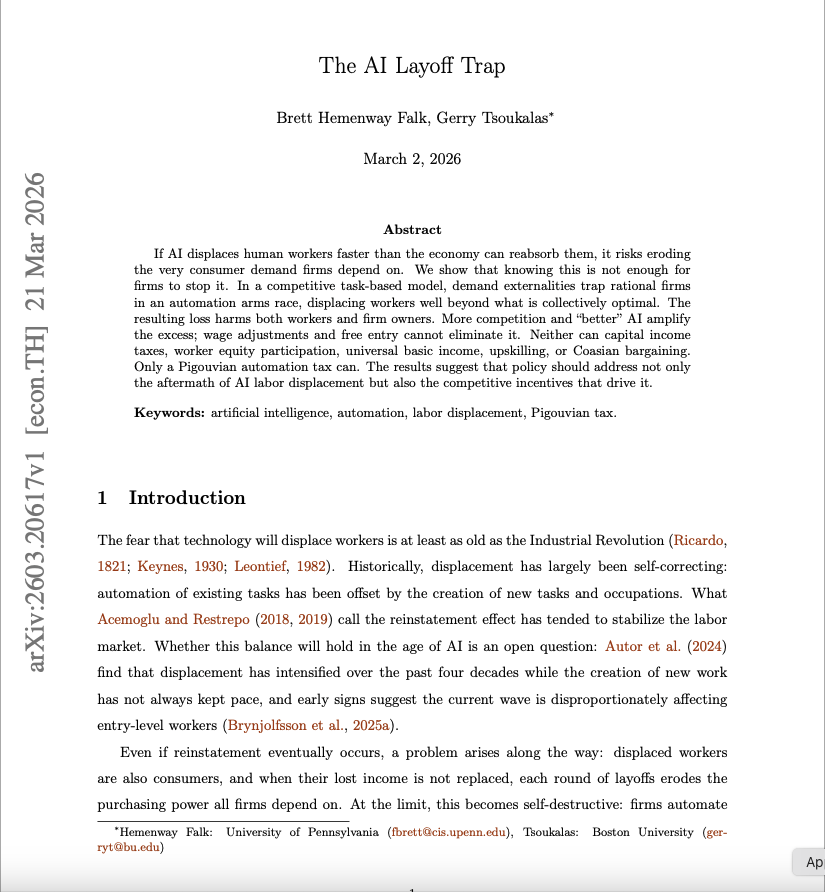
Two economists just published a mathematical proof that AI will destroy the economy.
Not might. Not could. Will — if nothing changes.
The paper is called "The AI Layoff Trap." Published March 2, 2026. Wharton School, University of Pennsylvania. Boston University. Peer reviewed. Mathematically modeled.
The conclusion is one sentence.
"At the limit, firms automate their way to boundless productivity and zero demand."
An economy that produces everything. And sells it to nobody.
Here is how you get there.
A company fires 500 workers and replaces them with AI. A competitor fires 700 to keep up. Another fires 1,000. Every company is behaving rationally. Every company is following the incentives correctly. And every company is building a trap for itself.
Because the workers who were fired were also customers.
When they lose their jobs faster than the economy can absorb them, they stop spending. Consumer demand falls. Companies respond by cutting costs — which means automating more workers — which means less spending — which means more falling demand — which means more automation.
The loop has no natural exit.
The researchers tested every proposed solution. Universal basic income. Capital income taxes. Worker equity participation. Upskilling programs. Corporate coordination agreements.
Every single one failed in the model.
The only intervention that worked: a Pigouvian automation tax — a per-task levy charged every time a company replaces a human with AI, forcing them to price in the demand they are destroying before they pull the trigger.
No government has implemented this. No major economy is seriously discussing it.
Meanwhile the numbers are already tracking the curve. 100,000 tech workers laid off in 2025. 92,000 more in the first months of 2026. Jack Dorsey fired half of Block's workforce and said publicly: "Within the next year, the majority of companies will reach the same conclusion."
Nobody is doing anything wrong. Companies are following their incentives perfectly. That is exactly the problem.
Rational behavior. At scale. Simultaneously. With no mechanism to stop it.
Two economists built the math. The math leads to one place.
Source: Falk & Tsoukalas · Wharton School + Boston University ·
https://t.co/4m8E9jQNYm
BREAKING NEWS: CHINA’S QWEN TEAM TODAY just squeezed the whole of ChatGPT (equivalent) into a package so small that you can stick the entire thing into your laptop.
And it sent an earthquake into the tech world about a game changer in the way we use large-scale AI: from now on, no internet connection needed, full privacy available, and no waiting.
Oh, and the new Qwen AI launch is free to download.
.
MOVING INTELLIGENCE FORWARD
The Alibaba program has a very dull name -- the Qwen 3.5 Medium series. But its efficiency is mindboggling.
It beats its own much larger predecessors, and roughly rivals the bigger boys (GPT-5-mini and Claude Sonnet 4.5) on the standard benchmark exams – reasoning, agents and coding.
The Qwen team said it was “a reminder that better architecture, data quality, and RL [reinforcement learning] can move intelligence forward, not just bigger parameter counts”.
.
CHANGING THE RULES
Will the new Qwen program come first on every benchmark? No, it probably won’t. But that’s not the point. The point is that it changes the rules. Big AI capability is no longer something in a distant cloud called ChatGPT that you connect to.
That level of capability is now cheaper, fully private, and easily customizable—right there on your laptop. (Programmers often pay several thousand dollars a week for AI services from Gemini or Sonnet.)
There's much excited chatter about it in tech circles today as programmers download it across the world and try it out.
How do you join in? You download the new Qwen program free of charge from Hugging Face, a free software library, and quantize it to 4-bit so it can fit onto a laptop with around 22GB RAM/VRAM of space available.
It’ll be like having the Star Trek computer tucked under your arm as your new full-time assistant.
It’s incredible that now we can create ads with one AI tool
Higgsfield AI is killling it with its cinematic camera movement and special effects
check this out
Stanford just uploaded a 1-hour webinar on "Agentic AI" covering:
> basics of LLMs and training
> prompting best practices
> reasoning and actions in agents
> agentic design patterns
> customer support example
the internet is filled with great resources on ai agents.
Reddit user shares how ChatGPT fixed a medical issue they had for 5 years. Replies are flooded with users who had the same condition, and finally found answers too.
Superagency!
I scaled Chatbase from a side project to a $6M ARR startup. No sales team, no VCs, just product‑led growth.
Here is the full strategy for scaling to millions purely through product-led growth.
this node based AI canvas is so crazy
you can:
- keep unlimited subjects consistent 🤯
- remix them in any way you want
- generate 20 variation in seconds
- turn to videos directly
it's complex, but possibilities are endless if you use it well
step by step tutorial:
Microsoft just a 1-bit LLM with 2B parameters that can run on CPUs like Apple M2.
BitNet b1.58 2B4T outperforms fp LLaMA 3.2 1B while using only 0.4GB memory versus 2GB and processes tokens 40% faster.
100% opensource.
Grok 3 builds a Customer Support AI Agent team just by going through the documentation.
Replit lets me run, test and deploy that agent team directly from the browser.
All of this in less than 2 mins.






![NuryVittachi's tweet photo. BREAKING NEWS: CHINA’S QWEN TEAM TODAY just squeezed the whole of ChatGPT (equivalent) into a package so small that you can stick the entire thing into your laptop.
And it sent an earthquake into the tech world about a game changer in the way we use large-scale AI: from now on, no internet connection needed, full privacy available, and no waiting.
Oh, and the new Qwen AI launch is free to download.
.
MOVING INTELLIGENCE FORWARD
The Alibaba program has a very dull name -- the Qwen 3.5 Medium series. But its efficiency is mindboggling.
It beats its own much larger predecessors, and roughly rivals the bigger boys (GPT-5-mini and Claude Sonnet 4.5) on the standard benchmark exams – reasoning, agents and coding.
The Qwen team said it was “a reminder that better architecture, data quality, and RL [reinforcement learning] can move intelligence forward, not just bigger parameter counts”.
.
CHANGING THE RULES
Will the new Qwen program come first on every benchmark? No, it probably won’t. But that’s not the point. The point is that it changes the rules. Big AI capability is no longer something in a distant cloud called ChatGPT that you connect to.
That level of capability is now cheaper, fully private, and easily customizable—right there on your laptop. (Programmers often pay several thousand dollars a week for AI services from Gemini or Sonnet.)
There's much excited chatter about it in tech circles today as programmers download it across the world and try it out.
How do you join in? You download the new Qwen program free of charge from Hugging Face, a free software library, and quantize it to 4-bit so it can fit onto a laptop with around 22GB RAM/VRAM of space available.
It’ll be like having the Star Trek computer tucked under your arm as your new full-time assistant.](https://pbs.twimg.com/media/HCE4QoIbgAAE0g8.jpg)