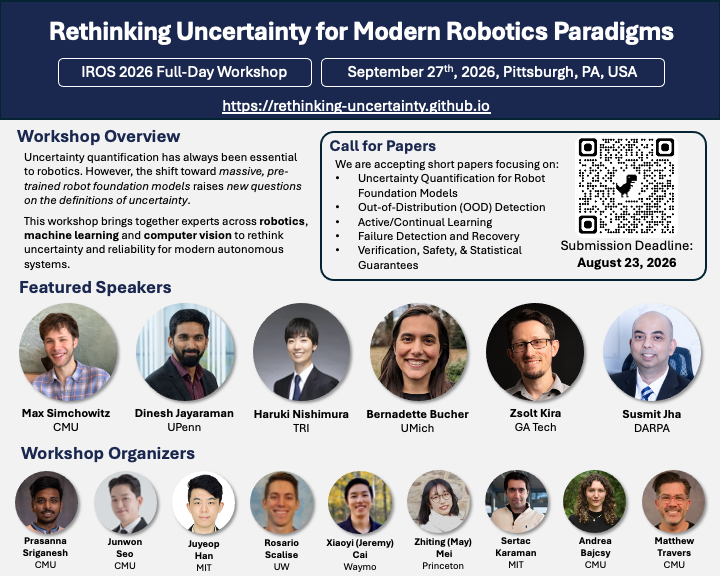
Do we still need Uncertainty Quantification for robotics? What does uncertainty mean in the modern robotics paradigm?
💡 We are organizing a workshop “Rethinking Uncertainty for Modern Robotics Paradigms” @ IROS 2026
Submit your work by Aug 23! 👇 (https://t.co/AUhtTyDmnK)
1. Make/edit docs. I don't want to use gemini in docs. It has no context of my chats. If I have a notebook and I have multiple chats planning a project/research idea, I need to be able to either make slides (not html) combining all info from notebook or even write a proposal.
2. MCP. Again the same logic applies. I want gemini to be able to organize thoughts from different chats (from the same notebook) into notion or some other app.
No real use of having good models if everything is just a chat and can't be exported/imported from actual productivity apps.
Do we still need Uncertainty Quantification for robotics? What does uncertainty mean in the modern robotics paradigm?
💡 We are organizing a workshop “Rethinking Uncertainty for Modern Robotics Paradigms” @ IROS 2026
Submit your work by Aug 23! 👇 (https://t.co/AUhtTyDmnK)
@ChongZitaZhang The weird leg lifting happens on Spot locomotion everytime. Haven't tried ame, but happens on regular PPO. Never got time to look into it more. Never would have guessed it's an issac lan thing.
See all the videos and details on our new project page: ➡️ https://t.co/gzoVfNTN2s
Full paper: 📷 https://t.co/Fjfv5nskuE (4/4)
#Robotics#Halloween2025#AI
Spot dressed up for Halloween!🎃 It's on a mission for its favorite 'candy'! 🔋 But two 'ghosts' were blocking the path…
A fun demo of our new paper on how robots can intelligently 'make way' on cluttered stairs! (1/4) @CMU_Robotics
A planner then computes safe trajectories, which are executed by a learned pedipulation policy.
This tight coupling results in much higher success rates and lets the robot reclassify heavy 'immovable' objects. Here's a look at more technical results: (3/4)
The code for our work on staircase perception is now public. This repository includes implementations from our papers on Bayesian staircase estimation and fast staircase detection.
Code: https://t.co/78NpjyFjQM
Making robots safer on stairs! 💪 Our new work, just accepted to RA-L, introduces a clever way for robots to perceive the whole staircase, even when parts are hidden from view! 👀
Full paper: https://t.co/IBiyCRjRuP
@CMU_Robotics
(1/4)
But that's not all! We also use this information to segment the stair surfaces and remove clutter, enabling safer navigation on staircases. 🤖
Check out our project website for more info and images! 👉 https://t.co/NBW8OJeloo
(4/4)
Bayesian Inference: We use this model with Bayesian inference to intelligently combine noisy sensor readings with prior knowledge about staircase already seen.
This combination lets us tackle challenges like occlusions, clutter, limited field-of-view and sensor noise.
(3/4)
How does this work? We've developed a method that combines two techniques:
Staircase Modeling: We create a model that parameterizes and represents the state of the entire staircase, including parts the robot can't currently see.
(2/4)
Making robots safer on stairs! 💪 Our new work, just accepted to RA-L, introduces a clever way for robots to perceive the whole staircase, even when parts are hidden from view! 👀
Full paper: https://t.co/IBiyCRjRuP
@CMU_Robotics
(1/4)