Scientists have created one of the most detailed 3D reconstructions of a human cell (eukaryotic cell) ever produced.
This groundbreaking model, often termed a "Cellular Landscape Cross-Section Through a Eukaryotic Cell," combines data from X-ray tomography, nuclear magnetic resonance (NMR), and cryo-electron microscopy to map molecular structures in extreme detail.
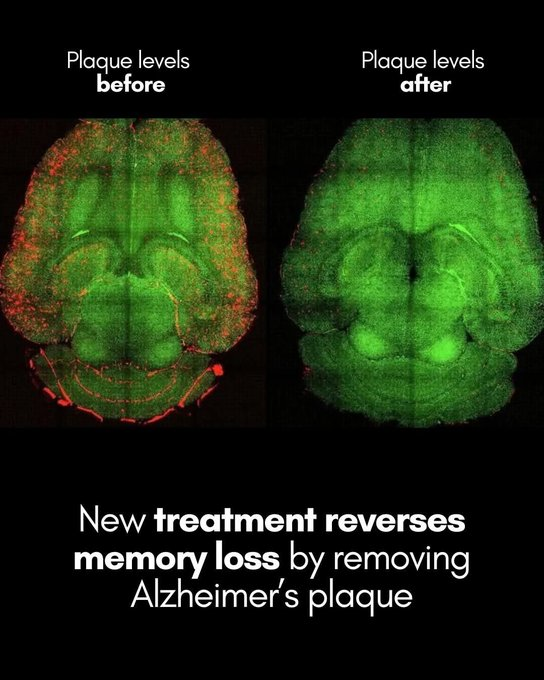
Researchers from Spain and China achieved a significant advance in Alzheimer’s research by developing nanoparticles that clear toxic brain plaque, a key contributor to the disease, and reverse memory loss in mice.
Published in Signal Transduction and Targeted Therapy, the study showed that three injections of these nanoparticles reduced harmful amyloid beta proteins in the brain by up to 60% within an hour.Remarkably, mice with severe memory and cognitive impairments regained normal behavior within six months.
The treatment not only cleared brain plaque but also repaired the blood-brain barrier (BBB), which protects the brain and clears waste but becomes impaired in Alzheimer’s, allowing harmful substances to accumulate.
Acting as a “supramolecular drug,” the nanoparticles restore the brain’s natural waste-clearing system by activating the LRP1 protein. This improved blood flow, reduced inflammation, and supported brain healing. While still in animal testing, this approach suggests a new path for Alzheimer’s treatment, focusing on enhancing the body’s defenses rather than just targeting toxic proteins.
If successful in humans, it could transform the fight against Alzheimer’s and other neurodegenerative diseases.
The next stage of evolutionary complexity after mammals would probably have been (hermaphroditic but multimorphic) exowombists, where individuals can lay a seed that grows into an arbitrarily large sessile womb organism requiring external feeding, and others fertilize it.