We ran a real-world AI coding experiment: Kimi K3 and OpenAI Codex received exactly the same prompt, the same project, the same starting time, and the same persistent "Goal"... keep working until it’s done” instruction.
Both started 24 hours ago on a MASSIVE project.
The difference was night and bloody day. I've commented before on how Codex likes to go on little fucking side quests and do its own thing. Digging into the code, I figured out a lot of why that is. I'll save that for another post.
Kimi, using K3, stayed product-focused. It built a working agent for what we're working on, integrated FluxRouter, created 12 focused crates, added tools, sessions, MCP, skills, containment, six-platform CI, packaging, and installed the agent into Wayland Desktop for live conversations, permissions, file operations, streaming, and cancellation. It’s roughly 75–85% functionally complete.
Codex with ChatGPT 5.6 Sol took the opposite path. It built extremely rigorous CI, security, provenance, ACL, clean-host, and evidence systems... but became trapped in perfecting the baseline.
After the same amount of time, it was only about 8–12% through the formal plan and had not produced anything bloody near a product candidate.
Kimi’s is so much further along and won on all tests, code quality, speed, production, and focus. Tested rigorously per the team's plan.
Neither project is a finished, signed release. But the result is unambiguous: given the same task and goal system, Kimi built the product while Codex went on a technically impressive side quest. Kimi won this round by a massive margin.
In the image below, I got ChatGPT to evaluate its own work and create the comparison.
OpenAI's next model doesn't have a final name yet and it just broke a mathematical bound that had stood since 1978... Then it did it nine more times.
Meet Astra. Or don't, because you can't have it.
Sound familiar?
Yesterday OpenAI published ten proofs of open problems in math and theoretical computer science, all generated by what they describe as an internal version of Astra, their next major model.
Every one of these had seen no progress on the main result for at least a decade. Most of them far longer than that.
The list reads like someone raided a century of unfinished business.
The first explicit non-sofic group, constructed out of nothing, settling whether every countable group admits finite permutation approximations.
For ma math needs first...
Connes' rigidity conjecture, disproved. Ehrhart's volume conjecture, proved.
The first improvement to the general high-dimensional sphere packing bound since 1978.
Quantum parallel repetition, proved for every finite two-player entangled game.
New lower bounds on circuit complexity for the permanent. And three Erdős problems gone, including 183 on multicolored Ramsey numbers.
Every single proof ships with a Lean 4 formalization on GitHub and all machine-checkable.
That kills the usual failure mode of AI math announcements, where a plausible-looking chain of reasoning quietly hand-waves the one step that actually mattered.
You don't hand-wave past a Lean kernel.
This just shows how far we've come in such a short period of time. These problems have confounded the best mathematicians in the world for 50 years plus. AI has evolved in just a few short years to be able to solve these problems and the mind boggles at what can be achieved in just the next five years from here.
Now this is the part the AI Bros won't be talking about but you know Uncle Sean will
Cost of the successful runs... Roughly $2,000 in tokens at Sol API rates.
Two grand. For problems that had sat untouched for decades.
Now I'm a stickler for accuracy of wording and that's the trader in me but that specific number was a successful run. That stood out to me because what does it mean for an unsuccessful run? All of the pre attempts and the failures. It's because in reality that's the real fricking cost.
That's the actual cost per task, and it's missing from the announcement.
And as you know that's the number I keep banging on about.
Noam Brown did admit they came up empty on the Millennium Prize problems, so we know the misses exist.
We just don't get the denominator.
Same week, Anthropic burned $100,000 in tokens having Mythos Preview find real weaknesses in cryptographic algorithms. Also unreleased. Also demoed rather than shipped.
That's the pattern I keep coming back to and as you've seen me talk about in previous posts.
You get Sol and Opus 5. The actual frontier is sitting in a lab getting walked through Washington before it ever gets walked past you.
Altman demoed Astra to policymakers in DC last week, and it's expected to be the first model submitted under the new federal review framework.
For anyone building, the architecture is the real story here. Astra is designed to coordinate multiple agents on one problem for hours or even days at a stretch.
Same shape as what I've been running with Ferrox Factory and the Anvil gating system... worktrees and a serial merge queue and evidence gates, just with a compute budget I will never see in my lifetime.
Nobody's even decided yet whether it ships as GPT-6 or GPT-5.7. There's no date.
Meanwhile 3,000-plus mathematicians have signed the Leiden Declaration, and Timothy Gowers is writing about the possible destruction of mathematical culture after GPT-5.6 Pro solved two problems he'd sweated over, first attempt on both.
His words...Strange and not particularly pleasant to have the rug pulled out from under him.
What are your thoughts?
Anthropic shipped a model whose coding agent index score drops at its most expensive setting.
Almost nobody noticed. They were all busy screenshotting 61.
Claude Opus 5 is now the smartest model you can actually buy. 61 on the Artificial Analysis index, past Fable 5 on 60 and Sol on 59.
Buried in Anthropic's own system card: it hallucinates factual claims MORE than Opus 4.8, and confidently states answers it isn't sure about.
Everyone screenshotted the 61. Nobody read page whatever.
Which means "which model" stopped being the question a while ago.
Effort setting, harness, and what silently happens on a classifier fallback move your results more than the name on the invoice.
For me it's cost per task, not cost per token.
Now you know me, I'm all about the numbers.
Six labs above 50 on that index: Anthropic, OpenAI, Moonshot, xAI, Zhipu, Meta.
First to fifth fits inside seven points. The spread is tiny. Nobody is locked in to anybody.
Still a strong release. It IS noticeably better.
But CodeRabbit benchmarked it for code review: better precision on the comments that mattered, fewer real bugs caught than their baseline, 4x the nitpicks.
One review called it "brilliant (but annoying)".
And the 61 comes with a BIG asterisk everyone's ignoring.
AA labels the runner up "Fable 5 (with fallback)". Fable's score is measured with Opus 4.8 catching what its safety classifiers block.
Anthropic beat its own flagship while it wore ankle weights and a blindfold.
In a chat window, who cares.
For an agent running unsupervised across a production repo at 3am, it's the most expensive failure mode there is.
Wrong and hesitant costs you a retry. Wrong and certain burns your whole weekend before you notice it lied.
Every partner quote praises its judgment. One engineer bragged it pushed back on his architecture and didn't fold when he insisted.
Same model that got measurably worse at knowing when it doesn't know.
Even more reason to bang the Cross Audit drum.
Read the system card. Anthropic's own words: it hallucinates factual claims slightly MORE than Opus 4.8, despite being more accurate overall.
Plus "a surprising number of cases" where it confidently stated an answer it wasn't sure about.
Erm. That's not helpful.
Claude Opus 5 landed like a slap in the face to its competitors.
Tops the Artificial Analysis index at 61. Fable 5 on 60. GPT-5.6 Sol on 59. Same price as Opus 4.8.
That's what every AI bro will tell you today.
Now dig deeper. 🧵
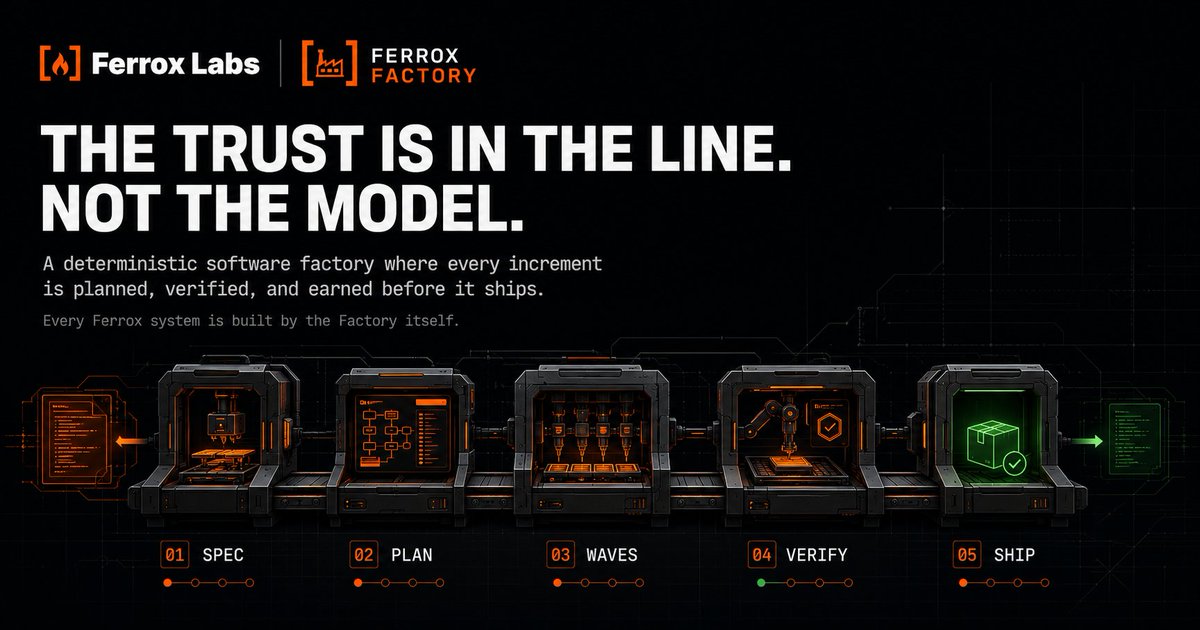
We open-sourced our factory. Ferrox Factory: the agentic build line that built Wayland Desktop, Wayland Core, FluxRouter, and the Anvil engine.
Then it built its own v1.8. 714 checks green. Spec in. Verified software out. Machine gates at every station, and the model can't talk its way past them.
Runs inside Claude Code, Codex, Cursor + 14 more. MIT. https://t.co/FBYZ3mm9ul
We ran 20 systems through 196 machine checks.
Our gated pool of low-cost models matched frontier correctness. 100% visible, 98% hidden. $0.0063 a task.
The frontier lanes that matched it? 12.6x to 28.9x the cost. Same green checkmark.
And the gate is the entire lift.
Same pool, no gate: 88%. We published everything. Tasks, gates, raw JSONs, an offline verifier. Try to break it. https://t.co/ExOMQIiGQl
Write-up: https://t.co/LGrv7E4K05
Someone built a company with no employees and left it running overnight. It's called Auto-Company, an open source project out of Carnegie Mellon that just crossed 725 GitHub stars. I went through the code properly, and it's worth your attention for reasons that have nothing to do with the headline pitch.
The pitch: 14 AI agents modeled on real experts. Bezos as CEO, Werner Vogels as CTO, DHH writing the code, Charlie Munger running pre-mortems. They wake up, form a squad, build, deploy, market, then sleep. Repeat forever, on your own machine.
The reality under the hood: a 743-line bash script calling Claude Code on a loop every 30 seconds. Each cycle is a fresh headless session. The entire memory system is a single Markdown file that each cycle reads on wakeup and rewrites before it dies. No vector database, no orchestration framework. The 14 agents are persona prompt files, and each cycle picks 3 to 5 to roleplay as subagents.
It's a loop wearing 14 costumes.
But three design decisions in it are genuinely smart:
Forced convergence. Cycle 1 brainstorms. Cycle 2 runs a pre-mortem, market check, and unit economics, then forces a GO or NO-GO. Cycle 3 onwards must produce artifacts. Pure discussion is banned. Anyone who has watched an agent loop plan itself in circles for six hours knows why that matters.
Stuck detection. If the same Next Action appears two cycles in a row, the system declares itself stuck and forces a direction change or a ship.
Minimal human-in-the-loop. Steering the entire system is one file edit. Change one line, the whole company pivots on the next wakeup.
The ugly: it runs with bypassPermissions directly on your host. No container, no sandbox. The safety guardrails are polite requests in a markdown file. A 24/7 unattended loop with full system access and prompt-based guardrails is a spicy combination, and there's zero evidence any of these autonomous companies has shipped anything that made a dollar.
Would I run it as-is? No. Would I fork it, put real isolation and evidence gates underneath, and steal the consensus baton and GO/NO-GO cadence? Those patterns already mirror how I run parallel agents on production code, just with actual rollback underneath instead of vibes.
Fun project. Real ideas. Do not point it at anything you care about. But as a starting point for something bigger, it's worth a look.
Link in comments. Star it if it lands.
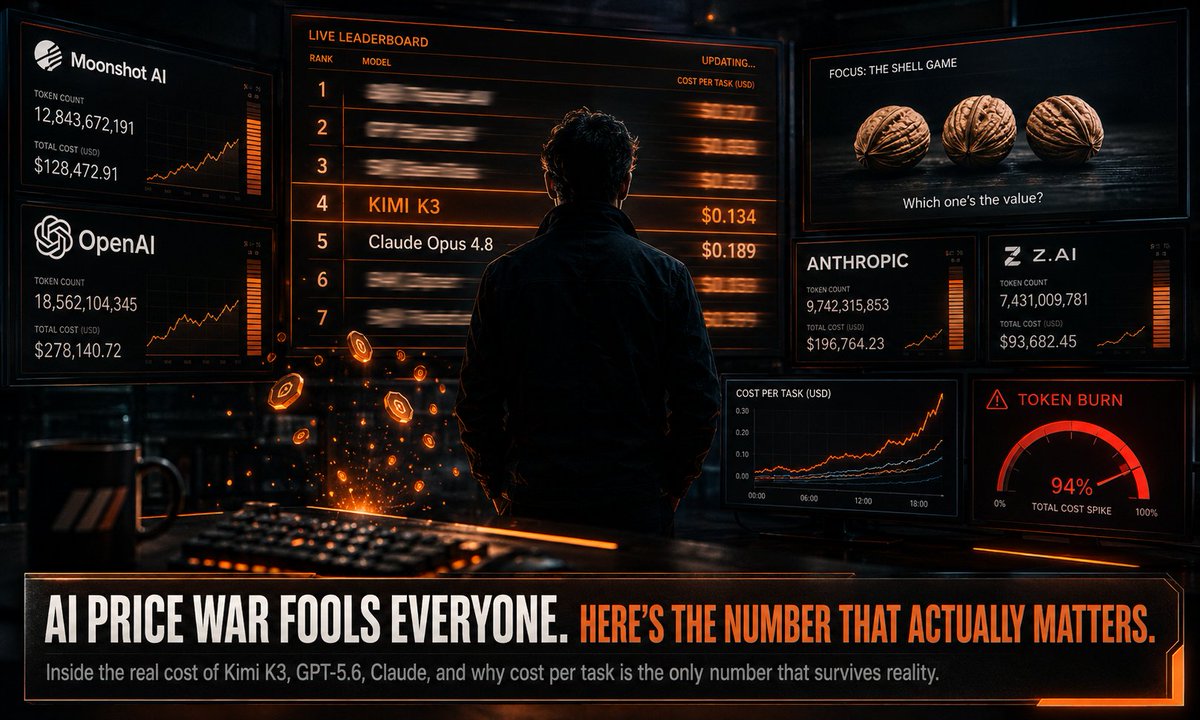
The sticker price is the most misleading number in AI right now.
Kimi K3 dropped this week at $3 input, $15 output per million tokens. A third of Fable 5. It benchmarks fourth in the world on the Artificial Analysis index, above Opus 4.8. On paper that's a steal.
Here's why I keep banging the drum about cost per task instead.|
K3 is always-on max thinking. No dial, no off switch. Every task gets the full reasoning treatment whether it needs it or not, which means it takes longer AND burns more tokens getting there.
Simon Willison's single SVG test cost him about 25 cents. One image. The cheap model isn't cheap if it thinks like it's defusing a bomb every time you ask it to rename a variable.
And it's not just a Kimi thing. I've been running GPT-5.6 Sol hard, and even with tight prompting and proper build discipline, it likes to wander off the reservation for a side mission every now and then. Runaway side quests, tokens billed accordingly. Sol charges $30 per million output, so those little adventures add up fast.
Meanwhile Anthropic has Fable running on a continuous marketing loop. Most capable model ever shipped, until the next one, six weeks later. Every lab is doing it.
Moonshot's own launch charts claim K3 beats Fable 5 on cost per task, but they don't publish the token accounting, so nobody can actually reproduce the numbers. It's a shell game inside an infinite horse race, and it's driving the industry nuts. The crown changes heads every fortnight, and the benchmark charts are drawn by whoever's wearing it that week.
Which is why the only number that survives contact with reality is what it costs YOU to get a finished task out the other end. Retries, detours, reasoning traces, all of it.
That's why GLM 5.2 is still my main workhorse for a lot of things right now, with Fable or Sol sitting above it doing planning and overwatch. Cheap, fast, disciplined execution at the bottom, expensive brains at the top only when the task deserves them. The routing IS the cost strategy.
One more K3 note: web search is currently broken and Moonshot is rebuilding it. And that's not just K3, that's the entire Moonshot line. This world moves fast.
We're building some tools that make this rapidly moving world a little more focused and controlled. But that's an announcement for another day.
What's your daily driver right now, and what's it actually costing you per finished task?
Wayland Desktop Agent just got a major upgrade
We just tore through 23k lines of code, 354 files in five days. 85 pull requests. The biggest stability overhaul Wayland has ever shipped.
If you wonder why I've been quiet for the last week, well, here's why...
The next phase of Wayland is a major refactor of the core agent engine and the desktop itself. Close to a rebuild. And you don't pour a new engine into a machine without checking for loose bolts.
So before we touch it, we went through the entire thing, top to bottom, and tightened every wrinkle we knew about, every reported issue or bug or friction. Five days of it. This release is the result.
What does that actually get you...
The model layer got rebuilt around you. Newest models up top in the picker. Model filtering, smart defaults, optimized picks, and memory for your favorite/most-used models.
OpenAI models route to the right provider every time, your API key gets used when you've got one, teams remember their models across restarts, and the context meter reads the real context window and tracks.
Pick a model, you get that model, and the header tells you what's actually answering you.
And a lot of the work focused on Codex... Codex got the deepest cut. Especially with Sol, Terra and Luna because Codex has one HUGE issue they don't tell you.
Codex has no native ACP, never has... Every other agent has this as a default. Codex doesn't want to play with other agents.
Bugger that.
So we rebuilt the ACP engine ourselves and wired it straight into the live Codex App Server. GPT-5.6 Sol, Luna, and Terra now run in Wayland, same as they do in the Codex CLI. No sitting a version behind.
Security got hardened and smarter. Wayland now warns you if a proxy you didn't set up is sitting in front of it. Remote peers can't touch your config. Clear-text HTTP gets refused. Logs redact tool output.
A profile can never run against another profile's data.
Sixteen separate changes in that lane alone, and every one of them is the kind you only notice when it's missing.
Windows got a deep dive. We know most desktop agents right now "Prefer" Mac... Well, we're agnostic.
Clean uninstall, npx tools that properly resolve around Windows' weird handling of these things, and a silent failed update that finally tells you why instead of just sulking.
One of the biggest challenges we face is that every system, every operating system, and every agent has its own quirks. Consolidating all of that is a mammoth task.
And if Wayland ever falls over mid-task, it now picks up your conversation on the next launch instead of losing your place.
Export a whole assistant or workflow with every credential stripped. Task notifications with quiet hours. The About page checks for updates the moment you open it, and it won't restart you mid-response.
Now the part nobody puts in an announcement. Of the 23,500 lines we added, almost 14,000 are tests. More than half. That's not filler, that's the lengths we go to.
Anyone can claim their tool is solid. We'd rather show you what we spent to make sure.
None of this is the flashy stuff. That's deliberate. Flashy is easy. A tool you trust to run real work every single day without babysitting it, that's the actual product, and that's what this build buys. The big leap comes next, and it now has a floor worth standing on.
Engine's on wayland-core 0.12.25. It auto-updates, so open About and it's already pulling the new build. Go make something.