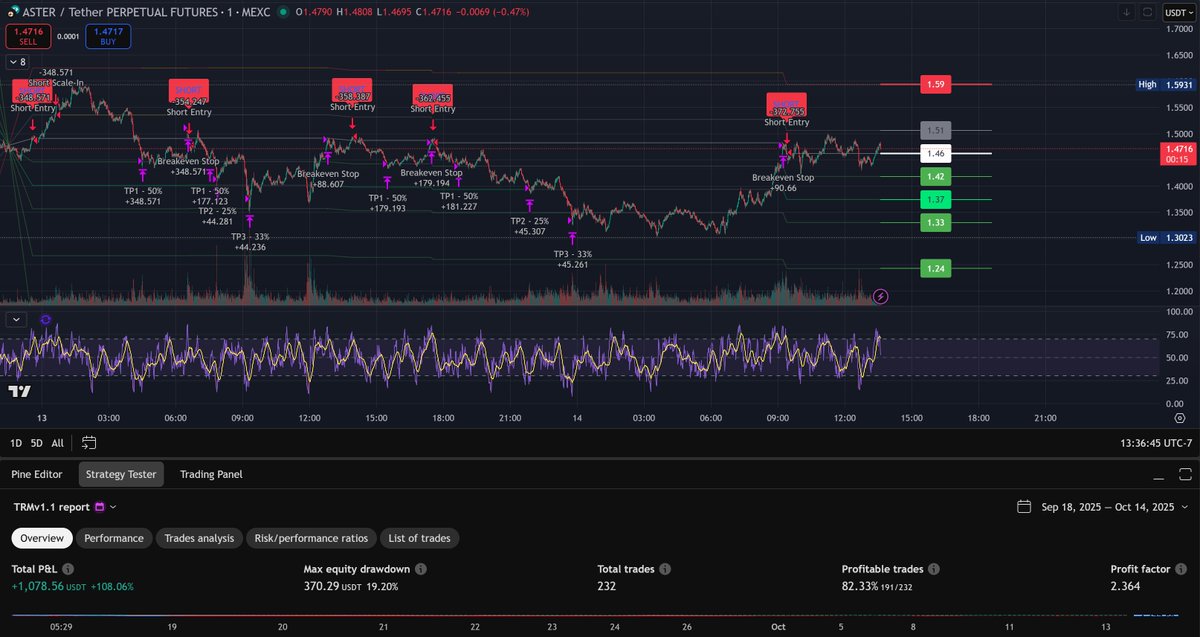
The TrueRMv1.1 #TradingView strategy is live.
I have been using it on $ASTER and the numbers are wild (>80% win rate). See for yourself... for access, please go to: https://t.co/9XL6PKsPYf
🎯 Intelligent #Market Reversal Detection
TrueRM is a sophisticated trading #strategy designed for serious traders seeking high-probability reversal opportunities. This advanced system combines multiple layers to identify potential turning points with precision.
⚡ Key Features:
✅ Smart Entry System - Dual-entry approach with intelligent scaling capabilities
✅ 5-Level Take Profit System - Systematic profit-taking at predetermined levels (TP1-TP5)
✅ Dynamic Risk Management - Automated stop-loss with breakeven protection after TP1
✅ Position Visualization - Clear on-chart display of entry, TP, and stop levels
✅ Non-Repainting Logic - Uses confirmed bar data for reliable backtesting
Key insight here: AI isn't replacing SaaS — it's reshaping who controls the workflow.
The real disruption? Users running open-source AI agents locally, routing to the best model for each task, keeping their data under their own roof.
Enterprise security concerns are valid. That's exactly why BYOK and zero telemetry matter. The winning stack isn't closed-source monoliths — it's modular, user-controlled AI with smart routing that cuts costs 70%+ while keeping compliance teams happy.
Is AI really disrupting all software?
Software stocks have come under pressure following recent advances in frontier AI models, but the narrative around broad-based disruption across SaaS may be somewhat overstated, at least at this stage. While large language models have made meaningful progress in natural language tasks such as search, summarisation, and synthesis, their capabilities in more complex enterprise environments remain evolving.
In practice, AI systems are often layered on top of existing systems of record rather than replacing them entirely. Many enterprise platforms continue to benefit from deeply embedded context, including historical data, workflows and governance layers that are important for accuracy and reliability in production settings. This suggests that, in many cases, AI will probably complement rather than displace existing software vendors.
Concerns around commoditisation also appear more nuanced. While certain surface-level features may become easier to replicate, underlying data structures, integrations and operational depth can still provide meaningful differentiation. Enterprises also tend to be cautious when it comes to exposing sensitive systems to external tools, particularly given ongoing considerations around security, compliance and control.
The potential for increased competition from startups is real, particularly as AI lowers the cost of building and iterating on new products. However, scaling enterprise-grade software typically still requires time, trust and integration into existing systems. Incumbents retain advantages in distribution, customer relationships and access to proprietary data, although the competitive landscape is clearly evolving.
Another area of debate is the potential for seat compression as AI improves productivity. While some efficiency gains are likely, the broader impact may vary across use cases. In some instances, value may shift towards new workflows that require orchestration, observability and governance, which could offset some of the pressure on traditional pricing models.
Overall, AI appears to be both a source of disruption and a driver of incremental demand for some software vendors. As organisations move from experimentation towards production, spending on data infrastructure, security and system modernisation should continue to grow. The longer-term outcome is still unfolding, but it seems increasingly likely that platforms with strong data foundations, embedded workflows and infrastructure software vendors will likely remain important in an AI-enabled environment. https://t.co/YKr5pL7G2c
Local LLMs + cloud model routing is the sweet spot. Run simple tasks locally for speed and privacy, route complex ones to frontier models when you need the firepower.
The real unlock is BYOK — bring your own API keys, no markup, no middleman. That's how you keep costs predictable while getting access to 200+ models.
Hermes Agent is seriously underrated. The tool-calling capabilities and structured output handling are best-in-class for an open-source framework.
568 stars in 48 hours tells you the demand was always there — the documentation just wasn't. This guide fills a real gap. The fact that you can go from zero to a fully autonomous agent in an afternoon changes the accessibility of the entire ecosystem.
NVIDIA open-sourcing an agent platform makes strategic sense — they want to commoditize the software layer while selling the hardware underneath.
For users though, more open-source options means better interoperability and less vendor lock-in. The winning platforms will be the ones that let you run multiple frameworks and route between models intelligently based on task complexity.
DESIGN.md is the right abstraction layer. The problem with Figma-to-code has always been too much implementation detail — AI agents don't need pixel specs, they need design intent.
Plain text > complex schemas every time. LLMs parse markdown natively. No conversion layer, no lossy translation. This is how AI-native tooling should work.
Our main goal is to create a truly decentralized trustless network. Even though our whole project is open source, we wanted to introduce a feature no other tech has. We get tons of messages asking "build this" and "build that" some with amazing ideas. So we built Privacy Tools Lab.
What Is It?
An AI-powered builder where anyone creates professional privacy tools using just word prompts. No coding required.
Type your idea → AI generates code → Deploy instantly
Economic Impact
Community-driven development accelerates innovation True ownership - you create it, you own it Distributed power - anyone can build, no gatekeepers
This boosts the decentralized economy by turning ideas into income and making privacy tool creation accessible to everyone.
Live Beta Now
Test it free today. Raw demo, lots coming, but functional now.
Working:
-AI code generation
-Live editor with preview
-Instant deployment
-Conversational refinement
Coming Soon:
-GitHub integration
-Advanced language models
-Multi-file projects
-Tool marketplace
We're removing technical barriers. Ideas are now the only requirement.
Still printing….. 🏄♂️ 🏄♂️ 🏄♂️ TrueRM script is by far the best trading #strategy I have ever written. The hit rate is savage, especially on $ASTER… Link for access to script in bio. How’s your port doing anon? 👀 #trading#tradingview
@RoundtableSpace $WHISTLE this is the kind of james bond tech you should be interested in for your sources and network. It's groundbreaking and still early. Your welcome....
https://t.co/nfvcPmrlbi
https://t.co/ziAJjThMbs
I found some sweet tech. Its not often you find a gem like this in the $SOL trenches that has some incredible and potentially life-saving utility. This is some James Bond level tech. It's so early and I am excited by all these cool use-cases.
$WHISTLE
CA: 6Hb2xgEhyN9iVVH3cgSxYjfN774ExzgiCftwiWdjpump
https://t.co/Smkk0zf33X
You can even run a Whistle Node yourself. The process is very simple
👉Go to the site: https://t.co/NUXXhoGwM5
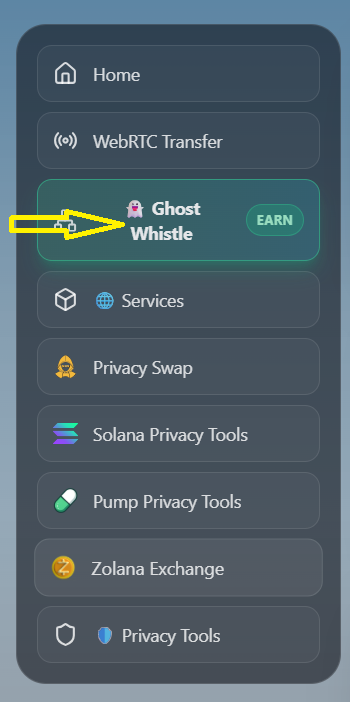
👉Click on the "Ghost Whistle" tab in the left menu.
👉After staking, you can run your node by clicking "Start Node." If the process is successful, it should look like the image below