How can we visualise external constraints to growth in Africa? Have fluctuations in commodity prices and capital inflows conditioned growth paths? Some thoughts in the post below. https://t.co/rUrMWVmbhk
🚨 @Keir_Starmer, we have an urgent agenda item for your discussion with President Trump tomorrow: stop ethnic cleansing in #Sudan.
1 million people in Sudan’s largest camp for displaced persons, mostly women & children, are starving. And many more could die unless YOU do something about it. #Darfur
Are African elites longstanding, or nouveau riche? In a new @AfEconHis working paper I review some of the debates about- and channels through which elites are reproduced and renewed, in the context of African history.
https://t.co/33YDc6PqCJ
@JohanFourieZA@bryan_caplan Interesting! I make a related point in a recent piece on racial wealth (aka housing) inequality in SA: https://t.co/bhmXztrdcD
How have Black middle class South Africans and Kenyans come to share in the wealth stock of their nations since colonial rule and Apartheid? @rebecca_simson explores in our latest blog post #LSEInequalitiesBlog
https://t.co/iDudDNEVUG
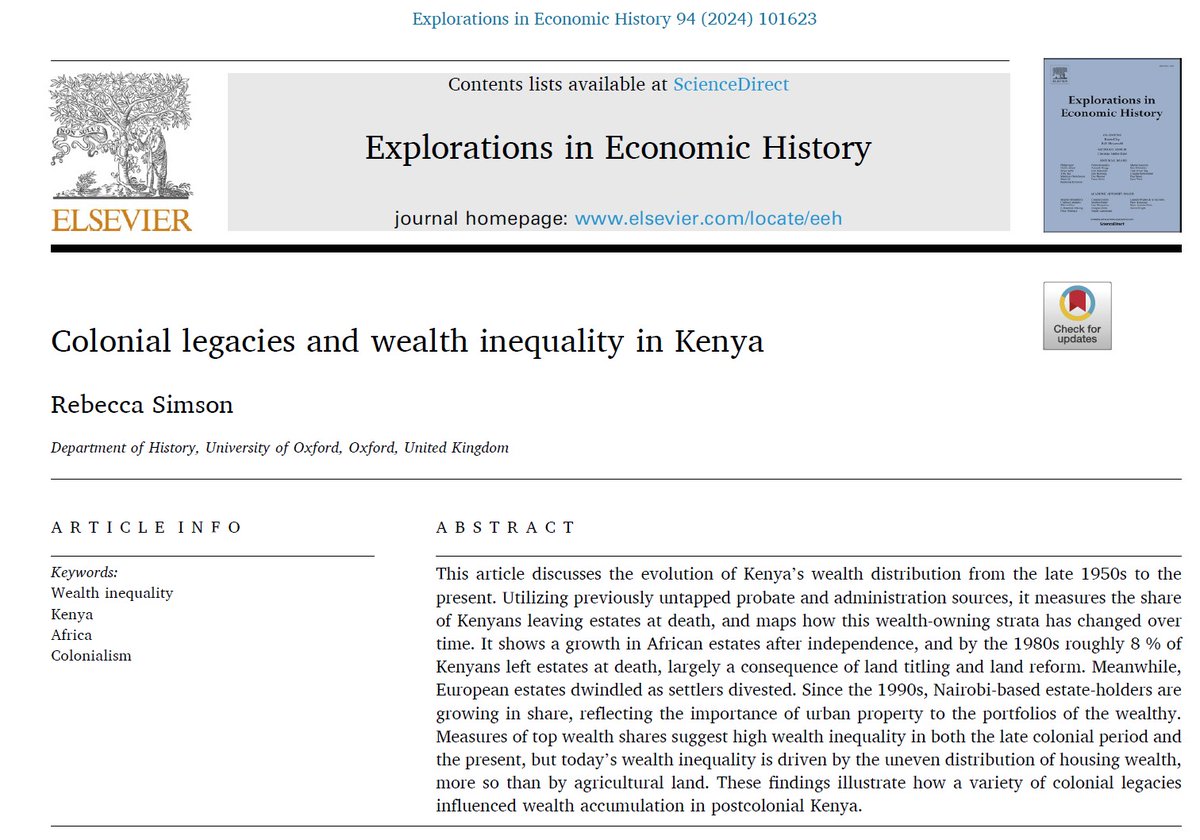
It seemed to me that these notices offered an interesting lens on wealth holding in a postcolonial African setting – as patterns of wealth holding, and the magnitude of wealth stocks, are very poorly mapped for most African countries. This is what eventually emerged.
Belated advertisement of my recently published paper on the history of wealth inequality in Kenya. A couple of years ago I went down a rabbit hole and started digitizing public notices of inheritances under probate in Kenya.
When teaching African economic history, I often need to discourage students from thinking of African development exclusively in terms of AJR’s extractive & inclusive institutions, but this is testament to how inspiring their research has been, and important to the revival of AEH.
Fabulous news that the Nobel memorial prize in economics has been awarded for work of a historical nature again! Congrats to Acemoglu, Johnson and Robinson.
Another wonderful book review on @hnetafrica! @rebecca_simson reviews "Quantitative History and Uncharted People: Case Studies from the South African Past" edited by Johan Fourie.
https://t.co/FSnxV3sD5j
The highest share of women estates is found in Nairobi – but what seems to matter more than urbanisation or income level alone, is the degree of property market activity – in places where land and housing is bought and sold, women are more likely to acquire formal property rights
I have a new article out that uses an experimental approach to studying gender wealth inequality in Kenya. I collected notices of estates undergoing probate to measure the share of inheritances are left by women, relative to men. https://t.co/eZafCtMjq8
I position this as a glass half full story – women are much less likely to leave estates at death than men, but they are catching up steadily – they account for about a quarter of those leaving estates today, up from well below 10% in the early 1980s.