I'm an undergraduate at Virginia Tech that studies bones! Follow me for interesting facts about bones, pictures of specimens, and much more. @RebeccasBugs
My first ever #research paper with @VTechmeetsPaleo & @Paleoswego has been published!! 🎉 It's about #skull differences in a species of worm #lizard. The research & paper took about 4 years to finish. You can read it for free here: https://t.co/oqwXt0ljlj #ScienceTwitter
@wathompson@VTechmeetsPaleo@Paleoswego to make them consistent and sleek. (Note, you can do a lot of graph customization in R itself too.) For Fig 5, I colored over the CT slices in Paint .NET. Finally, I put the figures together in Illustrator. Inkscape is a free alternative to Illustrator. (2/2)
@wathompson@VTechmeetsPaleo@Paleoswego Thanks!! I took the screenshots of the 3D models in Meshlab, just be sure to change the projection to orthographic and increase the screen multiplier to make the screenshots high quality and lifelike. I made the graphs in R and Google Sheets, then edited them in Illustrator (1/n)
@boydpaleo @EmuLarge@VTechmeetsPaleo@Paleoswego Oh wow, you found enough fossils to get a brief look at intraspecific variation too? Screen washing sure is effective!
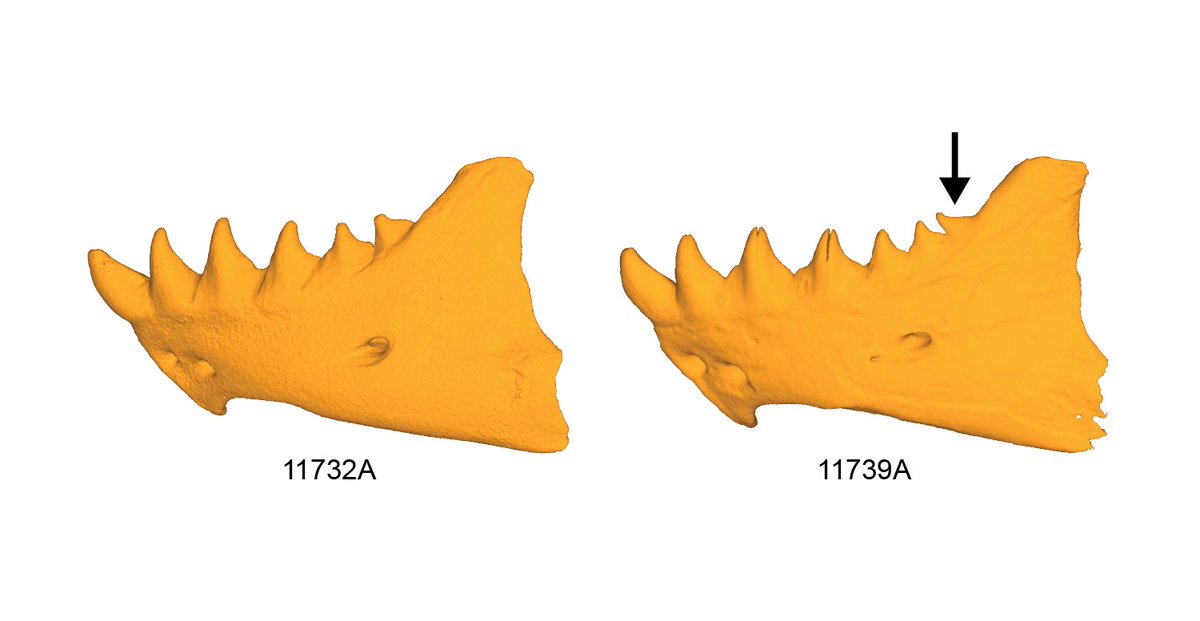
@boydpaleo @EmuLarge@VTechmeetsPaleo@Paleoswego Thank you!! And no, we didn't observe variation in the tooth count or spacing, at least in the upper dentition. We didn't formally examine the dentaries, but there is an individual with an extra tooth on their left dentary.
@Rapha689P Good question! The teeth in your picture look lophodont because they have folds in the enamel & dentine (the dark parts). However, I have seen Peromyscus molars described as bunodont in literature. There's likely a spectrum between lophodont and bunodont teeth in rodents.
@jp_zonneveld Thanks for answering! I did eventually find out what they were caused by. It's such an interesting condition. I'm surprised that I've yet to find an academic paper that mentions the effect of Besnoitia darlingi cysts on bone.
I recently prepared a beautiful #opossum (Didelphis virginiana) skeleton! But, the skull, mandibles, and scapulae have tiny "craters" and some bones have calcification on their surfaces. Does anyone know what could have caused this? Bugs, aging, disease, etc? #osteology
How do #rodents keep their incisors (front teeth) sharp? It's all thanks to their tooth structure! Instead of being covered in enamel, rodent incisors only have enamel on the front. This makes the front wear down slower than the back as they gnaw, keeping a sharp edge. #osteology
@Yara_Haridy I don't have any pictures and can't find any online, sadly. You'd probably have to reach out to someone studying them to get pictures. There are a couple articles about them online, but they focus on their green blood instead (which is also cool). https://t.co/ORh6ysgWDB
Occipital condyles are what connect the back of the #skull to the spine! Mammals & amphibians have two occipital condyles while birds, reptiles, & fish only have one. Two occipital condyles give finer control of head movements but also restrict side-to-side movements. #osteology
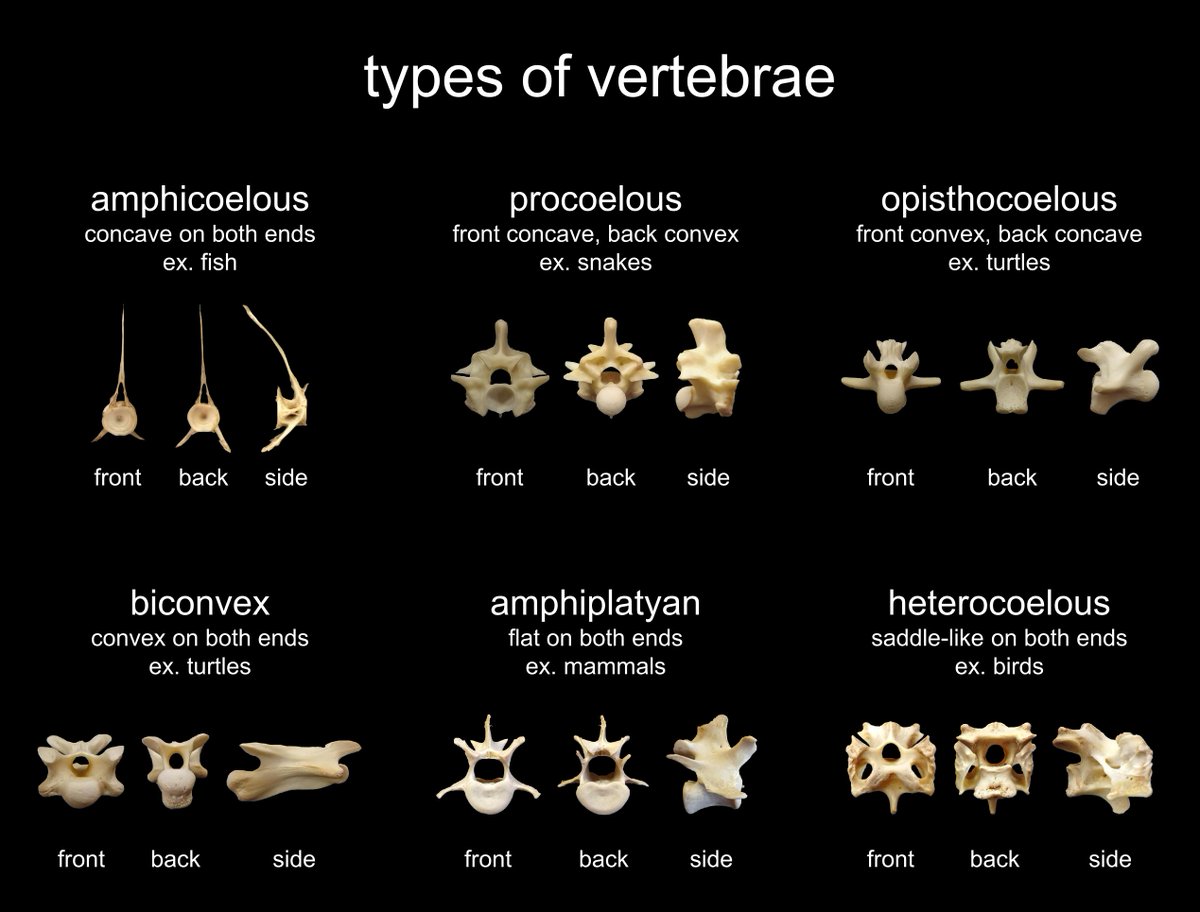
Not all #vertebrae are the same! One way of classifying vertebrae is based on the ends of the vertebra body. The ends can be concave, convex, flat, saddle-like, etc. Check out the diversity in vertebrae below! 👇
Did you know that some #rodents have grooves on their incisors (front #teeth)? Their function isn't well understood, but the grooves may improve the strength or efficiency of the #incisors. Regardless, since only some rodents have them the grooves are useful for ID! #osteology
@geologami I saw some sources saying "suture" could be used outside the skull and some saying it couldn't, so I didn't know who to believe. Is there a better term to use for similar structures outside the skull?
Sutures are the lines where two or more bones join together. They can be straight, squiggly, zigzag, or more! Here's a particularly beautiful #suture from a white-tailed #deer skull. The top bone is the parietal and the left & right bones are the frontals. #osteology#skull