Think about what it means to order the killing of your own soldiers in order to prevent them from becoming part of a prisoner exchange.
It means that Israeli officials consider it a higher priority to keep detaining Palestinian men, women, and children without charge than to release some in exchange for those soldiers.
That logic is so obviously inhumane that Israel officially ended the Hannibal Directive policy on paper, yet obviously kept it in practice, because we now have many different reports of it being implemented on October 7. And we also know that the bombing campaign was organized through 2023 and 2024 in a way that many Israeli officials understood to be highly likely to kill captives Israelis in Gaza, as +972 has exposed.
The Manchester Model. What It Actually Looks Like Up Close.
Andy Burnham is asking the country to trust him with Downing Street on the strength of what he calls the Manchester Model. Eight years of integrated public services and progressive governance that he says Britain should adopt nationally. Before the country decides, it should know what that model actually produced.
Start with the money.
£578 million in public money was lent by Burnham's Greater Manchester Combined Authority to a single developer, Daren Whitaker of Renaker. A tribunal found that GMCA failed to obtain a statement of assets and liabilities from Whitaker before lending, exposing taxpayers to a risk the tribunal described as potentially wiping out the public funds. A meeting between a senior GMCA officer and Whitaker at which loan terms appear to have been agreed produced no minutes or notes. Court papers allege Renaker presented high profit figures to the GMCA when seeking loans and low profit figures to Manchester City Council when seeking exemption from affordable homes requirements. The Court of Appeal is considering judgment on whether the loans were lawful.
Out of 11,000 homes built with that public money, 503 are classed as affordable. Less than five percent. Whitaker's personal fortune grew from £140 million to £698 million during Burnham's mayoralty. The luxury towers were marketed to Chinese buy to let investors through Hong Kong estate agents. Hundreds of flats have been sold to Asian investors according to Telegraph analysis of Companies House filings.
Now the transparency.
In April 2026 the Information Commissioner issued a practice recommendation to the GMCA for failing to publish Freedom of Information compliance statistics. Greater Manchester Police, under Burnham's authority as Police and Crime Commissioner, was separately issued with an ICO enforcement notice for 850 overdue FOI requests, more than 800 over six months old. The oldest had been waiting two and a half years.
Now the transport flagship.
The Bee Network has absorbed a £30 council tax precept increase in two years to subsidise its operation. The £115 million Clean Air Zone was scrapped after £211 million in public funds was received and only £22.5 million returned. Burnham's own transport commissioner acknowledged the network remains twenty two years behind London. The board of Be.EV, the company holding the Bee Network's public EV charging contract, includes Burnham's wife, who joined the company six years into his mayoralty and was appointed to the board as his Westminster ambitions became increasingly visible.
Now the promises.
Burnham pledged to end rough sleeping by 2020. Rough sleeping rose. Today 18,000 people across Greater Manchester have no permanent address. He promised Platt Bridge a flood solution by 2018. The area flooded in 2015, 2021 and on New Year's Day 2025. The projected solution is now 2028. When asked on Question Time why he would not apologise, he said it was before his time. He became Mayor in 2017. The promise was made in 2018.
Now the politics.
Labour's candidate to replace Burnham as Mayor is Bev Craig, leader of Manchester City Council, the body that accepted Renaker's low profit figures and granted the affordable homes exemption. The mayoral by-election on 30 July will be fought under the supplementary vote system rushed through the Lords two days before Burnham's Makerfield victory, designed to consolidate left of centre second preferences and lock out Reform.
108 Labour councillors lost their seats in Greater Manchester in May's local elections. The region Burnham governed for eight years delivered the most devastating local election result in Labour's history.
This is the Manchester Model. These are its documented facts. The country is being asked to implement it nationally. It should read the small print first.
Bev Craig. Labour's candidate to replace Burnham. Leader of the council that granted Renaker's affordable homes exemption.
Currently, Germany would play Scotland in Boston to open the R32. There might not be enough beer in the state of Massachusetts to support those two fan bases if that comes to pass.
FIFA World Cup physical data exposes who actually has an elite engine.
In elite tracking data, the 20-25 km/h bracket is classified as High-Speed Running (HSR), while 25+ km/h is pure Sprinting. Looking at HSR volume shows a brutal physical drop-off at tournament level:
• 700m+ : Strong modern fullback or midfielder output.
• 800m+ : Rare territory. Maybe 10-15 players total.
• 900m+ : Pure physical outliers. Only 5 players hit this ceiling.
• 1000m+ : Complete anomaly. Just 1 player cracked it.
The Outliers (HSR/Sprinting):
🟢 Petar Sučić: 962m/236m (Massive coverage)
🟢 Ismael Saibari: 964m/465m (Absurd power profile)
🟢 Mohannad Abu Taha: 975m/211m (Constant transition threat)
🟢 Raphinha: 989m/500m (Out-of-possession gold standard)
🔵 Michael Olise: 1.049m/421m (1k+ volume from a creative profile is simply a cheat code)
Flashy top-end sprints look great on a highlight reel. But repeatable, high-volume output in that 20-25 km/h HSR bracket is what actually breaks an opposition's defensive structure over 90 minutes. Elite physical profiles.
Bu gece DC Kongo tribünlerinde maç boyu sabit duran şık bir adam görürseniz şaşırmayın. Antiemperyalist politikaları nedeniyle Belçika-ABD ittifakı tarafından katledilen kurucu önder Patrice Lumumba'yı onurlandıran ünlü taraftar Michel Nkuka Mboladinga o.
Claire Kerrison was arrested at 4:33am from her Brighton home for sending emails concerning 'israel's' genocide in Gaza to her MP Peter Kyle.
Four police officer raided her home on 17 June 2025. They seized her electronics. Held her for over eight hours with no one knowing where she was. Released her on strict bail. Charged her in late 2025 under the Communications Act.
The case dragged on for a full year. She faced multiple court hearings including not-guilty pleas.
The emails were described by those who read them as articulate and non-abusive— simply expressing horror at events in Gaza.
The man who triggered the police complaint? Her own constituency MP, Peter Kyle:
- Britain's trade minister responsible for arms exports to 'israel'.
- Long standing member and previous vice-chair of Labour Friends of 'israel'
Kyle has been accused of breaching the Ministerial Code by failing to declare his LFI membership in the official List of Ministerial Interests for 18 months despite the clear conflict.
The case was finally dismissed yesterday, with costs awarded to Claire Kerrison.
This is why British politicians who are paid/influenced by the 'israel' lobby must be banned from public office.
https://t.co/viU9p4EGL7
https://t.co/0MR8J2EAU3
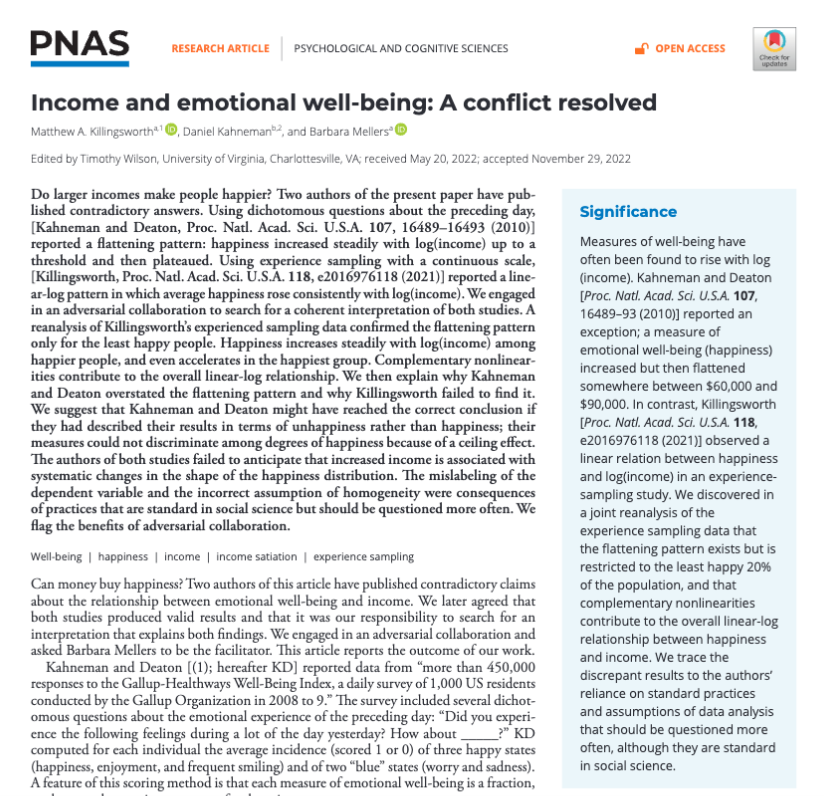
Does money buy happiness? A Princeton Nobel laureate said no above $75,000. A Penn researcher with 1.7 million data points said yes. The day they sat down together to settle the fight, the answer they reached should change how you think about your own life.
The Nobel laureate is Daniel Kahneman. The Penn researcher is Matthew Killingsworth.
The fight between them lasted 13 years, and the way it ended is one of the cleanest examples in modern science of two smart people being wrong in opposite directions about the same question.
In 2010 Kahneman and his Princeton colleague Angus Deaton published a paper that became one of the most quoted findings in the history of social science.
They analyzed 450,000 responses to the Gallup-Healthways Well-Being Index and concluded that emotional well-being rose steadily with income up to about $75,000 a year, and then flattened out completely. Above that line, the extra money was not buying any more daily happiness.
The headline traveled around the world. Every news outlet ran the number.
A CEO in Seattle famously cut his own salary to raise his employees to that exact threshold. The 75,000 dollar figure became cultural shorthand for the idea that the rich are not actually any happier than the rest of us once basic needs are met.
For 11 years almost nobody seriously challenged it. Kahneman had a Nobel Prize in Economics, the sample size was massive, and the conclusion was emotionally satisfying in a way that made everyone feel a little better about not being wealthy.
Then in 2021 a 33 year old researcher at the University of Pennsylvania published a paper that quietly destroyed the entire finding. His name is Matthew Killingsworth.
He had spent the previous decade building a smartphone app called Track Your Happiness that pinged users at random moments during their day and asked them a simple question.
How do you feel right now, on a scale from very bad to very good. The app was designed to catch happiness in the act, not to ask people to recall it later.
By 2021 he had collected over 1.7 million real-time happiness reports from 33,000 adults. When he plotted income against in-the-moment well-being, there was no plateau anywhere.
The line just kept rising. People earning $200,000 were happier on average than people earning $100,000. People earning $400,000 were happier than people earning $200,000. The curve flattened slightly but never stopped climbing.
The famous $75,000 ceiling that the world had been quoting for 11 years simply did not exist in his data.
Now there were two Nobel-quality findings sitting in direct contradiction with each other. One of them had to be wrong, and neither researcher was willing to walk away.
What happened next is the part of the story almost nobody knows.
Kahneman called Killingsworth and proposed something rare in academic science. He called it an adversarial collaboration. The two of them, joined by Penn psychologist Barbara Mellers as a neutral referee, would sit down together and reanalyze the raw data from both studies, line by line, until they figured out which one of them was wrong.
The paper they co-authored was published in March 2023 in the Proceedings of the National Academy of Sciences. And the answer they reached was not what either of them had expected.
Both of them had been right at the same time. They had been measuring two different populations without realizing it.
When the team broke Killingsworth's 1.7 million data points apart by baseline happiness, the picture clarified completely. For the happiest 70 percent of people, more money kept buying more happiness all the way up to $500,000 a year, with no sign of slowing down.
For people in the middle, the same pattern held. But for the bottom 20 percent of the sample, the ones who were already unhappy before the question of money even came up, the curve flattened almost exactly where Kahneman's original paper had said it would. Above roughly $100,000 a year, adjusted for inflation, more money did nothing for them.
This is the finding that changes how the question should be asked.
If you are not already unhappy, money keeps buying happiness for a much longer stretch than Kahneman's original paper suggested. The runway is wider than the world has been telling itself for a decade.
If you are already unhappy, money does almost nothing past a certain point. There is a ceiling, but the ceiling is not about income. It is about the underlying state of the person collecting it.
The deeper insight in Killingsworth's original research, the one almost nobody talks about, is the part that should sit with you longer than the income numbers. The Track Your Happiness app had been telling him for years that the single biggest predictor of in-the-moment well-being is not money at all. It is whether your mind is on the thing you are doing.
His most cited paper, written with Daniel Gilbert at Harvard, is titled A Wandering Mind Is an Unhappy Mind. The data from the app showed that people are mentally absent from what they are doing 47 percent of the time, and that mental absence is one of the strongest predictors of unhappiness in the entire dataset. More predictive than income. More predictive than the activity itself. More predictive than almost any demographic variable you could measure.
Which means the unhappy 20 percent that Kahneman's plateau actually described were probably not unhappy because they did not have enough money. They were unhappy for reasons that more money could not reach.
The reason the curve flattened for them at $100,000 a year is the same reason it would have flattened at $300,000 or $700,000. The thing they were missing was not buyable.
The most uncomfortable line in the entire 2023 paper is the one that nobody on the internet quotes. The authors note that the relationship between income and happiness, while real, is much weaker than the relationship between attention and happiness. A person earning $40,000 who is fully present in their own life will, on average, report higher in-the-moment well-being than a person earning $400,000 whose mind is somewhere else.
The fight about money was the wrong fight the entire time.
The two researchers spent 13 years arguing over whether the dollar ceiling was at $75,000 or $500,000, and the data from Killingsworth's own app was sitting there the whole time saying the ceiling was not about dollars at all. The ceiling is whether you can hold your attention on the life you actually have.
You can run the experiment yourself the next time you catch your mind drifting. Stop. Put your phone down. Look at the room you are in, the person across from you, the food in front of you, the work you are actually doing. That is the part the apps cannot sell you and the salary cannot buy you.
The data has been clear for over a decade. The plateau is not in your bank account. It is in your attention.
In my lifetime, China lifted 850 million people out of poverty, while the US created one trillionaire. It is clear as day that socialism is the key to our future.
BREAKING: Tensions Are Escalating In Albania.
After days of protests over a controversial luxury resort project, demonstrators in Rrjoll, northern Albania, tore down fencing surrounding the construction site.
Protesters say land belonging to roughly 200 local families was confiscated to make way for the development.
The confrontation comes as environmental and anti-corruption demonstrations continue to spread across the country.
This is no longer just a dispute over a resort.
It’s becoming a broader fight over land rights, political influence, and who benefits from Albania’s development boom.
Karl-Anthony Towns finished the playoffs with averages of 15.9 points, 10.6 rebounds, 4.9 assists, 1.3 blocks and 1.3 steals in 30.4 minutes, while shooting 45.6 percent from three.
His +258 plus-minus for the playoffs is the highest single-postseason plus-minus on record.
A heartbroken elderly Albanian man says Jared Kushner has taken everything he spent a lifetime building, including his land, his home, and the future he hoped to leave behind for his children.
He says he returned home one day only to find his property sealed off behind barbed wire, with men in black uniforms standing guard and refusing to let him step inside the house he once called his own.
In a single moment, he says, the life he had worked for was gone.
“It was the end of the world. The end of the world.”
“I felt imprisoned.”
“They took my freedom.”
“They took my livelihood.”
“They took my land.”
The Swedish government told her she owed 102% of her income in taxes. She was 68 years old, a children's book author, and held no political power. Yet, by writing a simple fairy tale, she helped topple a government that had ruled for 44 years.
Stockholm, 1976.
Astrid Lindgren opened her mail to find a tax assessment that defied logic. As Sweden’s most beloved author and the creator of Pippi Longstocking, her books had taught generations of children about courage, independence, and standing up to bullies. Now, she had to face a broken system of her own.
She read the document carefully, did the math, and realized the truth: due to a quirk in the law that combined regular income tax with self-employment fees, her marginal tax rate had hit 102%.
It was not a typo, nor was it a rounding error. One hundred and two percent.
If she paid what they demanded on her extra earnings, she would owe more than she actually made. She would literally go into debt for the privilege of working.
At 68 years old, she could have hired expensive accountants to quietly find loopholes and protect her wealth. She could have done what many powerful people do when systems overreach—safeguard her own position and leave everyone else to figure it out alone. Instead, she picked up her pen.
In March 1976, she published a satirical fairy tale in Expressen, a major Stockholm newspaper. It was called "Pomperipossa in Monismania" (Pomperipossa in Money-mania). It told the story of a successful author who loved her country and worked hard, only to discover a tax system designed to punish honesty and success.
The story was witty, precise, and impossible to misread. Pomperipossa was Astrid; Monismania was Sweden.
The ruling Social Democratic Party—which had governed Sweden for over forty consecutive years—was furious. Prime Minister Olof Palme went on the defensive, dismissively claiming in public that Lindgren was a wonderful storyteller but a terrible mathematician.
Astrid didn't back down. She stood by her numbers, and soon enough, the Ministry of Finance was forced to admit that her math was completely correct.
She began appearing on television and speaking out publicly, pointing out—with the calm, steady patience of someone used to explaining things to people who aren't listening—that a tax system taking more than 100% of a person's earnings wasn't progressive. It was absurd.
That September, Sweden held its national elections. For the first time in forty-four years, the Social Democratic Party lost power. While political analysts pointed to several contributing factors, like economic stagnation and inflation, everyone acknowledged that Astrid Lindgren’s tax revolt had fundamentally shifted the national conversation. She had made it safe to question a system that once seemed untouchable, giving a voice to frustrations millions of people felt but hadn't known how to articulate.
The new coalition government reformed the tax code, cutting the most extreme rates, and Astrid quietly went back to writing children's books.
But she never stopped paying attention. In the 1980s, when Sweden debated a new animal protection bill, she noticed loopholes that would still allow for cruel factory farming practices. She wrote articles, lobbied politicians, and testified before Parliament well into her eighties. In 1988, Sweden passed some of the strongest animal welfare laws in the world. It was widely nicknamed "Lex Lindgren" (Lindgren's Law) because everyone knew she was the driving force behind it.
Astrid Lindgren passed away in January 2002 at the age of ninety-four. Sweden honored her with a state funeral attended by the Royal Family and the prime minister, while thousands lined the streets of Stockholm.
But her true legacy lives on far outside of official ceremonies. Every child in Sweden still reads her books, every debate about fair taxation still references Pomperipossa, and animal welfare advocates across Europe still look to Lex Lindgren as proof of what is possible.
She never ran for office, nor did she ever build a formal political movement. She had no credentials in economics or public policy—just an extraordinary gift for storytelling. But she had spent decades writing about Pippi Longstocking, a girl who refused to follow rules that didn't make sense, stood up to bullies, and never shrank herself to make others comfortable.
Astrid Lindgren simply chose to live her life exactly like the hero she created. When authorities insisted that nonsense made sense, she refused to pretend along with them. And because she spoke up, the world listened.
There you have it. Anthropic's CEO said it: The murder of more than 100 schoolgirls in Minab targeted by Anthropic's CLAUDE "is a use case that doesn't even violate our red lines." Time to rise up against these technofeudal war criminals.