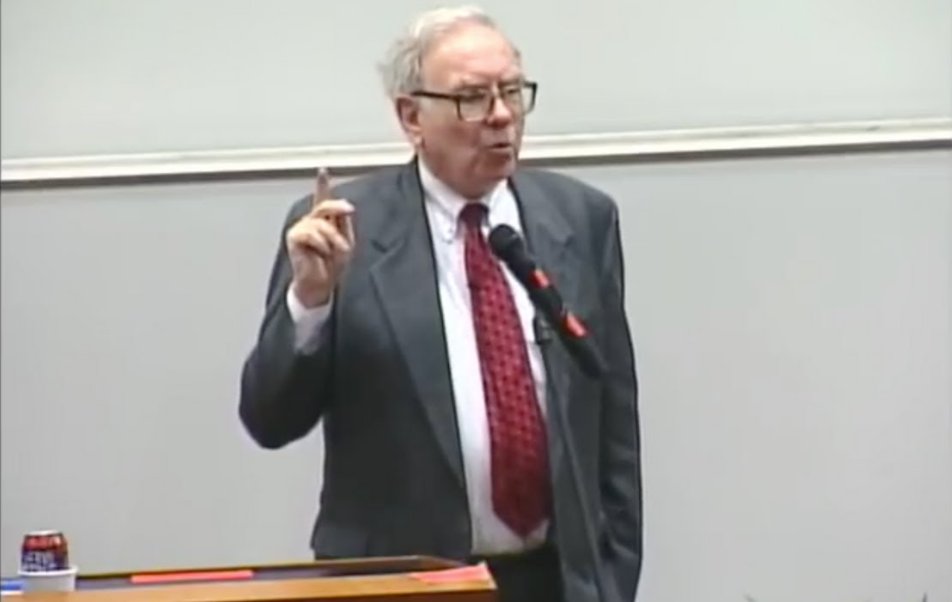
In 2001, Warren Buffett gave a talk at the University of Georgia.
He asked them the most Warren Buffett question ever:
• If you could invest in a friend and get 10% of their income for life -- who would you pick?
Once the students answered the question, he then asked this:
• Why would you invest in that person?
• What character traits do they have?
Now they have a list of character traits to adopt.
Shortly after this, Buffett asked:
If you could short a friend's earnings, who would you pick and why?
Now you have a list of character traits to avoid.
----
1. Do not think this thought experiment is only about money.
You can use it for whatever currency you value.
E.g. Happiness coin
If you could get 10% of a friend's happiness, who would you invest in and why?
If you could short someone's happiness, who would you pick and why?
You can run the same thought experiment with Fitness coin, Friendship coin, Romance coin, etc`
2. This thought experiment is genius because it hacks a bug in life's video game:
Humans are terrible at self-awareness.
But we are great at spotting things in other people.
E.g. If your friend is in the wrong relationship, you can realize in 10 minutes what may take them 10 years.
Daniel Kahneman summarised his book on cognitive biases with the following:
“The premise of this book is that it is easier to recognize other people’s mistakes than our own.” - Daniel Kahneman
3. Nuance - It has to be purely from merit.
Buffett says it can't be because someone will inherit a large sum from their parents.
It has to be based on their behavior.
E.g. If you want 10% of someone's fitness coin, it's not because of incredible genetics -- is because of the actions they take.
Escucho mucho podcast por trabajo, pero los podcasts literarios los escucho por puro placer. Os dejo mis 10 favoritos. Este de @javierpenalopez y de @BlackieBooks es mejor cada temporada. El episodio dedicado a Mishima una joya (1/10)
10. Julian's Creativity Faucet
The incredible @Julian has this idea:
1. Visualize creativity as a backed-up pipe of water
2. The first mile is wastewater that needs to be emptied
3. After emptying the bad ideas, you begin to spot patterns as to why they are bad
In 2011, Pixar employee Emma Coats shared its “22 Rules of Storytelling.”
They’re a masterclass in story, psychology, and human connection.
Here are 10 gems:
Durante más de un año @leonvaca recorrió las casas de Madres y Abuelas de Plaza de Mayo a lo largo de todo el país para ver como estaban atravesando la pandemia. Charló con ellas, las conoció y las fotografió delicada y amorosamente a partir de una propuesta de la @SDHArgentina
ChatGPT is overhyped.
That's what I told myself after 2 weeks of trying (and failing) to use it well.
Turns out, I was just a poor prompt writer.
But after spending hundreds of hours tinkering, I've finally cracked it.
And now, it's my personal writing assistant.
Here's how:
GPT-4 is taking the world by storm.
And every AI influencer has a bundle of 250+ prompts as a retweet giveaway.
I'm going to give you just FOUR prompts.
4 whose structure will teach you things.
4 that are actually good.
4 that are free.
(Copy these 4 ChatGPT megaprompts👇)
All these ChatGPT-4 threads are a joke.
The best AI writing prompts aren't 1 sentence. That's like having a Ferrari and driving it 5 mph.
Here's a 60-second masterclass on how to create prompts like a virtuoso writer:
Hoy publicaron los datos de "exceso de mortalidad" que viene a ser "cuanta gente se murió de más (o de menos) comparado con el promedio histórico reciente"
Es la manera real de descubrir cuantas vidas costó la pandemia y si funcionaron o no las medidas tomadas.
Veamos:
Si algún día quieren dar de baja algún servicio sepan que la empresa lo tiene que hacer en el momento que uds lo piden. Eso de “después de tal día” o “el mes adelantado” está prohibido.
Guarden esto, algún día lo van a necesitar.