@HourofPoop While it sucks to see this show go, I can at least respect Michael and Zach for choosing creative quality over mediocre quantity.
I remember EmpLemon worrying about how this show could drag on turning into the next Rick and Morty. Clearly not going to happen now.
Great edit btw
Maduro’s capture illustrates what I believe is one of the biggest problems in politics: people frequently treat principles as costumes—worn when convenient, discarded when costly.
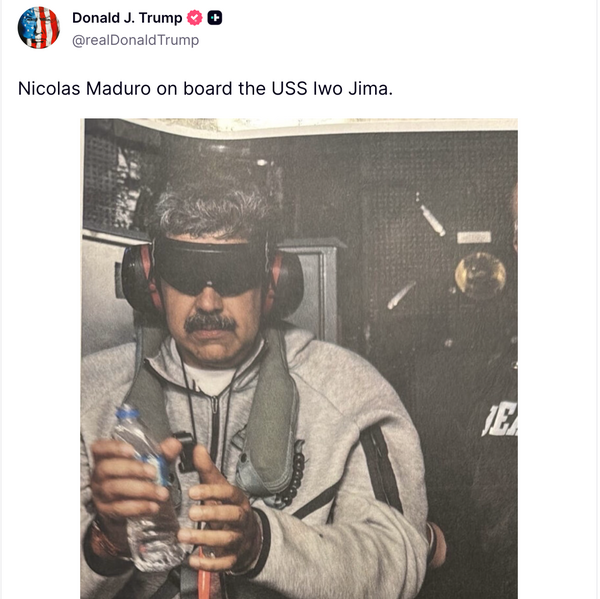
Over nearly two decades working in and around politics, I’ve watched the same pattern play out again and again—and today’s events in Venezuela put it on display in neon. The US military carried out strikes in Caracas and captured Venezuelan President Nicolás Maduro and his wife, flying them to New York in what the administration is framing as a kind of “law enforcement” operation. 
Look, there are plenty of people who never even pretend to have a core set of principles they cling to. They’re utilitarians and technocrats—ruled by polling, vibes, ambition, and career incentives. Fine. At least they’re honest about being wind vanes.
But most people do claim to stand for a consistent set of ideas—constitutional restraint, limited government, “America First,” non-intervention, rule of law, due process, sovereignty, you name it.
The problem is that they’re often inconsistent, especially when the outcome is emotionally satisfying.
Today proved that again. People who claim to champion the Constitution suddenly ignore its restraints on executive power and, when pressed, point to court precedent, congressional statutes, and past presidential deviations as if those things are the Constitution.
“But… the Barbary pirates!”
“But George H.W. Bush removed Noriega in Panama!”
“But the courts said XYZ!”
“But Congress passed some statute in 199-whatever!”
So I’ve asked a simple question, repeatedly, across social media threads today: Where, exactly, is the constitutional provision authorizing the president to invade another country and depose its leader?
The replies come back empty, no constitutional provision cited. They can't, because it doesn't exist. The Constitution gives Congress the power to declare war. No "targeted strikes" or anything of the like are separately authorized for the president to execute at his whim.
That’s the whole point of written limits: the text is supposed to bind you. Instead, we get arguments that past presidents did it, and some lawyers said it was okay. This is tantamount to saying “Billy did it, so I thought it was okay for me to do it.” That’s playground logic, not constitutional rigor.
And that’s my point: there is no rigor. There’s only precedent—meaning, prior lawlessness used to justify the next round of lawlessness. The administration itself appears to be leaning on the idea that indictments and “national interests” somehow transform regime change into a lawful “arrest mission.”
Trump was elected in part because people were exhausted by foreign meddling. He was praised (by some of these same voices!) for resisting the interventionist itch. And now he’s kicking up dirt in Venezuela.
“But Venezuelans are happy!” the commenters have repeatedly said. “They’re in the streets celebrating!”
Yes. Sometimes they are. That’s not a serious argument. That’s the-ends-justify-the-means dressed up as compassion—again, playground-level reasoning.
Guess what: Iraqis filled the streets when Saddam was deposed. “Baghdad Celebrates Saddam’s Fall,” read a headline in Voice of America, for an article describing dancing and cheering as thousands poured into the streets. 
Then Iraq spiraled into insurgency, sectarian civil war, mass death, displacement, and the conditions that helped give rise to ISIS.
Libyans filled the streets when Gaddafi fell. So then we got an article titled “Libyans celebrate Gaddafi’s death” in Al Jazeera, describing jubilant crowds and the “end of tyranny.” 
Then Libya fractured into militias and rival governments, becoming a prolonged civil conflict and a humanitarian disaster.
I could go on. You get the pattern.
Here’s the deeper point that people keep refusing to learn: if your principles only apply when they’re easy, you don’t have principles… you have preferences. And preferences make terrible guardrails for state power.
Every time you cheer an exception, you’re not just celebrating a moment… you’re authoring a precedent. You're excusing the next guy, in any political party, and for any reason, to do it too.
If you’re applauding unilateral regime change today because the target is a villain, you’re also applauding unilateral regime change tomorrow when the target is someone you don’t want touched. Power doesn’t care about your intentions (or your preferences). It cares about the permission slip we seemingly always give it.
To be clear: Maduro is no hero. He’s a tyrant who has presided over ruin and repression. But the question isn’t whether Maduro is bad (he obviously is). The question is whether we are governed by law or by appetite.
Because “he’s bad” is not a constitutional argument, nor is "Venezuelans are happy and freer." It’s the (fake) argument every president uses when he wants to do something he has already decided to do.
And this is why presidents since Washington have gotten away with exceeding constitutional limits: because the public trains them to. They learn that violating restraints can spark national pride, satisfy a thirst for vengeance, and earn adoration from people who swear they oppose unchecked power—right up until it produces an outcome they like.
You want a country of laws? Then act like law matters when it’s inconvenient.
Stop treating the Constitution as a decoration.
Stop citing precedent as if it were permission.
Stop excusing today’s overreach because you hate today’s target.
Because the bill always comes due, and the payment is usually made by people who never voted for the war, never authorized the mission, and never wanted their country turned into the kind of thing it once claimed to oppose.
So yes, we can answer James Madison’s question: “Will it be sufficient… to trust to these parchment barriers (i.e., the Constitution) against the encroaching spirit of power?” Obviously not. Parchment only restrains power when the people treat it as a leash—not a suggestion. When half the country cheers the leash getting snapped because their guy did it to their enemy, the paper might as well not exist. And that's the cycle we've long been in.
Yes, Venezuela may be a little freer, for now. But listen to the triumphalism in Trump's announcement. In the same breath as announcing Maduro’s capture, he talked about sending in “our very large United States oil companies,” and about the U.S. “running” Venezuela's government “until such time as we can do a safe, proper, and judicious transition.”
This is the raw material of unintended consequences: blowback, corruption, and the kind of protracted entanglement that turns “just this once” into the next twenty years.
Count me out. I've seen this story before, and I don't like how it ends.
@WallStreetApes@hodgetwins Much of Europe has shown farmers what they need to do.
A couple of hundred tons of (cough) "product" donated to the US House in a robust and amusing manner might help to clarify the thinking of those who pretend to represent Americans.