@Corey_Leander@MattBruenig@EricLevitz Why is that outcome more likely than what happens in all of the other countries that do not have private health insurance?
@Corey_Leander@MattBruenig@EricLevitz Your country would be spending less on healthcare with M4A. But you wouldn't get to consume as many administrative services. It doesn't seem like a loss to me, except you'd have to support all of the people who were put out of work. But maybe they could do something useful.
@Corey_Leander@MattBruenig@EricLevitz There's no causal connection between having more money and needing to invent processes/jobs that make healthcare more expensive and of worse quality.
@Corey_Leander@MattBruenig@EricLevitz My understanding is that the reason American healthcare costs are so high is because of all the unnecessary administrative processes involved. Other countries get along fine without those inefficiencies.
@WilliamHogeland I've always liked this from William Gaddis: “What's any artist, but the dregs of his work? the human shambles that follows it around. What's left of the man when the work's done but a shambles of apology.”
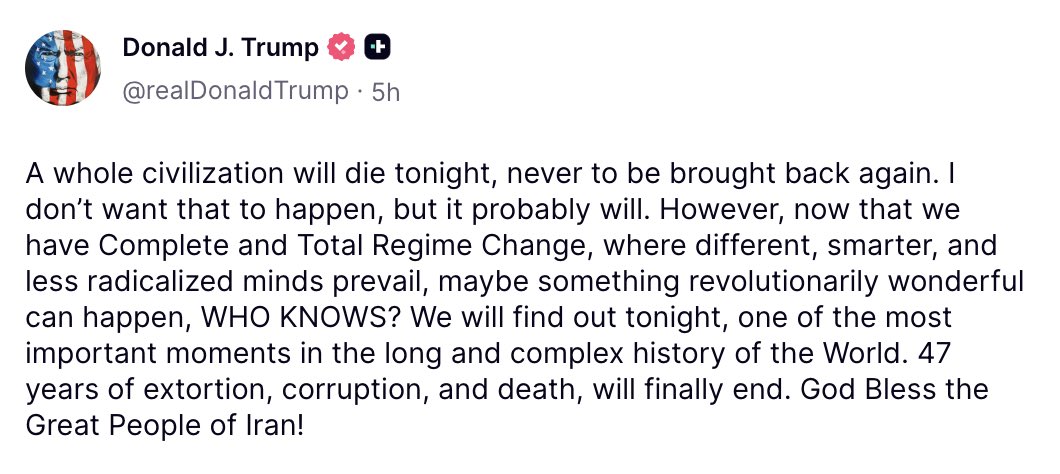
The President of the United States is openly threatening to commit genocide against 90 million people.
Prime Minister Carney: if there was ever a moment to denounce this illegal war, withdraw your support, and call for accountability for war crimes—it’s now.
About what’s happening in and around Iran.
Without pretending to predict the future, I believe there are clear escalation thresholds here. If any two of the following will occur at the same time:
• a major mass-casualty event. For example, 20+ U.S. or 100+ Israeli fatalities, or more simultaneous senior Iranian leadership killings, or a large civilian mass-casualty event in Tehran or a major city;
• sustained escalation in Lebanon or another secondary front ;
• a real stop of Hormuz traffic lasting more than 7–10 days;
then this conflict will likely transform into a full high-intensity regional war. I’m not saying this is an inevitable outcome, but the trajectory is there.
Iran, for its part, may calculate that escalation is the rational move. Iran is fighting in a different manner than it did in 2025. And from Tehran’s perspective, a ceasefire without imposing higher costs on the U.S. and Israel risks simply resetting the battlefield for another round. Escalation can serve multiple purposes at once: restoring deterrence, demonstrating resolve, strengthening internal cohesion, and increasing leverage in any future negotiation.
Contrary to the cliché that mass casualties push Western / Israeli publics toward de-escalation, I don’t think that’s how this plays out in the short term. Large casualty shocks tend to harden political opinion (particularly in a polarised context), expand target lists, and compress decision time. Escalation (often for face-saving reasons) becomes easier than restraint.
Prolonged attrition, of course, is a different business. A steady stream of losses over weeks or months, combined with economic strain and no visible strategic outcome, becomes politically corrosive. This could spell political doom for Trump or Netanyahu.
Russia and China have different stakes in this crisis — Moscow benefits from higher oil prices, Beijing does not — but they share one preference: they do not want Iran to collapse. That constraint will influence diplomacy (at least in the initial phase), but it may favour a dramatic escalation once thresholds are crossed.