Really cool!
"Systemic Banking Crises Database: 1970-2025" by Luc Laeven and Fabian Valencia.
"This paper presents an updated version of the Laeven and Valencia (2013, 2020) database on systemic banking crises, extending the coverage through 2025. The update incorporates new episodes, while maintaining the definition established in previous editions, which emphasizes both significant signs of financial distress and substantial policy interventions. The update integrates textual tools to screen potential candidates that are then further scrutinized to confirm if our definition is met. The database includes information on banking crises episodes during 1970-2025, including starting dates, policy responses, fiscal costs, and output losses. It offers a comprehensive tool for assessing cross-country vulnerabilities and policies to resolve banking crises."
https://t.co/4nSydVP6lF
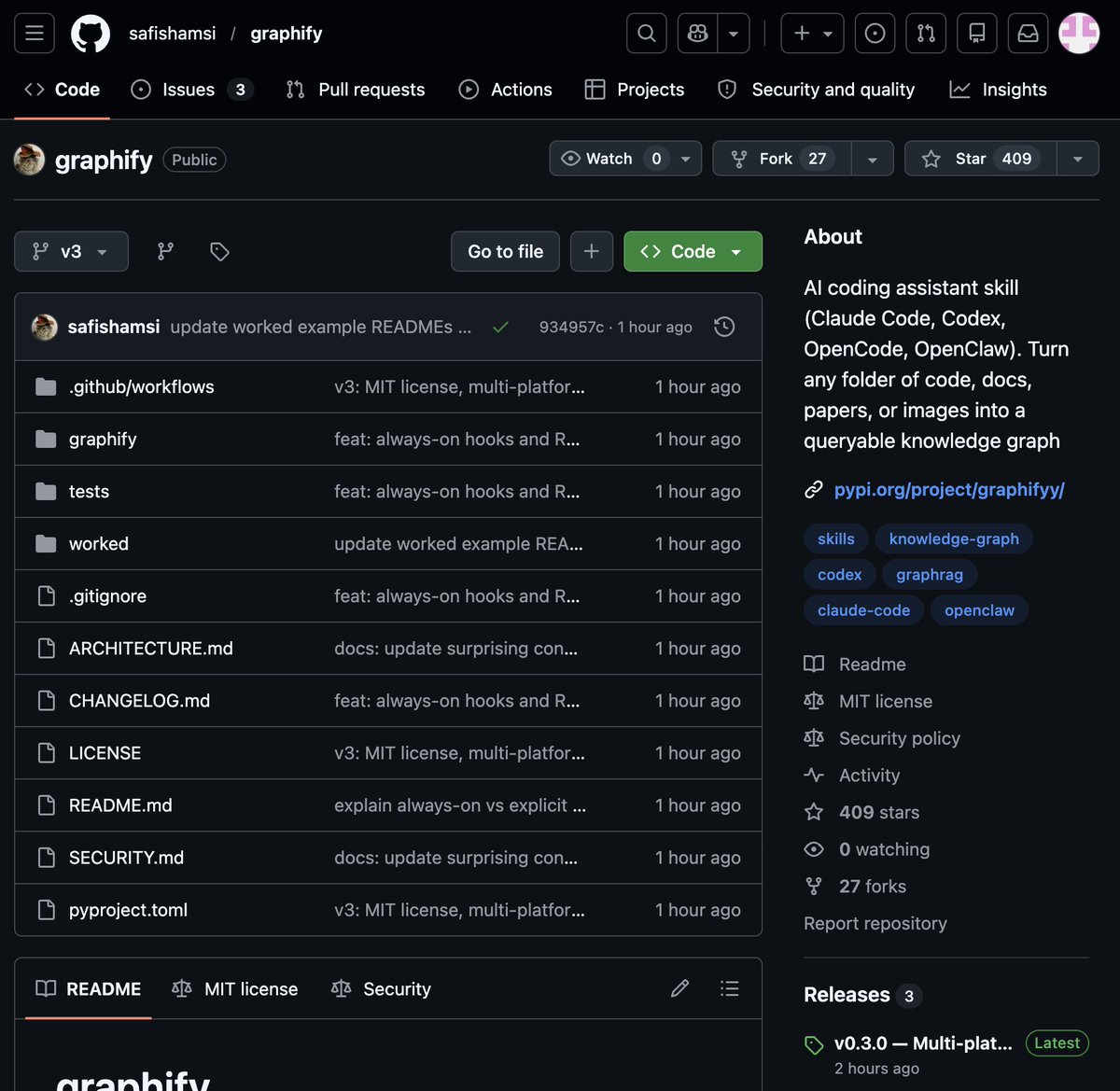
🚨 BREAKING: Someone just built the exact tool Andrej Karpathy said someone should build.
48 hours after Karpathy posted his LLM Knowledge Bases workflow, this showed up on GitHub.
It's called Graphify. One command. Any folder. Full knowledge graph.
Point it at any folder. Run /graphify inside Claude Code. Walk away.
Here is what comes out the other side:
-> A navigable knowledge graph of everything in that folder
-> An Obsidian vault with backlinked articles
-> A wiki that starts at index. md and maps every concept cluster
-> Plain English Q&A over your entire codebase or research folder
You can ask it things like:
"What calls this function?"
"What connects these two concepts?"
"What are the most important nodes in this project?"
No vector database. No setup. No config files.
The token efficiency number is what got me:
71.5x fewer tokens per query compared to reading raw files.
That is not a small improvement. That is a completely different paradigm for how AI agents reason over large codebases.
What it supports:
-> Code in 13 programming languages
-> PDFs
-> Images via Claude Vision
-> Markdown files
Install in one line:
pip install graphify && graphify install
Then type /graphify in Claude Code and point it at anything.
Karpathy asked. Someone delivered in 48 hours.
That is the pace of 2026.
Open Source. Free.
LLM Knowledge Bases
Something I'm finding very useful recently: using LLMs to build personal knowledge bases for various topics of research interest. In this way, a large fraction of my recent token throughput is going less into manipulating code, and more into manipulating knowledge (stored as markdown and images). The latest LLMs are quite good at it. So:
Data ingest:
I index source documents (articles, papers, repos, datasets, images, etc.) into a raw/ directory, then I use an LLM to incrementally "compile" a wiki, which is just a collection of .md files in a directory structure. The wiki includes summaries of all the data in raw/, backlinks, and then it categorizes data into concepts, writes articles for them, and links them all. To convert web articles into .md files I like to use the Obsidian Web Clipper extension, and then I also use a hotkey to download all the related images to local so that my LLM can easily reference them.
IDE:
I use Obsidian as the IDE "frontend" where I can view the raw data, the the compiled wiki, and the derived visualizations. Important to note that the LLM writes and maintains all of the data of the wiki, I rarely touch it directly. I've played with a few Obsidian plugins to render and view data in other ways (e.g. Marp for slides).
Q&A:
Where things get interesting is that once your wiki is big enough (e.g. mine on some recent research is ~100 articles and ~400K words), you can ask your LLM agent all kinds of complex questions against the wiki, and it will go off, research the answers, etc. I thought I had to reach for fancy RAG, but the LLM has been pretty good about auto-maintaining index files and brief summaries of all the documents and it reads all the important related data fairly easily at this ~small scale.
Output:
Instead of getting answers in text/terminal, I like to have it render markdown files for me, or slide shows (Marp format), or matplotlib images, all of which I then view again in Obsidian. You can imagine many other visual output formats depending on the query. Often, I end up "filing" the outputs back into the wiki to enhance it for further queries. So my own explorations and queries always "add up" in the knowledge base.
Linting:
I've run some LLM "health checks" over the wiki to e.g. find inconsistent data, impute missing data (with web searchers), find interesting connections for new article candidates, etc., to incrementally clean up the wiki and enhance its overall data integrity. The LLMs are quite good at suggesting further questions to ask and look into.
Extra tools:
I find myself developing additional tools to process the data, e.g. I vibe coded a small and naive search engine over the wiki, which I both use directly (in a web ui), but more often I want to hand it off to an LLM via CLI as a tool for larger queries.
Further explorations:
As the repo grows, the natural desire is to also think about synthetic data generation + finetuning to have your LLM "know" the data in its weights instead of just context windows.
TLDR: raw data from a given number of sources is collected, then compiled by an LLM into a .md wiki, then operated on by various CLIs by the LLM to do Q&A and to incrementally enhance the wiki, and all of it viewable in Obsidian. You rarely ever write or edit the wiki manually, it's the domain of the LLM. I think there is room here for an incredible new product instead of a hacky collection of scripts.
Food for thought!
"A Framework for Understanding the Vulnerabilities of New Money-Like Products" by Kenechukwu Anadu, Patrick McCabe, JP Perez-Sangimino, and Nathan Swem.
"New money-like products, such as tokenized money market funds (MMFs), money market exchange-traded funds (MMETFs), and stablecoins, could be transformative for finance. These products may offer significant benefits, but like other money-like assets, they also have certain vulnerabilities. We introduce a framework to analyze the vulnerabilities of new products by comparing their features to those that contribute to vulnerabilities in MMFs."
https://t.co/CTDOy0deAC
Aside from the BIS 50% rule announced just before the holiday, the U.S. has in fact breached the "no escalation" consensus reached in Madrid, a consensus that He Lifeng and the Chinese delegation believed had established a clear "freeze" on further actions after the meeting...
However, after the Madrid meeting, the Commerce Department and its subordinate agencies have been pulling a lot of small moves, including but not limited to: adding new entities list, trying to disrupt the semiconductor supply chain from Japan and Netherlands to China, collecting port fees beginning October 14, and imposing 100%~150% tariffs on Chinese port cranes and truck chassis...
From China’s perspective this means… those negotiators are completely untrustworthy... what was discussed effectively doesn’t count...
Given all this… Mr. Trump should have expected this strong retaliatory move on rare-earths...
😅 In my view, Howard Lutnick should take the full responsibility... If U.S. wants to keep talking, that guy should be fired...
Across countries like the U.S., U.K., Canada, and France, the number of men in their early 20s who aren’t in school, don’t have a job, and aren’t even trying to get one is rising steadily. That used to be more common among young women, especially when more stayed home or followed traditional roles, but now that’s flipped. And what’s worse is that many of these men aren’t being absorbed into other productive spaces, they’re just opting out, entirely detached from the systems meant to prepare and employ them.
This isn’t just about laziness or lack of ambition. It’s the fallout from decades of economic transformation. For a long time, there was a clear path for young men, especially those who didn’t go to college, to find stable work in factories, construction, or other blue collar industries. But those pathways have been dismantled by automation, outsourcing, and a shift toward a services based economy that tends to reward social fluency, credentials, and emotional intelligence, traits our current education system disproportionately cultivates in women. So instead of adapting, many young men are simply dropping out of the game altogether.
At the same time, there’s a growing cultural detachment happening. Many young men feel alienated from the institutions that used to guide them like schools, employers, even government programs. Some of that is fueled by a sense that the system isn’t built for them anymore, or that it treats them with suspicion rather than support. For others, the internet has become a refuge with things like video games, YouTube, online forums, places where they can escape, feel competent, and build identity, even if none of that translates into tangible life outcomes. These aren’t temporary distractions anymore, they’ve become full time alternative lives.
Women, meanwhile, have surged ahead in education and early career success, and rightfully so. But society has invested heavily in helping girls succeed over the last several decades, while doing far less to help boys adjust to this new world. As a result, a growing number of young men are drifting, not just unemployed, but untethered, unmotivated, and unmoored.
This isn’t just an economic problem. When large groups of young men lose their place in society, it creates ripple effects: in family formation, in community stability, in politics, and in national cohesion. These young men aren’t just missing paychecks, they’re missing meaning. And if this continues, the consequences will stretch far beyond the job market. We’ll feel it in our households, our democracy, and even our cultural stability. Society simply can’t afford to leave this many young men behind.