install Git and Rust on your computer, these two software are the only requirements as of today. open a terminal / powershell:
1. git clone https://t.co/R0ajELehBJ
2. ./setup
3. follow this video: https://t.co/8gvRDLIhWk
Additionally, you can observe different working examples here: https://t.co/AOcj7Kt7s7 and here: https://t.co/PClgCOmueh
And finally, don't forget to PR your own crafted apps to argent-lang/argent-playground
Community-based support in 'development' on Kaspa's Discord: https://t.co/iAnE2WQU5z
want to take part of this journey?
help shape the next documentation site, my suggestion would be:
- Argent: Getting Started
- Specialized cookbooks/recipes highlighting a specific design or technique
- Concept section
my personal acceptance criteria (and please challenge them):
- no unnecessary jargon: a builder landing here wants to iterate fast, they don't want to enter a complexity-realm that gives no net benefit. if a term is required: Concept section, if not, abstract the lang.
- human friendly content (that happens to also be LLM-friendly content): e.g.: a getting started must be enjoyable/friendly, no friction, no verbosity.
- diagrams are helpful if built correctly, use mermaid and avoid unnecessary introduction.
overall, the docs shouldn't describe Argent nor how it operates but: how to use it.
you can either produce plain markdown documents or PR to this repo below, keep in mind it'll be entirely re-shaped, it's unlikely we'll keep any of the existing content that is programmability-related (but we can get inspiration from).
https://t.co/CU5Bzyyqxa
🚨BREAKING: $25,000 buys you 1,000,000 $KAS today. Soon to be $1.000.000 American dollars 🔥
Now imagine what that million Kaspa could be worth if the project reaches its long term potential.
$25K to $1M. That’s the kind of upside that gets people thinking.
Sounds crazy? Maybe.
But the biggest opportunities rarely look obvious while they’re still unfolding.
Kaspa isn’t another ticker chasing the latest narrative. It’s building around a serious technological vision, with unique architecture and long term ambitions.
The potential is what gets your attention. The technology is what makes you look deeper.
Of course, those returns are hypothetical, not guaranteed.
But if you genuinely believe in what Kaspa is building, the risk/reward from these levels is worth studying.
Imagine holding 1 million KAS before the wider market understands what it could become.
Would you take that bet?
Every time I see Bitcoin, I remember Internet Explorer.
It brought millions online. It paved the way for Chrome. Then Chrome wiped it out. Lmao.
Bitcoin brought millions into crypto.
Now Kaspa is here to rewrite the story.
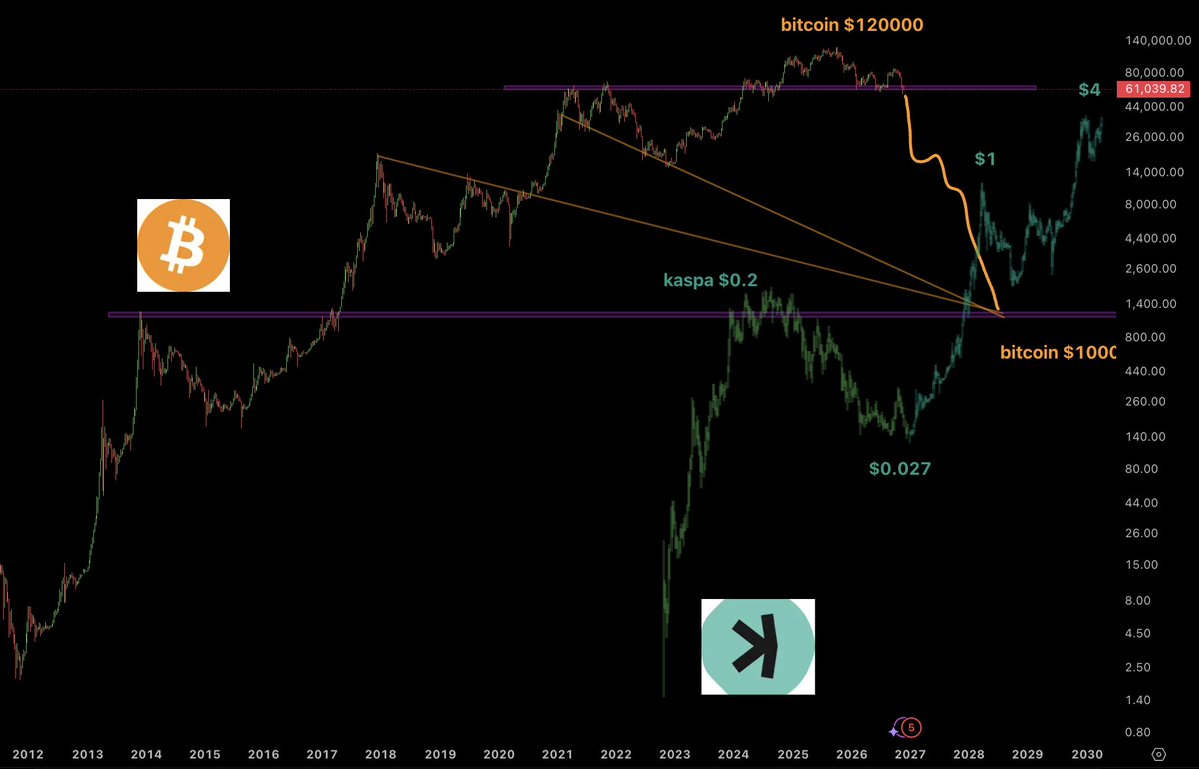
$BTC: $1,500 → $1,000
$KAS: $1 → $4
🔥 LATEST: @KaspaKii has introduced Kii-EnergyOS, an energy coordination and settlement platform powered by @kaspaunchained.
The system includes 12 programme families, payments triggered by verified delivery, privacy-preserving verification and regulatory reporting. Pilot programmes are expected to launch soon.
$KASCOV utility is live: lane tiers up to no per-address cap at 10,000+, every grant on a public ledger anchored on mainnet, the treasury machine at full pace with a receipt console. first tier 2 pass minted tonight.
kaspa:native
https://t.co/kmE5mT4m4x
#Kaspa#BlockDAG #KCC20
Write a Kaspa covenant with nothing installed: kascov's Build tab compiles SilverScript 1.0.0 or Argent and shows the KCC-1 template hash.
Or fill a Mecenas, Escrow or LastWill form for testnet-10, and preflight a tx without broadcasting it.
https://t.co/xnIa9WfbzX #Kaspa
I'm tired of armchair experts crying about "locked stablecoins" on Kaspa when they don't even know how the chains they use every day work. So here are the real numbers. $KAS
BNB has been running for over 6 years with $9.18B locked and there's still no native Tether USDT. Tether never issued it there. Binance owns the contract, holds the reserves and mints its own pegged token on a 21 validator PoS chain.
Arbitrum has been running for over 5 years and peaked at $3.46B in bridged USDT, with $1.31B in bridged USDC.e for 2 years. There's still no native USDT, it's all locked on ETH and it runs on a centralised sequencer.
Polygon has been running for over 6 years and peaked at $1.48B in bridged USDT, with $2.31B in bridged USDC.e for more than 3 years. There's still no native USDT there either and it's all locked on ETH.
Avalanche peaked at $1.98B in bridged USDC.e and $940M in bridged USDT.e, and native USDT only came after more than a year.
Every big chain ran billions on the exact same lock and mint model. Now look at Trestly on Kaspa L1.
It's the first pure PoW L1 with a native covenant stablecoin and a built in L1 DEX. It settles at 10 blocks per second and there's no centralised sequencer.
It's not controlled by one company like Binance's pegged USDT. 5 independent, known Kaspa signers secure it, so 3 of them have to sign every transfer and 4 have to agree to change the rules.
It's open source so everyone can audit its code, and you can check the 1 to 1 reserves on chain any time.
The critics can keep waiting for Tether to save them. We actually shipped it on Kaspa L1.
Do what you want with this information.
$KAS is the crypto version of what $NVDA did for computing
$NVDA revolutionized compute through parallel processing via revolutionary GPU engineering
That is EXACTLY what KASPA is doing for cryptocurrency. Parallel processing through BlockDAG on a programmable, decentralized proof of work protocol.
SOL’s fast finality requires a supermajority of the stake to sign off on the state. If SOL were properly decentralized (in its most important security axis: number of independent stakers), aggregating that agreement fast enough would be the processing bottleneck. That’s a tension which seems unavoidable in the PoS model.
(https://t.co/ZHSHEXPKIa)
Michael Sutton bets DeFi can run on pure $KAS L1, each app with its own state, composing in one atomic transaction.
Temporal/HumidiFi did up to 60% of Solana spot volume, unveiled a 2027 hub to stitch Solana's derivatives venues.
If he's right, no hub needed.
Kaspa will be the final currency to exist when DAGKnight ships, not because nothing else will launch, but because there will be nothing left to redesign. Bitcoin's 10-minute block and Kaspa's current GHOSTDAG are both built on a hardcoded guess about internet latency, while DAGKnight drops that parameter: it reads latency from the DAG itself, keeps 50% hashrate security, and gets faster as the internet does. Once it lands, Kaspa's consensus stops needing a next version. Let that sink in. End game.
Kii-EnergyOS is a complete operating system for energy markets.
At its core: a certificate registry, 24/7 hourly matching, secure data messaging between market parties, digital identity and verifiable credentials, and roaming across EV charging networks.
On top of that core, twelve program families run on one platform:
• Generation and utility programs
• Storage and long-duration storage
• Flexibility dispatch, charging and fleet networks
• Transmission and interconnector capacity
• Hydrogen and molecule networks, blending and transfer
• Thermal networks and industrial process energy
• Solid energy carriers
• Marine, freight and port energy
• Campus and building demand shaping
• Finance: offers, procurement and settlement
• Environmental attributes, fuel provenance and derivatives reporting
Underneath all of it:
• Settlement: energy, certificates and payments
• Escrow, bonds and market locks enforced by the network, not by a back office
• Privacy proofs, so holders disclose only what they choose
• A tamper-evident audit trail anyone can replay
Kii-EnergyOS will shortly open for pilots with utilities, traders, grid and storage operators, ports, fleets and fuel producers. Speak to our team.
#kaspa #cleanenergy #EnergyTransition #EnergySecurity #carbon
The next breakthrough in decentralized finance may not come from executing more computation, but from eliminating the requirement that everyone execute the same computation.
Kaspa is challenging this assumption. Its proof-of-work blockDAG provides shared transaction ordering, while covenants, zero-knowledge verification, and partitioned sequencing commitments establish the foundation for independent applications to coordinate without inheriting unrelated computational workloads.
Imagine autonomous AI agents, decentralized exchanges, and financial institutions operating under common consensus without sharing a universal execution environment. Kaspa’s emerging vProgs architecture aims to make this possible while preserving application sovereignty and synchronous composability.
Bitcoin demonstrated decentralized monetary ownership without institutional permission. Kaspa is exploring something equally consequential: decentralized economic coordination without universal computational obligation.
That distinction could fundamentally redefine blockchain scalability.