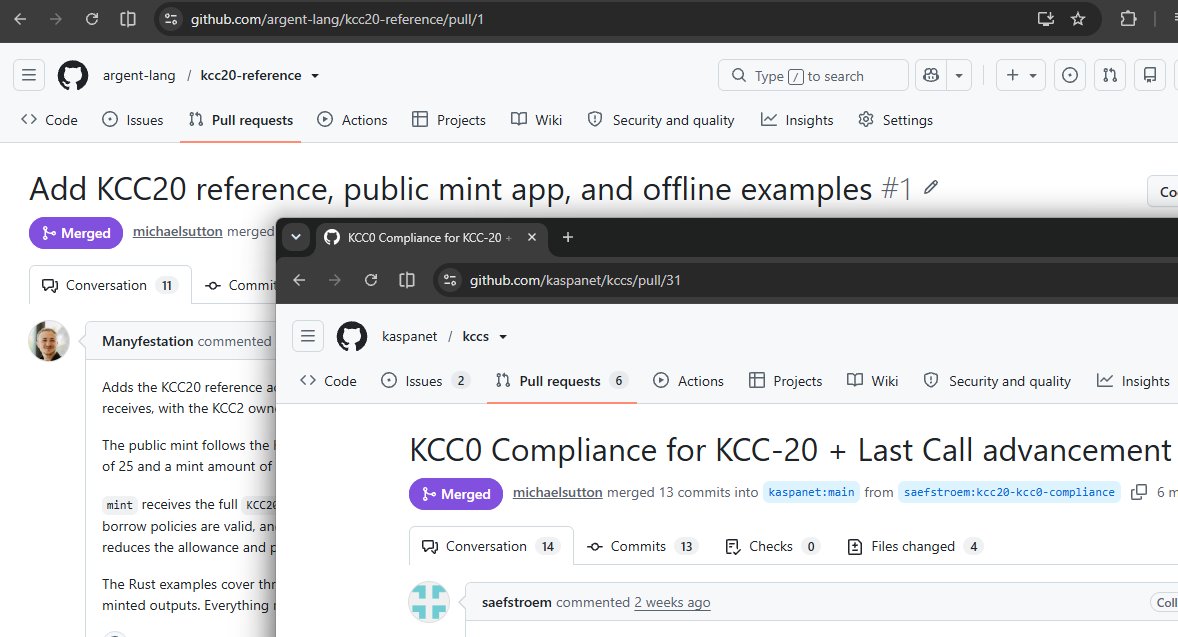
just a gentle reminder that krc20 is not kaspa L1, it only travels over L1 txs as data carriers, but the interpretation of krc20 state is done purely offchain just like any other non-zk based solution. this is why covenants were developed for kaspa L1 with kcc20 built on top of them for native assets (note: kcc20 spec is still in draft)
Finally, Silverscript v1 is out [Link in the reply]. This completes the journey we started eight months ago with Toccata — it's finally possible to write human- (and AI-) readable smart contracts on Kaspa.
This language started simply as "CashScript with loops", but eventually grew into a full-fledged smart contract language capable of expressing complex, stateful contracts. It's always fun to look back at the first token mechanism @IzioDev and I worked on using raw opcodes, which took thousands of lines of code, and see the same thing implemented in just 60 easy-to-read lines of Silverscript.
I'm excited to explore the possibilities of UTXO programmability together with the Kaspa community, and this is only the beginning - Silverscript will evolve, Argent will add higher layers of abstractions, and I'm sure more people will find their own way of extending this new ecosystem.
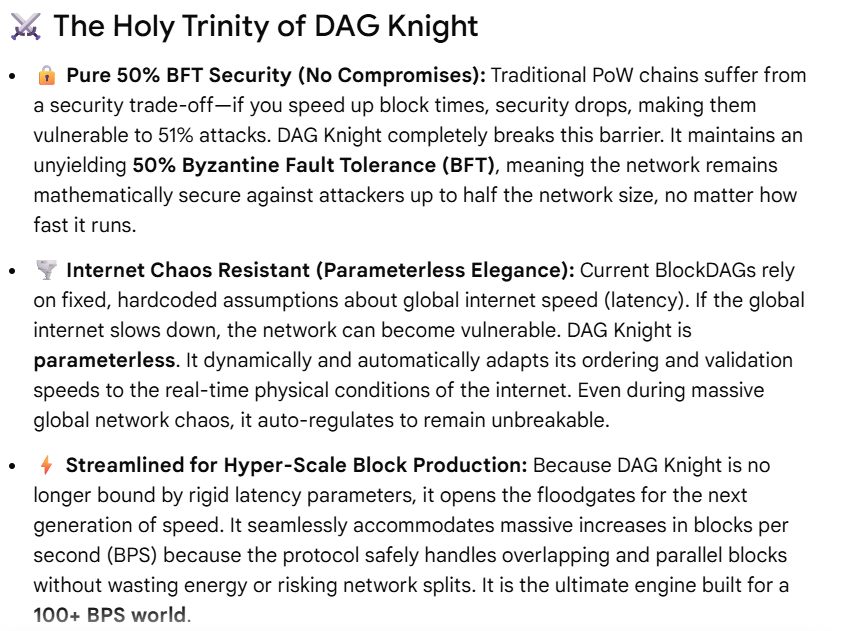
Kaspa devs secretly set the stage for testnet 13 with dagknight
dagknight isnt just another update
it is the most advanced protocol that ever existed in crypto
if you love consensus theory (like me) you really should take a look at this one
https://t.co/pWNLRKlZDR
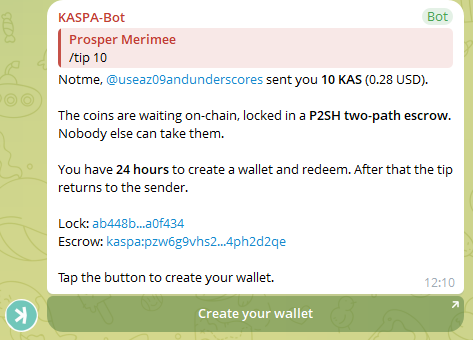
Released a new version for the #Kaspa Telegram Bot
• New wallet - legacy wallets migrate automatically
• Faster tips. No wallet? Held on-chain 24h - claim it or it returns
• kaspa:native Tip stats
• New admin role
• Live hashrate, supply, charts
• Way more!
People ask me:
Why are you all in on Kaspa?
Let me explain:
I believe most people have either forgotten by now or never learned what crypto actually stood for in the first place:
* Independence from fiat
* Independence from governments
* Privacy / censorship resistance
* Fixed inflation
* The money of the people
* Essentially the counter-model to our current monetary system, which will collapse one day.
That was the original idea behind Bitcoin. By now, there are hundreds of thousands of cryptocurrencies. All of them claim to solve some made-up problems. All of them promise that you will be able to exchange the currency for more fiat later. Yet, these coins are created by people from the traditional financial system who have absolutely no interest in changing anything in the long term. For them, crypto coins are just a tool to squeeze fiat out of retail investors. The only difference is when they pull the plug and "launch the next big thing."
Crypto has become a giant casino where the only thing that matters is selling before the devs pull the plug. The original idea of crypto has somehow gotten lost in this casino.
For me, the price of Kaspa is now just an indicator of whether we manage to remind people what crypto is actually for. If we don't succeed, then I'll hold all the way to 0. For me, this has become a battle of narratives.
On one side, there is Bitcoin, Kaspa, and I gladly include Zec as well (which is exactly why these 3 communities should stick together). On the other side are all the others who love to casually halt their chains and freeze funds.
You are welcome to see it differently, but I believe that many early Kaspa investors see it the exact same way. We form the backbone of Kaspa. We welcome every investor who is here to multiply their fiat, in the hope that along the way, they realize they are part of something much bigger than just "I have more dollars."
Bitcoin and Kaspa have the weirdest problem.
They both have the ever growing problem of block subsidies vanishing but they each have the one thing the other needs to solve this.
Bitcoin has the adoption but needs the speed of Kaspa to actually be used and Kaspa has the speed to be usable but needs Bitcoins adoption 😂
Here’s a crazy idea:
Forget the tribalism of the names of the networks. You have 2 networks that offer the same comparable security and decentralised assumptions at the same level of adoption but one has speed and can scale.
If Bitcoiners start to adopt Kaspa then we all have the freedom we’ve actually been wanting. The end result is a winner for all of us and our digital freedom needs.
Seriously study Kaspa.
$KAS
started to record a short 10-min live-coding argent episode: a basic multi-actor ticketing app.
one hour later, episode 01 exists 😅
start here:
https://t.co/Hjb9Tksypu
written code:
https://t.co/qdI40DaIoX
60+ Enterprise Markets to Be Disrupted by #Kaspa Tech
#30 Healthcare Data
Healthcare generates enormous amounts of sensitive data, but much of it remains trapped inside disconnected systems controlled by hospitals, clinics, laboratories, insurers, researchers, governments, and technology providers.
Legacy Standards and Systems
• Electronic Health Record systems such as Epic, Oracle Health, and MEDITECH
• HL7 and FHIR healthcare data exchange standards
• IHE healthcare interoperability frameworks
• HIPAA, HITECH, GDPR, PIPEDA, and other privacy regulations
• CDISC and 21 CFR Part 11 for clinical research and regulated records
• GS1 and Unique Device Identification standards
• Centralized health information exchanges
• Laboratory, pharmacy, insurance, imaging, and clinical trial systems
These standards and platforms are essential, but they often operate within separate institutional boundaries.
What’s Broken
❌ Patient information is fragmented across providers
Records are stored in different systems that do not always communicate effectively. Patients may repeat tests, manually transfer records, or discover that one provider cannot access information held by another.
❌ Data integrity is difficult to verify across organizations
Hospitals, laboratories, insurers, researchers, and governments maintain separate databases and logs. There is rarely one neutral way to prove when information was created, accessed, updated, or shared.
❌ Patients have limited control over their data
Patients may be able to view records through a portal, but they often have little control over how information is shared, how long permission lasts, or whether access can be changed or withdrawn.
❌ Medical records lack a shared version history
Healthcare records need to evolve, but it can be difficult to establish which version existed at a particular time, who changed it, and whether information was altered after an important medical, research, or legal event.
❌ Clinical research data passes through many separate systems
Trials may involve hospitals, laboratories, researchers, sponsors, manufacturers, auditors, and regulators. Information can move through multiple databases before results are reviewed or published.
❌ Privacy limits how healthcare data can be shared
Sensitive medical information cannot simply be placed on a public ledger. Healthcare systems need ways to verify facts, permissions, and events without exposing the underlying patient data.
❌ Medical devices and pharmaceuticals move through complex supply chains
Manufacturing records, product identifiers, maintenance histories, custody transfers, software updates, and recalls are managed by different organizations using different systems.
Where Kaspa Tech Could Help
❌ Healthcare organizations cannot easily prove that records have remained unchanged
✅ A digital fingerprint of a medical record could be anchored to Kaspa without placing the private record itself on-chain.
The information would remain encrypted within authorized healthcare systems, while Kaspa could provide independent evidence that a particular version existed at a specific time.
❌ Providers lack a shared audit trail
✅ Kaspa could provide a neutral record of important healthcare events, including record creation, test results, consent changes, clinical updates, approvals, and data transfers.
Different organizations could verify the order and integrity of events without depending entirely on one institution’s database.
❌ Patient permissions are difficult to coordinate
✅ Kaspa-based systems could support permissions that are clearly defined, time-limited, updated, or revoked as circumstances change.
A patient could authorize a provider, researcher, insurer, or specialist to access specific information under specific conditions, while the system maintains a verifiable history of those permissions.
❌ Records lose continuity as they move between systems
✅ A record, consent agreement, clinical trial entry, or medical device could maintain a persistent digital identity as it is updated over time.
This could help different organizations confirm that they are working with the correct record, device, agreement, or dataset, even when its status or information changes.
❌ Privacy and verification are often treated as opposites
✅ Kaspa could support systems that prove specific medical or regulatory facts without revealing the underlying private information.
A system could confirm that a test was completed, a credential is valid, a consent condition was met, or a dataset meets a requirement without exposing the full health record.
❌ Healthcare processes depend on changing conditions
✅ Rules could be built into healthcare workflows so that access, approvals, payments, data releases, or research steps occur only when the required conditions have been met.
This could reduce manual coordination while keeping the rules visible, consistent, and auditable.
❌ Clinical trial records are difficult to audit across participants
✅ Trial events, dataset versions, laboratory results, approvals, consent records, and submission histories could be independently timestamped through Kaspa.
Researchers, sponsors, auditors, regulators, and patients could verify the history of the trial without relying on a single organization to control the complete record.
❌ Medical device histories are fragmented
✅ Device identifiers, manufacturing batches, ownership changes, maintenance events, software updates, inspections, and recalls could be connected to verifiable records anchored through Kaspa.
This could strengthen existing GS1 and UDI systems without requiring every participant to abandon the platforms they already use.
❌ Healthcare networks struggle to coordinate at scale
✅ Different healthcare applications, institutions, and data services could operate independently while still connecting to a shared verification and settlement layer.
This could support large healthcare networks without forcing all participants into one central database or one provider-controlled system.
Kaspa would not replace hospitals, medical professionals, EHR platforms, privacy laws, or existing healthcare standards.
It could provide a shared verification and coordination layer beneath those systems, allowing records, permissions, research data, payments, and medical device events to remain private while becoming more auditable, programmable, and trustworthy.
Healthcare is becoming increasingly digital, connected, and data-driven.
The challenge is allowing patients, providers, researchers, regulators, and systems to trust the information they already depend on.
Are you a dev or an entrepreneur - See links in the thread to learn and get connected to the Developer community.
A new site in the making to show case each of these. 1000s of ideas for a new app, a new company or services #PoweredbyKaspa!
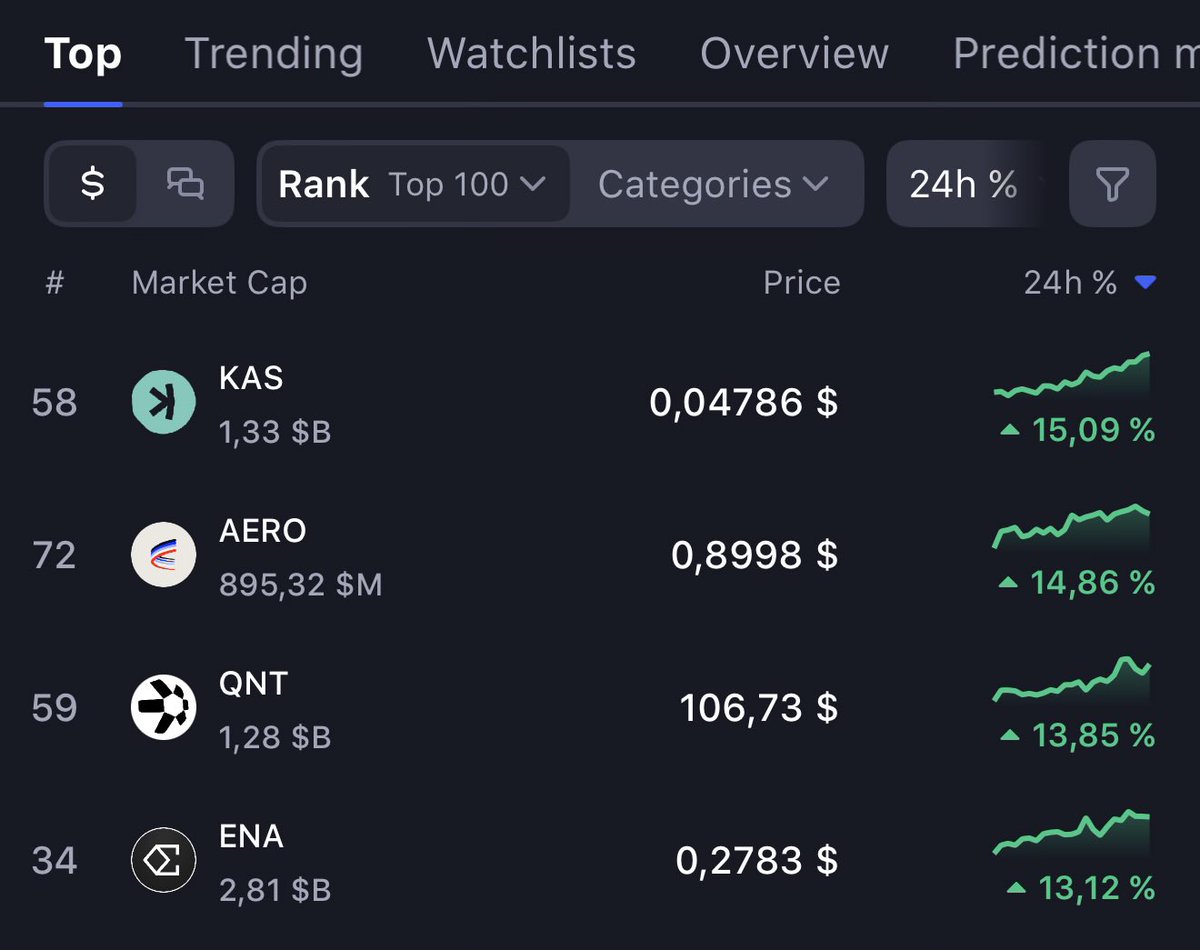
$KAS has been forked!
History has been made once again. The hard fork was a success!
Toccata brings many new features, and I'm excited to see what developments these possibilities will bring!
In less than 24 hours, toccata will go live on the #Kaspa BlockDAG 🔥
Tomorrow (Tuesday) at around 4:15 p.m. UTC, it’s finally happening 🚀
@KaspaSilver, are you doing another livestream?
You can find the countdown here: https://t.co/ZacrkNzVho