Registered Reports improve the credibility of scientific claims by rewarding big questions, sound methods and solid analyses. They need to become a standard tool in research.
https://t.co/7OPiFugXwv
“Did a Celebrated Researcher Obscure a Baby’s Poisoning?”
https://t.co/sOCH9F0wXc
A link to our 2021 coverage of the researcher.
https://t.co/iCwMiEkwJr
In the last interview of his life, Carl Sagan gave an uncannily prescient warning of the dangers that arise when you cannot ask skeptical scientific questions of those in authority.
Koroshetz was adamant about improving science but his project to get schools to teach rigor has had mixed results.
https://t.co/gca4cNiDgV
cc: @NIHDirector_Jay
https://t.co/TeVqiSdl1G
Rachel Aviv reviewed four decades’ worth of Oliver Sack’s journals—many of which had never been read before. What she found reveals how the neurologist’s own stories shaped the ones he told about his patients.
https://t.co/WWFG3WmnIs
At least @PhysicsWorld admits to using nonsense from the literature. YouTube "warriors for science" don't need to. #metascience
https://t.co/mvrxkzaZMu
We congratulate our parent project, the Brazilian Reproducibility Initiative, for winning the 2025 Einstein Award for Promoting Quality in Research! https://t.co/GoYwgfxast
New data: Most psychologists believe crisis persists despite significant progress. Yet evidence suggests there's still an advantage to bending the rules.
https://t.co/6v86zx23iV
A paper published in a Springer Nature journal critiquing post-publication peer review has numerous made-up references, including a Nature article falsely attributed to our Ivan Oransky.
https://t.co/8otQwQPfX0
https://t.co/GbeI2Now8j
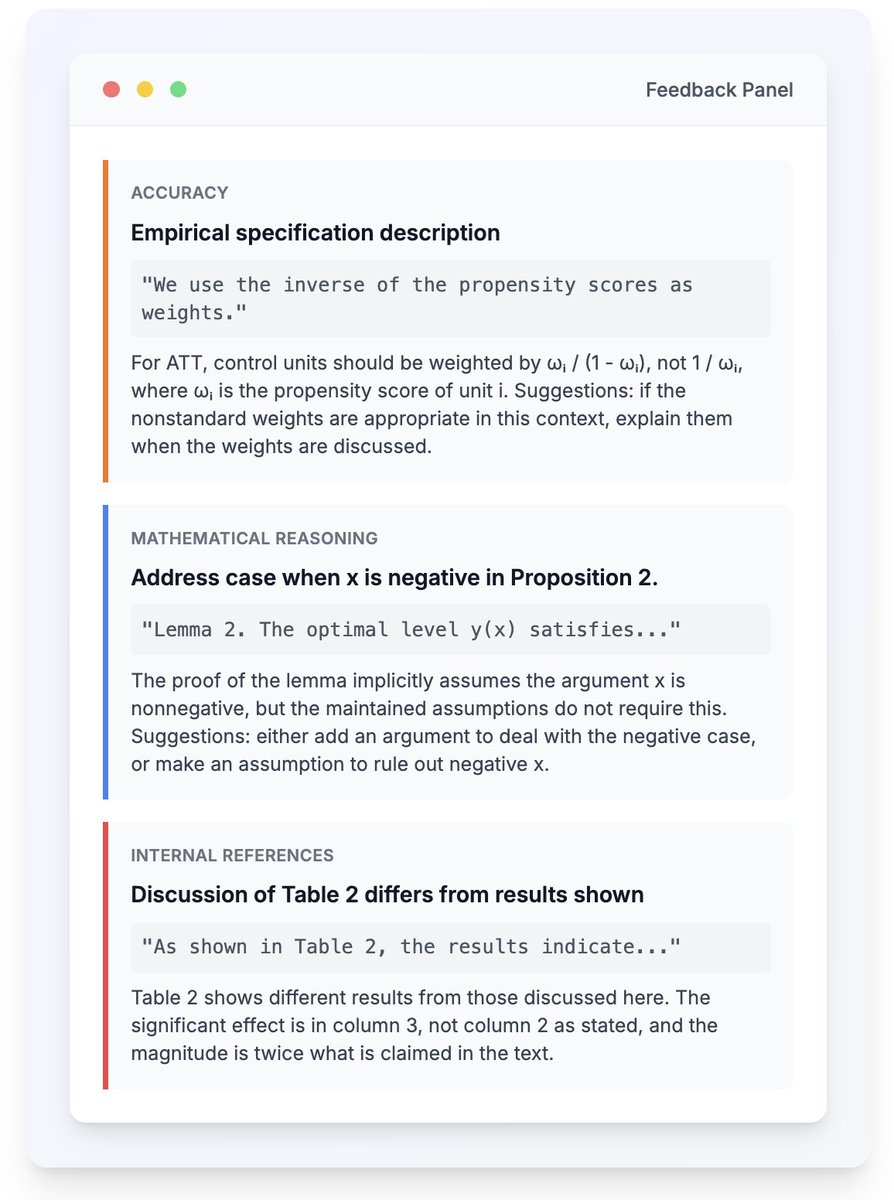
I am super excited to share a new AI tool, Refine.
Refine thoroughly studies research papers like a referee and finds issues with correctness, clarity, and consistency.
In my own papers, it regularly catches problems that my coauthors and I missed.
1/