The @qanplatform ecosystem is about to dominate the layer 1 crypto space. This is the community led place for all things QAN, and exciting projects built on QAN
There are so many reasons to think @Qanplatform and $QANX will be the next big L1, with genuine potential to go on and be the biggest. The pieces are in place and the timing is now for the world to embrace the first blockchain truly built for mass adoption. Consider all this:
- Any language coding
- EVM compatability
- 1 click migration
- Quantum resistant using Nist recommended Algo, years ahead of everyone
- Quantum threat/narrative growing
- Huge partners (IBM, Alpine, cointelegraph, EU country…….)
- Linux membership alongside Google etc
- Huge VC investment
- Private net already in operation
- Rapid TPS from the unique hybrid blockchain
- Phase 2 of the project is a new revolutionary new consensus mechanism, POR!
- Team excellent. CTO/founder is advisor for Qatari royal family fund. #ETH board member Patrick Storchenegger is CEO of QAN ip! Rest of named team incredible
All things considered, and with the timing of the mainnet under audit at hacken since December, I don’t think there has ever been a better time in the history of crypto to invest in any token, than $QANX now!
The markets are interesting, but from here whether it’s 250x, 500x, or 1000x plus! @QANplatform will still be considered cheap! It’s the easiest investment decision you’ll ever make!
@JoeParys@elliotrades@Cointelegraph
@Ashcryptoreal
@gordongekko@coinbureau@cryptomanran@AltcoinDailyio@Sarah_GreenOk
BlackRock Quantum Whitepaper: The Threat & The Hard Truth
Key takeaways:
Quantum computers could break current encryption within years, not decades. BlackRock confirms the timeline has accelerated.
The quantum threat
Shor's Algorithm can break Elliptic Curve Cryptography (ECC), the exact math securing Bitcoin and Ethereum digital signatures. A sufficiently powerful quantum computer could derive private keys from public keys visible on-chain.
Bitcoin's vulnerability
Approximately 35% of the Bitcoin supply (~7M BTC) is currently exposed:
• 1.9M BTC in P2PK/P2TR/P2MS addresses
• 5M BTC in addresses with reused keys
This creates two distinct attack vectors:
At-Rest: CRQC (Cryptographically Relevant Quantum Computers) can steal coins from the 35% of supply even if never spent.
On-Spend: All Bitcoin addresses become vulnerable during the 10-minute mempool window of a transaction.
Quantum is advancing fast
• Google has moved its encryption migration deadline to 2029.
• IBM targets large-scale, fault-tolerant quantum systems by 2029–2033.
• Recent breakthroughs in error correction have pulled timelines forward significantly.
The migration crisis
Governments plan full migration by 2035, BlackRock notes that while technically feasible, coordination is the bottleneck. It requires multi-year timelines that legacy chains simply may not have.
Legacy chain problems
• Bitcoin: Development is relatively decentralized and there is no current consensus on PQ encryption/signature schemes, migration timelines, and the optimal specific implementation mechanisms.
• Ethereum: Requires seven upcoming network updates/hard forks (2026–2029) with massive complexity due to Proof-of-Stake and smart contracts.
• Ecosystem: Exchanges, custodians, and validators must simultaneously upgrade hardware, software, and policies.
Why QANplatform, the post-quantum blockchain wins
We built quantum-resistant cryptography as our foundation, not as a retrofit. No consensus chaos. No 35% of supply at risk. Already defended from day one.
The bottom line
BlackRock states that upgrading cryptographic systems is easier than building a quantum computer. However, they also admit migration is coordination-heavy and slow, while quantum timelines have accelerated to within years.
We don't face this dilemma. We are already secured.
Q-Day favors the future-proof.
9 minutes.
That is the estimated time a primed fast-clock quantum computer could take to solve ECDLP, the Elliptic Curve Discrete Logarithm Problem, the core mathematical problem behind the signature schemes that secure Bitcoin, Ethereum, and many other blockchains.
No buffer. No second chance.
That's fast enough to turn blockchain's security window into a race against time.
@AltcoinDaily They all had one thing in common:
They were ahead of the curve, as mentioned.
Check out @QANplatform and see what market problems they solve
@AltcoinDaily@QANplatform was early on the quantum narrative.
But is right on time with the explosion of demand as all systems need migration solutions.
Only chain that has come up with innovation.
Much more powerful than legacy chains just trying to convince holders they will upgrade
Two tech giants. One timeline: 2029.
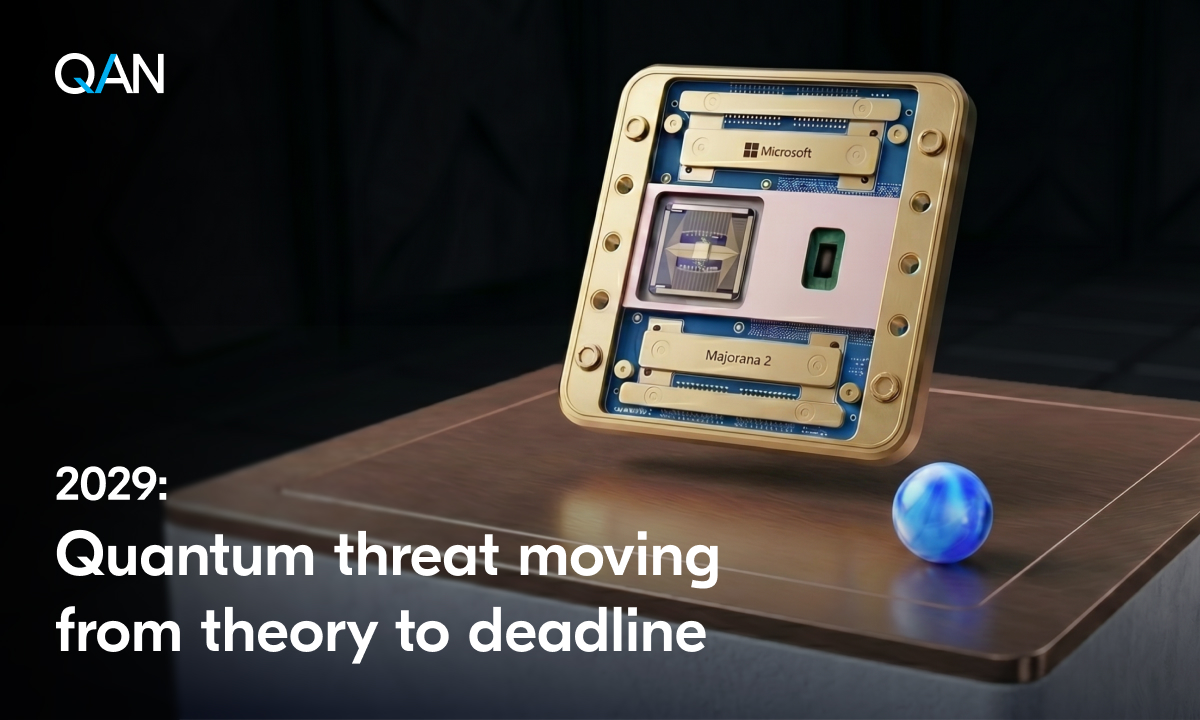
Microsoft just unveiled Majorana 2: topological qubits that last 20 seconds (vs. 1-12 milliseconds in Majorana 1).
That improvement is roughly comparable to inventing a phone battery that instead of dying in a day could last for nearly three years on a single charge.
That's a 1,000x reliability leap, built with agentic AI.
Their practical quantum computer target? 2029, the original timeline cut in half.
Google independently set the same year as its internal deadline to complete PQC migration across all systems, warning that quantum computers could break current encryption before the decade ends.
When Microsoft AND Google converge on 2029, that's not a prediction. That's a countdown.
Every blockchain still running on legacy cryptography needs to ask: are you quantum-safe?
The migration window is closing.
There are two main positions on quantum risk to blockchain infrastructure.
One of them requires believing decentralized networks can coordinate a full cryptographic migration under time pressure with no central authority and no enforcement mechanism.
The other one requires starting earlier than feels necessary.
Both positions might seem defensible. But only one survives the reality of decentralized coordination.
Position A: The threat is already active.
"Harvest-now-decrypt-later" means data collected today is already compromised. Chains not building on post-quantum primitives are accumulating debt, not buying time.
Position B: The timeline is long enough for a retrofit.
"Hard forks happen. Ecosystems upgrade." Migration can wait. It is too expensive to over-engineer for a threat years away.
Here is the friction point:
Position B requires a massive bet on coordination.
It assumes that decentralized networks, which lack central authority, enforcement mechanisms, and contain millions of independent wallets, can execute a full cryptographic migration in a compressed window under pressure.
History suggests this is the hardest thing a decentralized network can do.
The industry has mostly let Position B win by default, simply because it is the path of least resistance.
So, a direct question for the builders:
If a protocol must be secure in 2030:
Is it a viable strategy to bet the project's survival on a forced hard fork that requires 100% of the community to coordinate perfectly at the last minute?
Or is the only safe path to build on infrastructure where quantum resistance is native, not retrofitted?
@yourcryptodj Not a single one mate. $QANX has more potential than any meme coin and almost none of the risk. With @QANplatform mainnet due this year $QANX is the best investment of the decade!
Ethereum’s strength comes from decentralization, long-term vision, and institutional-grade infrastructure.
qanplatform:native is building in the same direction, but with quantum resistance and enterprise-ready architecture from day one.
If ethereum:native is the current standard, @QANplatform is positioning for the next era of secure, scalable finance.
A 30-year tokenized bond issued today will still be on-chain in 2056.
The cryptography securing it has to survive the whole ride.
The tokenized real-world asset market crossed $29 billion in Q1 2026. It grew about 30% per that quarter.
Almost no mainstream RWA coverage connects those numbers to quantum risk yet. 🧵
The building blocks are coming together for the @QANplatform ecosystem! Keep an eye on $QANX over the next few months.
The Builder Liquidity Flywheel https://t.co/lVFj07570b
@coinbureau@MartiniGuyYT
He built a legal practice on one promise: that anchoring agreements to a blockchain made them the most cryptographically verifiable contracts ever written.
He was right. Until it turned out the math underneath them had an expiration date.
It is a Friday afternoon in 2028.
Daniel is a law firm partner. Between 2020 and 2023 he built an entire practice around anchoring legal agreements to public blockchains. Immutable. Timestamped. Cryptographically verifiable. He gave talks. He wrote papers. He brought in fourteen enterprise clients.
He is staring at an email from the firm's new cryptographic security consultant.
The summary is this:
Nearly every agreement anchored on-chain during those years was signed with ECDSA. The public keys are permanently recorded on the ledger. And in a post-quantum world, where quantum computers can break elliptic curve math, a sophisticated adversary could forge a signature mathematically indistinguishable from the original. Not altering the document, but destroying the ability to prove beyond doubt who signed it.
Daniel's entire practice was built on one promise.
We can prove who signed what, and when, beyond any reasonable doubt.
He reads the consultant's recommendation.
"Review evidentiary reliance on pre-2024 on-chain signatures before introducing them in any proceedings."
He picks up the phone to call the first client on the list.
He puts it back down.
He picks it up again.
@cokiramirez $QANX had $20bn plus potential. Its currently sat around $20m! Easiest 1000x you will ever see with @QANplatform quantum resistant mainnet due this year!
Most ecosystems wait for activity before building the rails.
We’re doing the opposite.
Introducing Qanforge, the launch layer & full-stack toolkit being built to help power the next phase of growth on @QANplatform
Infra first.
Builders first.
The rails are being laid.