Assembly instructions for a coin. No tools, no code.
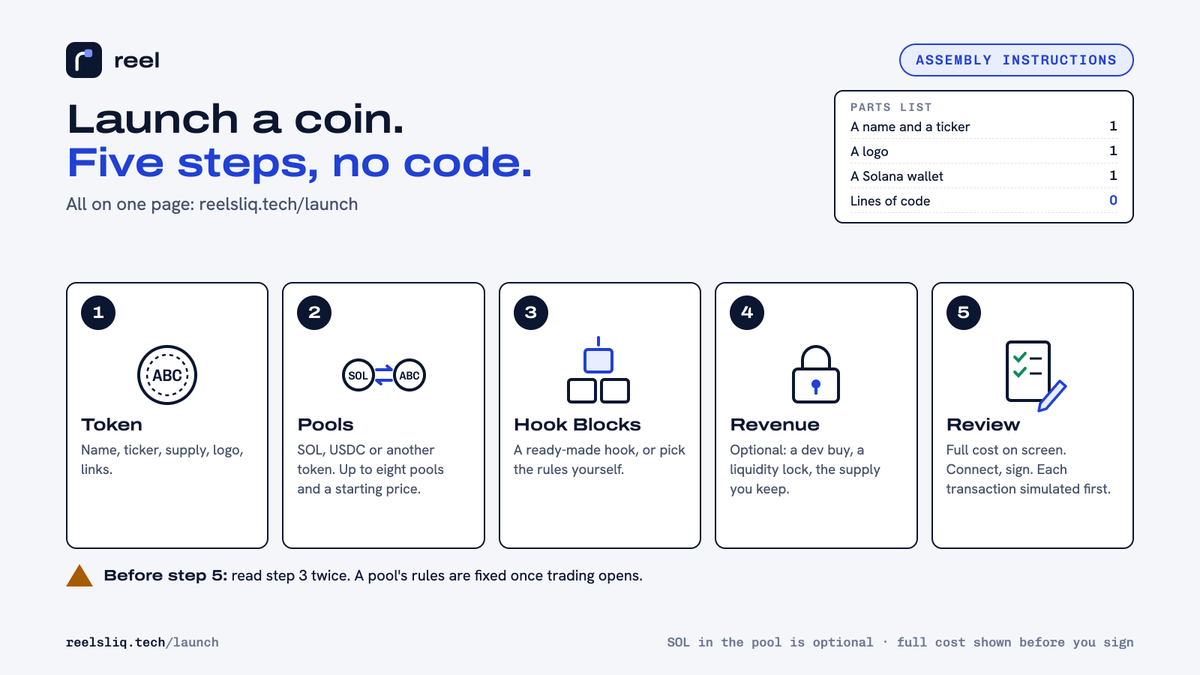
People keep asking where you launch a coin on reel and how. It's one page, https://t.co/edrlN3bsBx, and five steps:
1. Token. Name your coin, pick a ticker and a supply, add a logo and your links.
2. Pools. Choose what it trades against: SOL, USDC or another token. Open up to eight pools and set the starting price. SOL in the pool is optional; a coin can open with only its own tokens.
3. Hook Blocks. These are the rules your market runs on every trade. Start from a ready-made hook, or pick your own: anti-snipe, wallet cap, LP rewards, burn and more.
4. Revenue. All optional: a dev buy, a liquidity lock, and how much of the supply you keep.
5. Review. Every choice and the full cost on one screen. Connect your wallet and sign. Each transaction is simulated before you sign it.
One warning from the manual: read step 3 twice. Once trading opens, a pool's rules are fixed. Nobody can change them later, not you and not reel.
Your draft saves as you go, so you can stop at any step and come back.
Already have a token? Open the Existing token tab on the same page and give it a reel pool.
Start here: https://t.co/edrlN3bsBx
New to on-chain markets? reel wrote a six-lesson course. Free, no sign-up, and each lesson is a short read.
https://t.co/YxFassMbhu has six explainers, written from reel's program spec, in this order:
Lesson 1 · What is an AMM?
An order book waits for a seller at your price. A pool doesn't: it prices every swap from the two balances it holds (x · y = k), so the price moves as you trade. The worked example: a 1 SOL buy into a pool holding 100 SOL moves the price about 2%. The same buy in a pool ten times deeper moves it about a tenth as much.
Lesson 2 · What is a liquidity provider?
You deposit both tokens and get shares in a position account. Fees are kept outside the reserves and collected whenever you like. Then the part most people skip: divergence loss, with a table of how big it gets.
Lesson 3 · What are Hook Blocks?
How reel does on Solana what Uniswap v4 hooks do on Ethereum. Why the blocks live inside the pool program, and why a token's own transfer hook can't charge a tax, so every fee runs in the pool, where the money is.
Lesson 4 · What is a bonding curve?
Pricing tied to how much has sold, what changes when a curve graduates to a pool, and why a reel launch skips the curve and opens its pools directly, with one set of rules from the first trade.
Lesson 5 · What is a token launchpad?
What a launchpad standardises, why the first minutes matter most (bots buy in the first slot), and how a reel launch makes every rule readable: fixed supply, no freeze authority, a name that can't change, frozen pool settings.
Lesson 6 · Reading on-chain markets
The final exam. Fix a token's identity by its mint address, never its ticker. Read what the token and the pool are allowed to do. Size your trade against real depth. Trust settled transactions over dashboards, ours included.
Every lesson ends with links into reel's docs, and sample numbers are marked as samples.
Start at lesson 1: https://t.co/YxFassMbhu
Build on reel's data without asking us for anything. No key, no sign-up, no account.
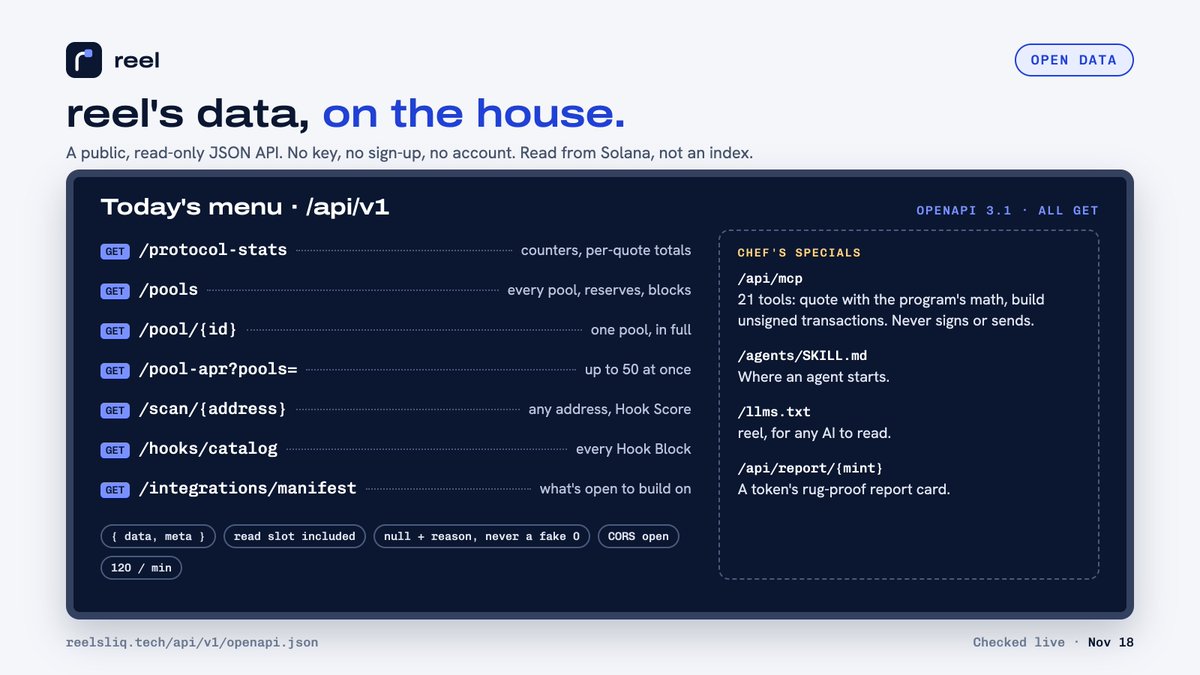
reel has a public, read-only JSON API, described in an OpenAPI 3.1 file at https://t.co/M9FRubfWA9. Everything it returns is read from Solana mainnet or from the Hook Blocks catalog. Nothing is indexed off chain.
The endpoints, all GET:
• /api/v1/protocol-stats: reel's on-chain counters, per-quote totals across every pool (volume, LP fees, the protocol's cut, real liquidity), and each program's deployment and upgrade authority.
• /api/v1/pools: every pool, with its pair, reserves, virtual quote, volume, trades, fees and Hook Blocks.
• /api/v1/pool/{id}: one pool in full, including its settings, fee buckets, LP stream, King of the Pool state and what's frozen.
• /api/v1/pool-apr?pools=a,b,c: APR for up to 50 pools in one call, with the method spelled out.
• /api/v1/scan/{address}: what any Solana address is, with a Hook Score for tokens, pools and programs.
• /api/v1/hooks/catalog: every Hook Block, its category, status and settings.
• /api/v1/integrations/manifest: what's open to builders today, in one file.
The rules it plays by:
• One shape: { data, meta } on success, { error: { code, message }, meta } on failure. Error codes never change meaning.
• Responses carry the Solana slot they were read at.
• A figure that didn't read comes back as null with a reason, never a made-up zero. Ask for the APR of a pool opened today and you get "The pool is under a day old" instead of a number.
• Amounts stay in each token's smallest units, and different quote tokens are never added together.
• CORS is open, so it works straight from a browser. The limit is 120 requests a minute per client.
Need more than reading? The MCP server at https://t.co/oD729YCOs4 has 21 tools to quote with the program's own math and build unsigned swap, launch, claim and agent transactions. It never signs or sends anything. Agents can start from https://t.co/pkRAA1FEL1, and any AI can read https://t.co/tKjjTvpq5M.
Rug-proof report cards have their own endpoint too: /api/report/{mint}.
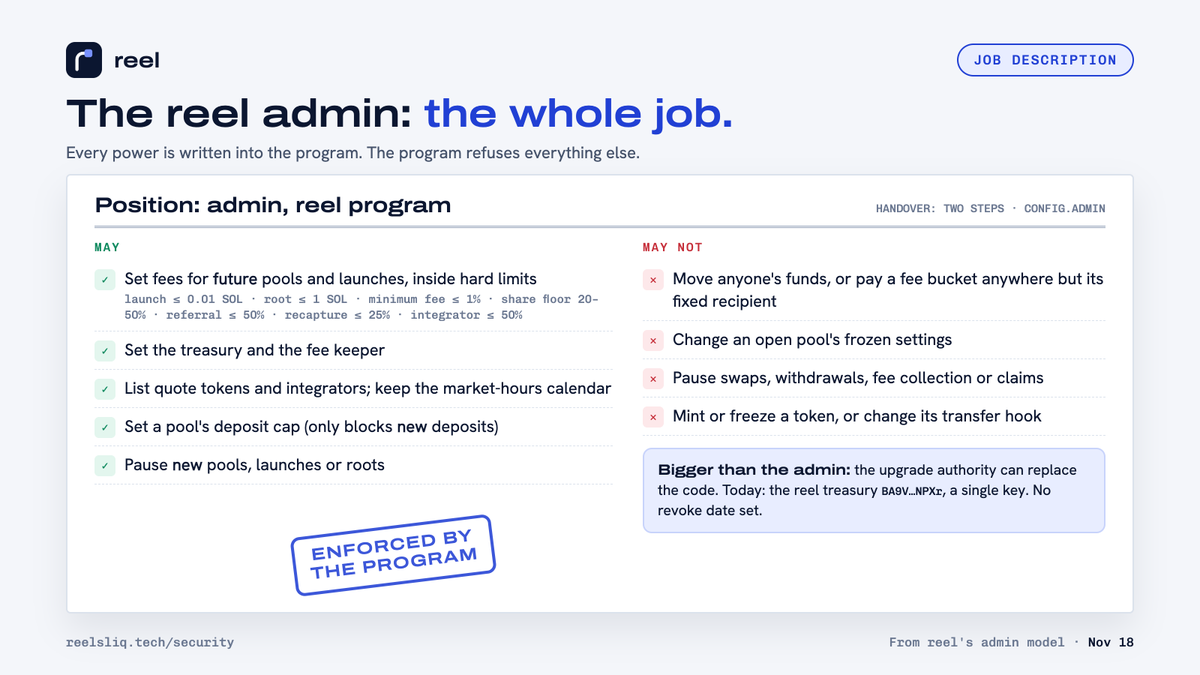
Job description: the reel admin. Every power it has is written into the program, and the program refuses everything else.
reel's program has one admin account, which can only change hands in two steps. Here's the whole job.
THE ADMIN CAN:
• Set the treasury and the fee keeper.
• Set fees for future pools and launches, inside hard limits: launch fee at most 0.01 SOL, root fee at most 1 SOL, minimum fee at most 1%, the protocol's share floor between 20% and 50%, referral at most 50%, the protocol's part of recapture at most 25%, integrator share at most 50%.
• List quote tokens and integrators.
• Keep the market-hours calendar and admit market blocks.
• Set a pool's deposit cap, which only blocks new deposits.
• Pause new pools, new launches or new roots.
THE ADMIN CANNOT:
• Move anyone's funds, or pay any fee bucket anywhere but its fixed recipient.
• Change an open pool's settings. Its Hook Blocks and fees were frozen when it opened.
• Pause swaps, withdrawals, fee collection or claims. You can always trade, leave and collect.
• Mint a token, freeze one, or change a token's transfer hook.
Two more powers people ask about.
The fee keeper. It can move a pool's Managed fee, but only inside the cap that pool froze at launch. It also records and drips Fee Bridges, only to each bridge's destination pool and within that bridge's per-drip limit. If the keeper goes quiet on a bridge for 7 days, anyone can do the job under the same caps.
The upgrade authority. This is the largest power of all: whoever holds it can replace the program's code. Today it's the reel treasury, BA9VJD2ux2XtQ1diiurBR9pmgqtb33ivs6H8fmSgNPXr, a single key. It stays the largest power until it's revoked, and no date is set for that. Check who holds it on any Solana explorer, or paste the program id into Scan.
None of this is a promise from us. It's what the program accepts and refuses, and anyone can read the program.
The full admin model: https://t.co/275VWhMDGB
Every reel pool, on one map. A guide to Discover.
https://t.co/z1FYFE9FHd is Discover: every reel pool, saved hook, root and launched token, read from Solana. There's no listing form and no database behind it. If it exists on chain under reel's program, it's there.
Four tabs:
• Pools: every pool with its pair, Hook Blocks, fee, liquidity, volume and total APR.
• Hooks: saved hooks (every version, decoded from chain) and roots.
• Tokens: every token launched on reel, with its type, price, FDV, pools and launch date.
• Revenue: for revenue tokens, which arrive with reel-vaults' tokenizer module. Nothing is listed yet, and the tab says so.
On Pools you can:
• Show all pools, new pools (opened in the last 7 days) or reel pools (on reel's shared root).
• Search by symbol, pair, pool address or mint.
• Sort by Moved today, Liquidity, Volume or Created, in either direction. Anything that couldn't be read sorts last both ways, so a missing figure never floats to the top.
• Filter by status: Earning (live, has trades and at least $100 of real liquidity), Empty, Pending (created, not open yet) or Aborted (the launch never went live).
• Filter by Hook Blocks: Guard (Anti-Snipe, Wallet Cap or Buy/Sell Block), Dynamic fees, Burn, LP rewards, Pot (King of the Pool) or Arb recapture.
Then switch List to Map. Quote tokens sit near the centre as hubs, base tokens sit on an outer ring, and every pool is one curved line from its token to its quote. The thicker the line, the more it has traded, all time. Tap a token and the list narrows to every pool trading it, on either side.
Two small things that matter:
• The tab, view, search and sort live in the link, so you can share a view and it reopens the same way.
• Under each list is a data coverage line: what was read, when, and what was left out. If the chain doesn't answer, Discover says "Could not read from chain" and shows nothing rather than a guess.
https://t.co/z1FYFE9FHd
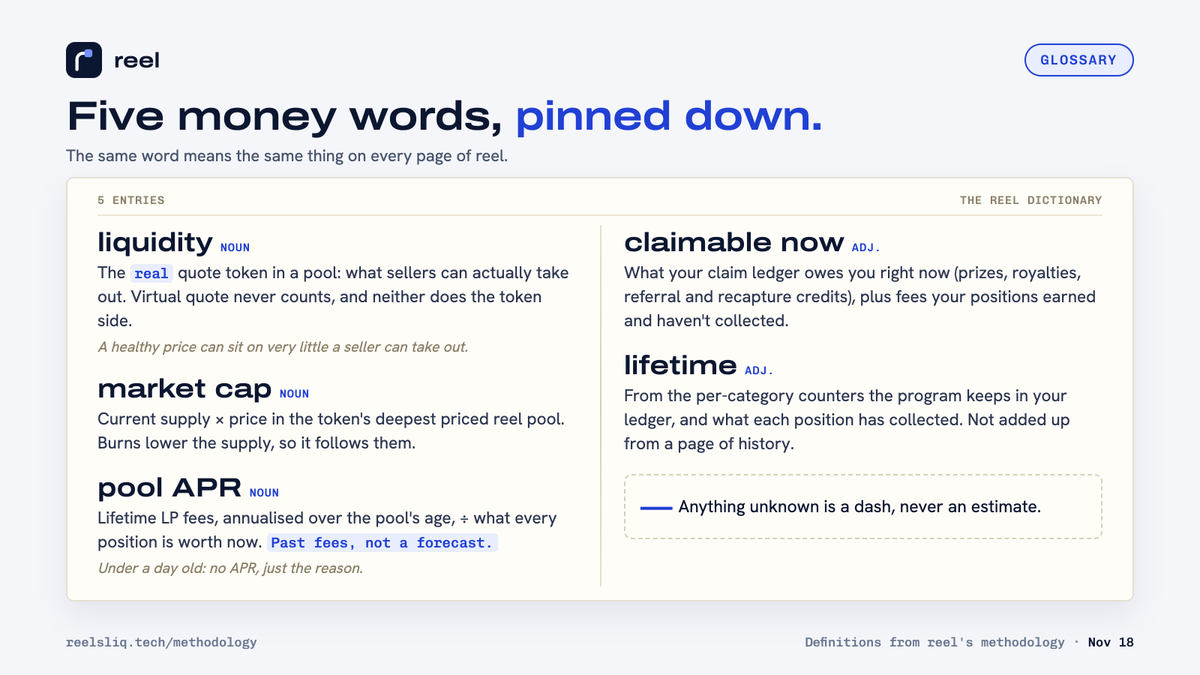
Five money words, and exactly what each one means on reel.
Dashboards use these words loosely. reel pins each one down, so the same word means the same thing on every page.
liquidity (noun)
The real quote token in a pool: what sellers can actually take out. A new token's pool can open with virtual quote, which sets the launch price but can never be withdrawn. Virtual quote never counts as liquidity, and neither does the token side. In USD, it's that real quote reserve at Jupiter's price, and "—" where Jupiter has no price.
Why it matters: a pool can show a healthy price and still hold very little that a seller can take out.
market cap (noun)
A token's current supply times its price in its deepest priced reel pool. Burns lower the supply, so the figure follows them.
pool APR (noun)
Lifetime LP fees, annualised over the pool's age, divided by what every position is worth now (real quote plus real tokens at the pool price). It's past fees, not a forecast. Auto Burn and the protocol's cut aren't LP income, so they're left out. A pool under a day old gets no APR at all, just that reason.
claimable now (adjective)
What your claim ledger owes you for a token right now (prizes, royalties, referral and recapture credits), plus fees your positions have earned and not collected. Fees a pool has earned but not yet settled to your position aren't shown as yours until the program would pay them.
lifetime (adjective)
Totals from the per-category counters the program keeps in your claim ledger, and from what each position has collected. Kept by the program itself, not added up from a page of history.
One rule covers all five: anything unknown is "—", never an estimate.
Every definition, word for word: https://t.co/EIXsVKmYj1
Paste any Solana address into reel's Scan and you get a Hook Score out of 100. Here's exactly how it's worked out, rule by rule.
Scan reads the address from chain and works out what it is. Tokens, pools and programs are scored. Wallets and token accounts are described, not scored.
A token is scored on 10 rules:
• Mint authority revoked: 20 points. A live one can print new supply.
• No permanent delegate: 20. One can move or burn anyone's tokens.
• No freeze authority: 15. One can stop any holder's tokens from moving.
• Transfers can't be paused: 10.
• No unknown transfer hook: 10.
• No transfer fee: 10.
• New accounts start usable: 5.
• Name and link are fixed: 5.
• Balances aren't rescaled for display: 5.
• Tokens can be transferred at all: 0 points, but failing it caps the score at 9. A token that can't move can never be sold.
A program is scored on 5:
• Code can't be replaced: 40.
• No single key can upgrade it: 15.
• Not deployed in the last two weeks: 15.
• Build verified against public source: 20. Scan can't check this yet, so it earns nothing and shows as lower coverage.
• A known program: 10.
A reel pool is scored on its terms (settings frozen, a swap paying at most 10%, sells at most 5%, no fragile price reference, launch liquidity locked, the program's upgrade key) plus six checks on its two tokens.
How the points add up:
• A pass earns full points, a "review" half, a fail none.
• A rule that couldn't be read earns nothing and lowers the coverage figure. It's never counted as a pass.
• Some fails cap the whole score however well the rest does. A permanent delegate, a pausable mint or accounts that start frozen cap it at 39. An upgradeable program can't go above 74.
• Bands: Strong 85+, Good 75–84, Needs review 60–74, High attention 40–59, Critical gaps under 40.
Every rule shows its points, what it checks and the evidence it read. No hidden weights.
Read live on Nov 18: the REEL token scores 97 out of 100, Strong, with 100% coverage.
And we don't grade ourselves on a curve. reel's own program fails both upgrade rules today, because its upgrade authority is a single wallet key, the reel treasury. Scan says so on reel's own site.
It's automated screening, not an audit: https://t.co/bTasS74GMy
A swap on reel, frame by frame.
You press Swap and it lands as one transaction. Inside it, the reel program runs the same eight steps in the same order on every pool. Each Hook Block only takes part where the pool switched it on when it opened.
Frame 1 · Check
The accounts are the right ones, the pool is live, and the program reads the clock.
Frame 2 · Catch up with time
Anything that moves with the clock is brought up to date: streamed LP income is released, the Dynamic fees reference steps, the Storm Fee sample rolls, and an expired managed fee lapses.
Frame 3 · The gates
The swap is refused here if buys are still paused, sells are locked, an exact-out buy arrives during the launch guard, the agent gate says no, or Market Guard's price feed is stale. A refused swap moves nothing.
Frame 4 · Price it
The curve prices the trade, and every charge is worked out on the gross amount. Fees round up and curve outputs round down, so the trader pays the last unit of dust, never the pool.
Frame 5 · Recapture
If the pool runs arb recapture and its reference price is fresh, a swap that closes a gap with other markets pays part of that profit.
Frame 6 · Settle and keep the books
The amounts and the Auto Burn share are settled. Then the bookkeeping: Wallet Cap tallies, the King of the Pool podium, the gap opener, the sandwich window and the pool's counters.
Frame 7 · Move the tokens
Your tokens go in, then the pool's go out, signed by VAULT_AUTH (the one program address that owns every reel vault). Then the burn, the claim-ledger credits and any reward mint.
Frame 8 · Prove it
The program checks that every vault still covers everything the pool owes. If it doesn't, the whole transaction fails and nothing moves.
Why a fixed order matters: a pool's settings are frozen when it opens and the steps never change, so what a swap will pay can be worked out from the pool's settings before you send it. The app quotes it with the same math and simulates it before your wallet opens.
Why it's all inside one program: on Solana, a pool can't call out to a separate hook contract that then calls the pool back. So reel runs the whole pipeline inside its own pool program.
How each block fits in: https://t.co/97OGPv0gYC
Everything you have on reel, on one page: https://t.co/BBgt1eZyBv
Connect a wallet and Portfolio reads everything reel's programs hold for it, straight from Solana. Connecting signs nothing.
Up top, three figures:
• Claimable now: what your claim ledgers owe you, plus fees your positions have earned and not collected, plus pool buckets you're the fixed recipient of.
• Income 7d: credits to your claims and fees you collected over the last 7 days, from transaction logs.
• Next unlock: the soonest lock to end across your positions and launches.
Below that, Holdings: your liquidity positions, claim ledgers and launches in one table. Value is both sides at the pool price. "To claim" is what Collect or Claim pays right now. "Collected" is the lifetime counter on chain.
Then six tabs:
1. Positions. Your liquidity, positions someone has named you to receive, and your launches. Filter open or closed, sort by value or newest. A launch owner can hand a launch over (and cancel before it's accepted), or put it under a launch lock with a beneficiary.
2. Add liquidity. Paste any reel pool's address, or pick one you already hold, and deposit with the same form as the pool page.
3. Returns. Each position's deposits, withdrawals and fee collections, from its own transaction logs, against what it holds and is owed now. Both sides are valued at today's pool price, so it's a gain or loss in the quote token, not a dollar P&L at entry prices.
4. Crowns and claims. Prizes and arb shares credited to you (exact lifetime counters), what each ledger owes you with a Claim button, the buckets you can Collect, and Holder Pot earnings on reel-hooked tokens.
5. Orders. Your limit orders and Floor bids across every pool. Cancel returns the escrow, the bounty and both rents.
6. Rewards. Your ref code (register once, it's permanent), the wallets linked to it and what they earned you, your own link to someone's code (one per wallet, for 365 days), and your agent record.
Your plain token balances sit underneath.
One more thing: Portfolio works for any wallet, read-only. Add ?address= and a Solana address to the link and you'll see that wallet's positions, claims and returns, marked "Viewing, read-only", with every action button hidden. Useful for looking up a creator before you buy, or checking a cold wallet without connecting it.
It isn't a full net worth, and it doesn't pretend to be. It's what reel's programs know about a wallet, read live.
Before you add liquidity to any pool, on reel or anywhere else, learn this one table.
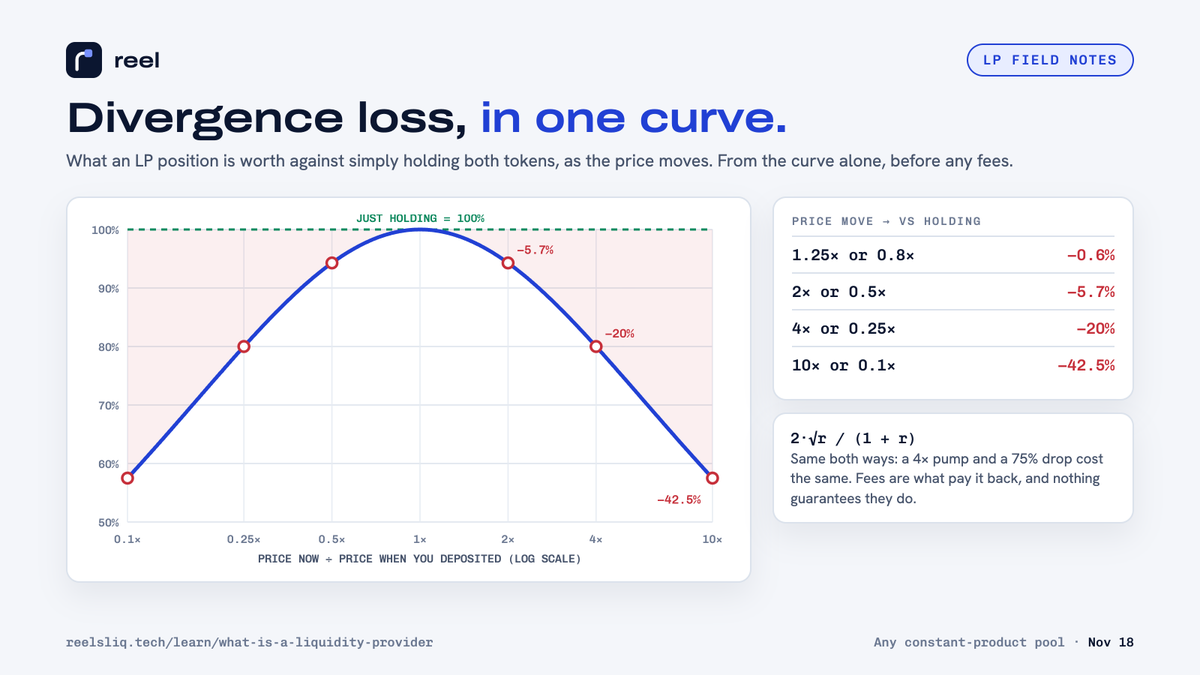
When the price moves, a constant-product pool sells the token that's rising and buys the one that's falling. So an LP ends up holding more of whichever token went down. Compared with simply holding the two tokens, the position is worth less. That gap is divergence loss, often called impermanent loss because it closes if the price comes back.
How big it gets, from the curve alone:
Price change since you deposited → position vs just holding
1.25× or 0.8× → about 0.6% lower
2× or 0.5× → about 5.7% lower
4× or 0.25× → about 20% lower
10× or 0.1× → about 42.5% lower
The formula is 2·√r / (1 + r) for a price ratio r. It cuts both ways: a 4× pump and a 75% drop cost an LP the same 20% against holding.
Fees are what pay you back. Whether they cover it depends on the pool's volume, its fees and how far the price moves. Nothing guarantees they will.
What a reel pool can do about it:
• The base LP fee (0.3% by default) goes 100% to the pool's LPs. reel takes none of it.
• Dynamic fees and Storm Fee raise the fee when the price moves fast, so LPs are paid more exactly when divergence risk is highest. (A creator can point Storm Fee at themselves instead, and the pool page shows which.)
• Anti-Snipe's early-buy tax and LP Rewards go to LPs, after the protocol's share.
• Where a pool runs arb recapture, the swap that closes a gap with other markets pays part of that profit, and the LPs' part streams to them.
• Those streams pay out evenly over time, so liquidity that shows up for one block just before a big payment earns almost nothing from it.
And the honest part: reel pools are full range. Your position covers every price and never falls out of range, but for the same deposit there's less depth near the price than on a well-managed concentrated pool.
Read a pool's Hook Blocks before you deposit. They're frozen when the pool opens and never change.
The full explainer: https://t.co/zHwGxgdHT6
On reel, a figure that couldn't be read shows as "—". Never as 0.
Zero is a claim. "0 SOL of liquidity" says the pool is empty. "—" says the figure didn't read this time, and usually says why, like "RPC did not answer". Mixing the two up is how dashboards end up wrong without anyone meaning it.
So every figure on https://t.co/pVSDvtvQaf comes from one order of authority:
1. Program accounts, read straight from Solana: pools, positions, launches, claim ledgers and the global config. This is the state the program enforces.
2. Settled transaction logs. Every swap, liquidity change, fee collection and payout emits an event. History, charts and activity lists are built from those.
3. Outside data, like a USD price, only where the chain has no answer. It's labelled with its source and never overrides program state.
Running totals (pools, launches, volume, fees per block, burns, prizes) come from counters the program keeps in its own accounts, not from adding up a page of results.
What "fail closed" means in practice:
• A value that didn't read shows "—", with the reason when there is one.
• A button that depends on that value stays disabled. You can't trade on a quote the app couldn't work out.
• A list read in part is labelled partial, and a count from it is a floor, not a total.
• SOL and USDC amounts are never added together unless a labelled price converts them.
A live example from reel's public API today: unique traders. The answer is null, with the reason "Unique traders are not counted: reel keeps no index, and pool counters record trades, not wallets." We'd rather leave the box empty than fill it with a guess.
Freshness works the same way. Live figures are read again on a timer while the page is open and visible, and stop while the tab is hidden. Nothing cached is ever used to build a transaction.
And a transaction is named by its real state: preparing, waiting for your approval, sent, confirmed. Approving in your wallet isn't a receipt. The explorer link is.
If the app and the chain ever disagree, the chain is right.
The full rules: https://t.co/EIXsVKmYj1
The time lock on day one.
Every new pool on reel can open with a launch guard: a window from 12 seconds to about 14 days, picked by the creator and frozen at launch. While it runs, some doors stay shut, even for the creator:
1. The launch liquidity can't be pulled. The launch position's principal stays locked for the whole guard.
2. Only the launch position adds liquidity. Nobody else can add until the guard ends.
3. Exact-out buys are refused. During the guard a buy says what it spends, not how many tokens it takes.
4. With Anti-Snipe on, guarded buys also pay the Snipe tax, under a per-slot buy cap for the whole launch.
No Anti-Snipe? The guard still locks the launch principal and refuses exact-out buys. It just charges no tax.
Want the liquidity locked for longer than the guard? Add a liquidity lock at launch, for a set date or for good. The report card on every token page shows which one a coin chose.
The first hours of a coin are when people get hurt. reel puts a time lock on them.
https://t.co/edrlN3bsBx
Open house: a tour of a reel pool.
Every reel pool has its own page, and it has nine rooms. Here's the floor plan:
• Trade: the swap, with a price chart.
• Analytics: lifetime volume and trades by side, fees by block, LP fees next to reel's cut, burns, recaptures and King of the Pool, all from the pool's own on-chain counters.
• Pool Map: where a swap's charges go on this exact pool. One line leaves the swap and splits into a line per destination, as thick as its share. Flip between a buy and a sell.
• Liquidity: add to the pool or manage your position.
• Orders: limit orders on this pool.
• Reserve: the pool's recovery reserve.
• Hook Blocks: the rules it opened with, and what each one is doing right now.
• Activity: every reel event in its transactions, newest first. Filter by buys, sells, block effects or liquidity.
• Details: the pool's terms and caps, reserves, timers, and every account it names.
Nothing in the house is staged. Every room is read from Solana, so what you see is what the pool actually does.
Pick a pool and walk in: https://t.co/z1FYFE97RF
The exchange board: what can your coin trade against on reel?
Every reel pool pairs your coin with a quote, the token people pay with. One launch can open up to eight pools, each on its own quote. When you press "+ Add pool" on the launch page, reel offers:
• SOL first, then USDC, then USDT.
• Any quote listed on chain with reel's program.
• Or paste any token's address. The launch page tells you straight away whether reel accepts it, and whether a deposit cap applies to that pool.
House rules at the counter:
• One quote per pool. Pool 2 can't repeat pool 1's quote.
• No mirrors. A pool can't quote the token it trades.
• No reel-launched quotes. A token carrying reel's transfer hook trades as the coin, never as the quote.
• Never mixed. reel keeps each quote's numbers apart, so volume, fees and prizes in SOL are never added to the ones in USDC to make a bigger number.
Why open more than one? People can buy your coin with what they already hold, and every pool's rules are frozen the moment it opens.
Open your pools: https://t.co/edrlN3bsBx
What goes with what: the Hook Block pairing guide.
Hook Blocks stack, but not every which way. reel's program checks these pairings when a pool opens, and the builder checks them as you go, so a bad combo never reaches your wallet.
Always served with a partner:
• Creator royalty needs LP Rewards. The royalty is a share of LP Rewards.
• King of the Pool needs Arb recapture, plus LP Rewards or Auto Burn. Without one of those, every prize is capped at 0.
• Holder Pot needs Sandwich Guard, and runs only on a new reel token.
Never on the same plate:
• Dynamic fees and Storm Fee. Both move the fee with the market; a pool gets one way, not two.
• Zap Relay target with Dev buy or Arb recapture. A relay target is a pool only zap vaults may buy.
One per table:
• Every pool has a single add-on slot, so pick one of Market Guard, Agent gate, Market-hours fee, Managed fee, Usage fee or Swap Reward Mint.
It's like a recipe that won't let you add salt twice. Mix your own: https://t.co/CmghwLAYxf
Three slopes for a Snipe tax.
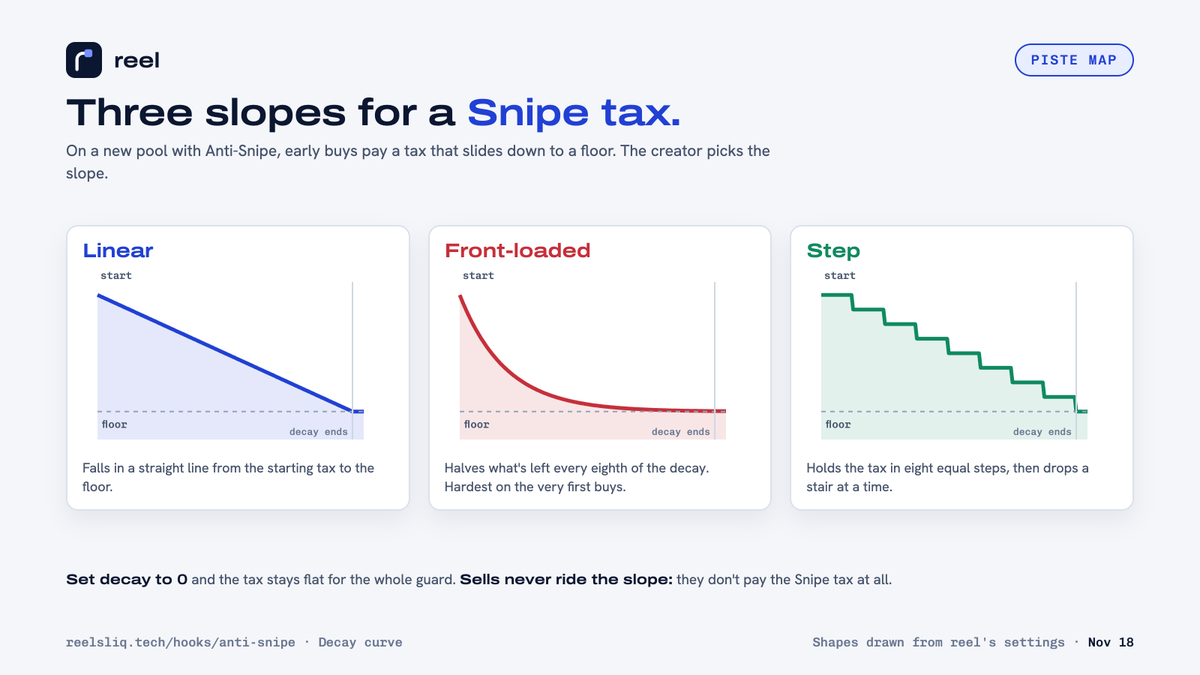
When a new coin opens on reel with Anti-Snipe, early buys pay an extra tax that slides down to a floor while the launch guard runs. The creator picks the shape of the slope at launch:
• Linear: the tax falls in a straight line from where it starts to the floor. Predictable, the same drop every second.
• Front-loaded: it halves what's left every eighth of the decay time. Brutal for the bot that buys in the first instant, then it gets out of the way fast for everyone else.
• Step: the tax holds still in eight equal steps and drops one stair at a time, each at a set point in the decay.
Two more settings shape the run:
• The floor: where the tax settles for the rest of the guard.
• The decay time: how long the slide takes. Set it to 0 and the tax stays flat for the whole guard.
And sells never ride the slope. They don't pay the Snipe tax at all.
Whatever the shape, it's frozen when the pool opens, and the tax goes to the pool's liquidity providers.
Pick your slope: https://t.co/edrlN3bsBx
Who sits where when a swap pays.
Every fee a reel pool charges has a seat at a table, and the Hook Blocks a creator picks decide which tables get served. The seating chart:
• LPs in range: the liquidity providers whose liquidity filled the trade. Fed by LP Rewards and the Snipe tax, among others.
• Burn: tokens burned in the same swap, by Auto Burn.
• The king's pot: prizes for each round's biggest buys, by King of the Pool.
• You, the creator: Creator royalty, and Swap Cut for the pool's liquidity owner.
• Holders: the Holder Pot, paid by tokens times time held.
• Traders: the trader whose swap opened a price gap, from Arb recapture (partly running today).
• Block builders: the builders and backers of an add-on block, through its Usage fee.
• reel: a 20% to 50% share of each block's fee, picked at launch, plus what Sandwich Guard catches.
The plan is set when the pool opens and frozen after, so nobody moves the place cards later.
Want to see the seating before you launch? The builder shows what a swap pays and where every fee goes: https://t.co/CmghwLBwmN
The reel yearbook.
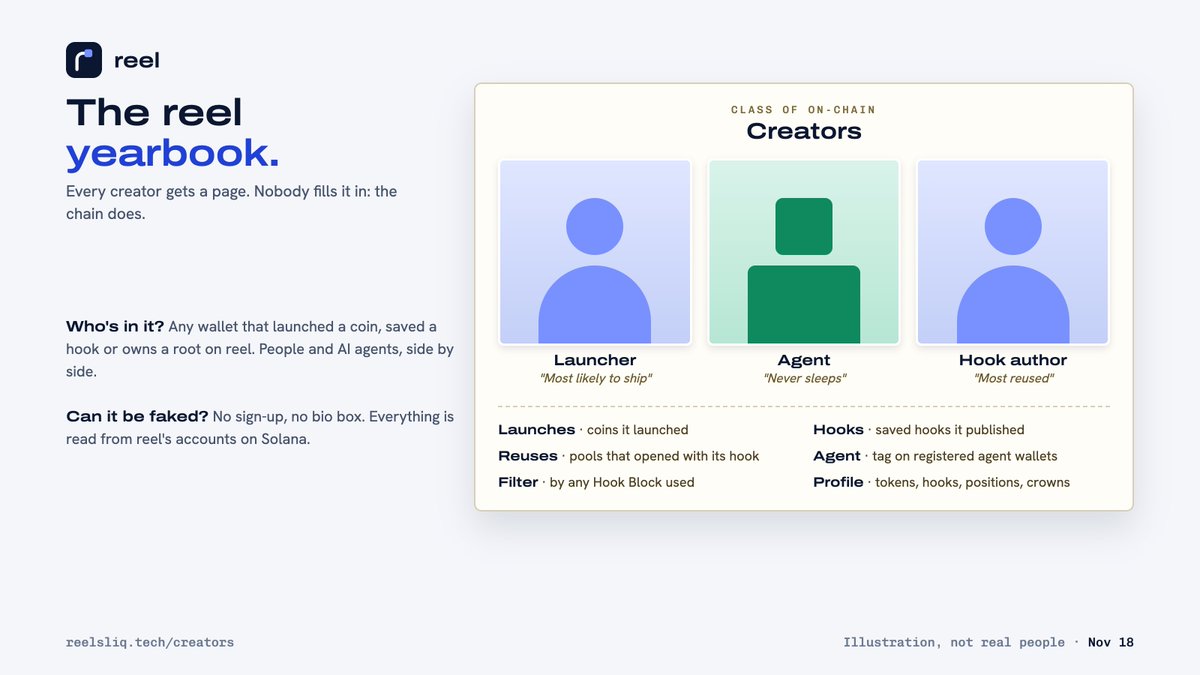
Every creator on reel gets a page, and nobody fills it in by hand. The chain does.
Who's in it: any wallet that launched a coin, saved a hook or owns a root on reel. People and AI agents sit side by side, and registered agent wallets get an Agent tag.
What each entry shows:
• Launches: the coins it launched on reel.
• Hooks: the saved hooks it published for others to use.
• Reuses: how many pools opened with its saved hook, its own included. The closest thing reel has to "most popular".
You can filter the whole class by any Hook Block, so you can find every creator who used, say, Anti-Snipe or King of the Pool.
Click any creator for their profile page: the tokens they launched, the hooks they published, the positions they hold and the crowns they've won.
Can it be faked? There's no sign-up and no bio box to type into. Everything on it is public, read-only and read straight from reel's accounts on Solana.
Flip through: https://t.co/fizarvbg5C
High scores, for liquidity.
Every arcade has a high-score screen. reel has Top positions: every liquidity position in every reel pool, ranked by how much of its pool it holds.
What's on the board:
• Rank: the biggest share of its pool comes first.
• Pool: which reel pool the position sits in.
• Owner: the wallet that holds it, or the launch's owner for a launch position.
• Pooled: what it holds, on both sides of the pair.
• Share: its slice of the pool.
• Lock: open, locked, locked for good, principal locked or launch locked.
• Age: how long it's been in.
Positions under 0.1% of a pool are left out, and you can sort by share, size or age.
Why it's worth a look before you add liquidity: you can see who's already in a pool, how big their slice is, and whether they're locked in or free to leave tomorrow.
And if you like what someone did, press Copy position. It opens Add liquidity on that same pool, so you can make your own deposit in one move.
Press start: https://t.co/Pswq5hDLk1
Every crown, on the record.
King of the Pool is a Hook Block that turns a pool into a contest: the biggest single buy in a round takes the crown, and the prize when the round closes. Rounds run from 1 hour to 30 days, lined up to UTC, and the creator picks one king or a podium (70/30 or 50/30/20) at launch.
https://t.co/Eje526jqLy keeps the royal ledger, read from every settle transaction on Solana:
• Live rounds: who leads, the leading buy, the pot and the prize, with the soonest close first.
• Crown changes: every time a bigger buy takes the lead.
• Past rounds, newest first: the king, the prize, 2nd and 3rd, and what went back to the pool's LPs.
• Titles: most crowns, longest reign and biggest prize.
• Your crowns: connect a wallet to see your own wins.
One rule of the ledger: each quote token keeps its own board. A prize won in SOL and a prize won in another token are never added together into one flattering total.
Read the ledger: https://t.co/Eje526jqLy
Put a crown on your launch: https://t.co/edrlN3bsBx
Your coin's luggage tag.
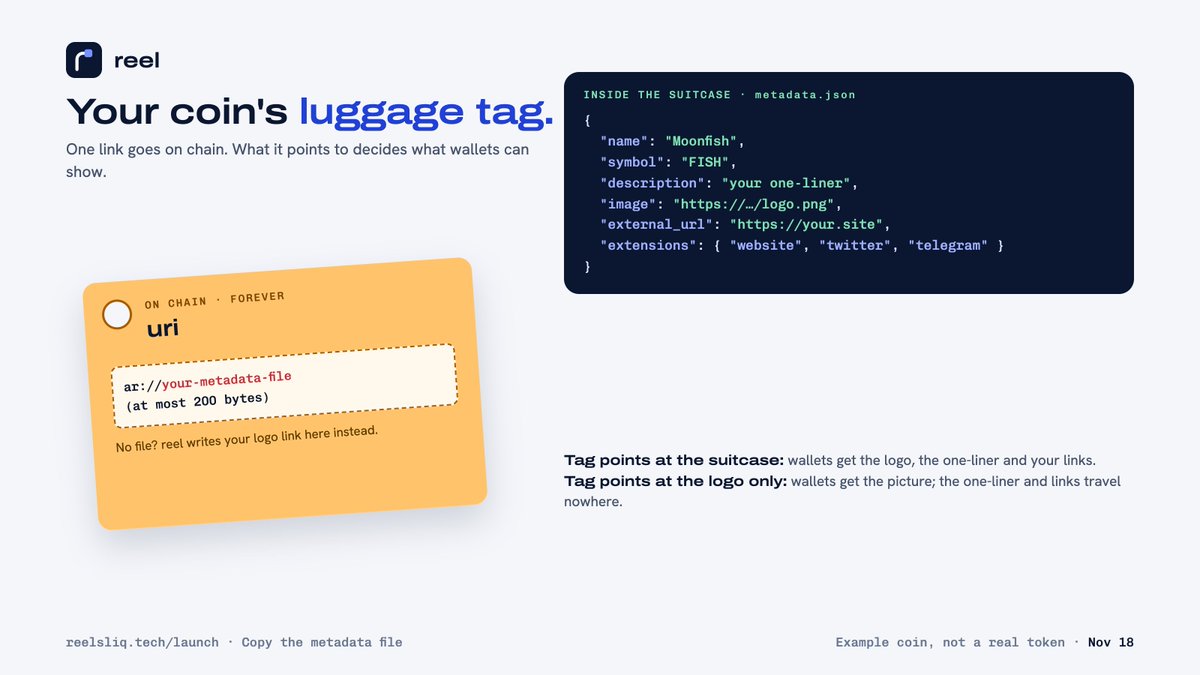
Every coin launched on reel gets exactly one link written into it on chain, called the uri. Think of it as a luggage tag: it doesn't hold your stuff, it says where your stuff is. And like the name and ticker, it's written once and never changes.
What it can point to:
• A metadata file (the suitcase). A small JSON file with your coin's name, ticker, one-liner, logo, website and socials. Wallets and explorers read it, so they can show all of that.
• Just your logo. If you don't give a metadata file, reel writes your logo link as the uri. Wallets get the picture, but your one-liner and links travel nowhere.
How to pack the suitcase: on the launch page, press "Copy the metadata file". reel builds the JSON from what you typed. Host it somewhere permanent, then paste its link in "Metadata file link" (under More options). The link can be https://, ipfs:// or ar://, up to 200 bytes.
Pack before you fly. Once the coin is launched, the tag can't be swapped.
https://t.co/edrlN3bsBx