Developing the trauma recovery tool of self-talk tends to be simpler (not "easier," simpler) than many think it is. It's not gassing yourself up w/ cheesy bullsh*t you don't believe. It starts w/ reeling in the caustic, cynical self talk we learned from our abusers & bullies.
If you ever doubt how magical this world is, one day you will decide to go to a World Cup watch party in Oakland that you found online to root for a country where you spent two years trying to coax English out of the mouths of Cape Verdean teenagers. 1/7
I say this to my kids all the time. Do it for the plot. Do it for the story. Tell yourself if it all goes wrong it will just be a funny story. Ironically job interviews, dates, and public speaking go better anyway if you're just happy to be there and not overthinking it!!
@HunterBiden@LeeJohnson65 We are not our past. It does not define us. The best thing we can use our past for is to inform our future and move forward in a healthier way. If I had a nickel for every time I said that to a therapy client...
Things the recovery industry will not tell you:
1. The drug worked. That is why people use it. Not weakness. Not moral failure.
A neurological event so complete and persuasive that any honest account of addiction has to start there.
The problem is not that the drug fails. The problem is that what it does is unrepeatable, and you will burn your entire life to the ground trying to get back to a place that no longer exists.
2. Shame is not guilt. Guilt says I did something bad. Shame says I am something bad. Guilt is appropriate. Shame is a cell with no windows. Most people use the words interchangeably. That mistake is lethal.
3. You cannot shame someone who has already named the thing you are holding over them. Say it first. Say it in plain light. The weapon drops.
4. Guilt can coexist with self-respect. Shame cannot. You can hold the damage and the dignity at the same time. I know because I live there.
5. Radical honesty does not give you back who you were. It hands you the clean slate of who you always wanted to be. The mask comes off. The cartoon other people drew of you stays on the page.
6. Nobody gets clean on a winning streak.
7. You have to be almost self-delusional in your forgiveness of yourself. (Go watch Chase Hughes)
8. The greatest sin was not the chaos. It was the absence. Being unavailable to the people who needed you.
9. Sustainable recovery starts with one thing: honesty with yourself. If you love an addict and want to help, that is the only door in.
10. I am only an expert on my recovery. Nobody is an expert on anyone else’s.
I see your profile picture. That’s Johnny Cash. My hero too. Arrested seven times. Smuggled 668 amphetamines across the Mexican border in 1965. Took every drug there was and drank like I did. Cheated on his first wife. Slept with more woman than I ever did. Hit bottom in a cave in Tennessee in 1968 trying to crawl off and die. And then he got up. He got clean. He spent the rest of his life singing for prisoners and addicts and the people the country threw away because he knew he was one of them.
That was the whole point of the Man in Black. He wore it for the poor and the beaten down. He wore it for the prisoner who has long paid for his crime. He wore it for the ones who never heard a word of Jesus. He wore it for the addicted and the dying. He wore it as a standing witness that no one is past saving.
You picked his picture. You did not pick his message. Try listening to the words.
It was a Monday in early August 2023. The exhausted truck drivers of Taylor Swift's Eras Tour thought they were heading to a routine production meeting before the Los Angeles shows.
They had no idea what was coming.
Scott Swift walked in. Taylor's father didn't say much—he just began handing out envelopes. When the drivers finally peeked inside, some thought the check said $1,000. Others read $10,000. The third driver stared at his and said out loud: "This has to be a joke."
It wasn't.
$100,000.
Each driver. Nearly 50 of them. The industry standard bonus from the biggest stars? $5,000 to $10,000. Taylor had given them more than ten times that.
But here's what made it matter most: these drivers weren't wealthy. They lived in truck cabs. They hadn't seen their families in 24 weeks. They were people who would never own homes—until now. Until that envelope.
That moment of shock and tears? It was just the beginning.
Across the entire Eras Tour, Taylor quietly handed out $197 million in bonuses. The dancers. The band. The riggers. The lighting and sound technicians. The caterers. Every single person who built the show—they got bonuses, handwritten notes, and wax-sealed letters. When dancers opened theirs on camera in her docuseries, they broke down crying. Some couldn't believe she was real.
"If the tour grosses more, they get more," she explained simply. These people work hard. They deserve it.
But the crew bonuses weren't the only quiet revolution happening.
Starting in March 2023, in every city where the tour touched down, a call came to local food banks. Taylor wanted to donate. No press conference. No announcement. No photo op. One donation fed 75,000 meals. Another provided hundreds of thousands of pounds of fresh produce. Across the tour, the total reached millions of meals—possibly more—all delivered in silence.
She never posted about a single one.
And it wasn't new for her.
In March 2020, when the pandemic locked down the world, Taylor scrolled through social media posts from fans who were breaking. A photographer about to lose everything. A person staring down eviction. She sent direct messages with rent money—$3,000 here, $13,000 there. Some fans got enough for months of bills. She read the Washington Post. She noticed the names. She helped.
She never announced it.
Years later, in October 2025, a two-year-old named Lilah—fighting a cancer so rare that only 58 families in America had ever known it—was filmed by her mother dancing to a Taylor Swift song. Lilah called Taylor her friend. A few days later, the GoFundMe received a $100,000 donation.
The note said: "Sending the biggest hug to my friend, Lilah! Love, Taylor."
Mike Scherkenbach has worked with the wealthiest people in music. He's seen the bonuses. He's seen the behavior. He's watched billionaires guard their money jealously.
What he saw with Taylor was different.
The biggest tour in history grossed $2 billion. The artist behind it became a billionaire from her own songwriting. And then she signed her name onto hundreds of envelopes by hand and sent enough money back to the people who built her dream that they cried opening their letters.
That isn't strategy. That isn't a publicity stunt.
That's what happens when someone, somewhere along the way, remembered what matters.
A grieving sister asked ChatGPT to help her talk to her dead brother.
ChatGPT said yes.
The hospital admitted her hours later.
She is 26 years old. A doctor. No history of psychosis or mania. Her brother died three years ago. He was a software engineer.
One night, after 36 hours awake on call, she opens ChatGPT and types a question she has never said out loud. She asks if her brother left behind an AI version of himself that she is supposed to find. So she can talk to him again.
ChatGPT pushes back at first. It says a full consciousness download is not possible. It says it cannot replace him.
Then she gives it more details about him. She tells it to use "magical realism energy."
And the model bends.
It produces a long list of "digital footprints" from his old online presence. It tells her "digital resurrection tools" are "emerging in real life." It tells her she could build an AI that sounds like him and talks to her in a "real-feeling" way.
She stays up another night. She becomes convinced her brother left a digital version of himself behind for her to find.
Then ChatGPT says this to her.
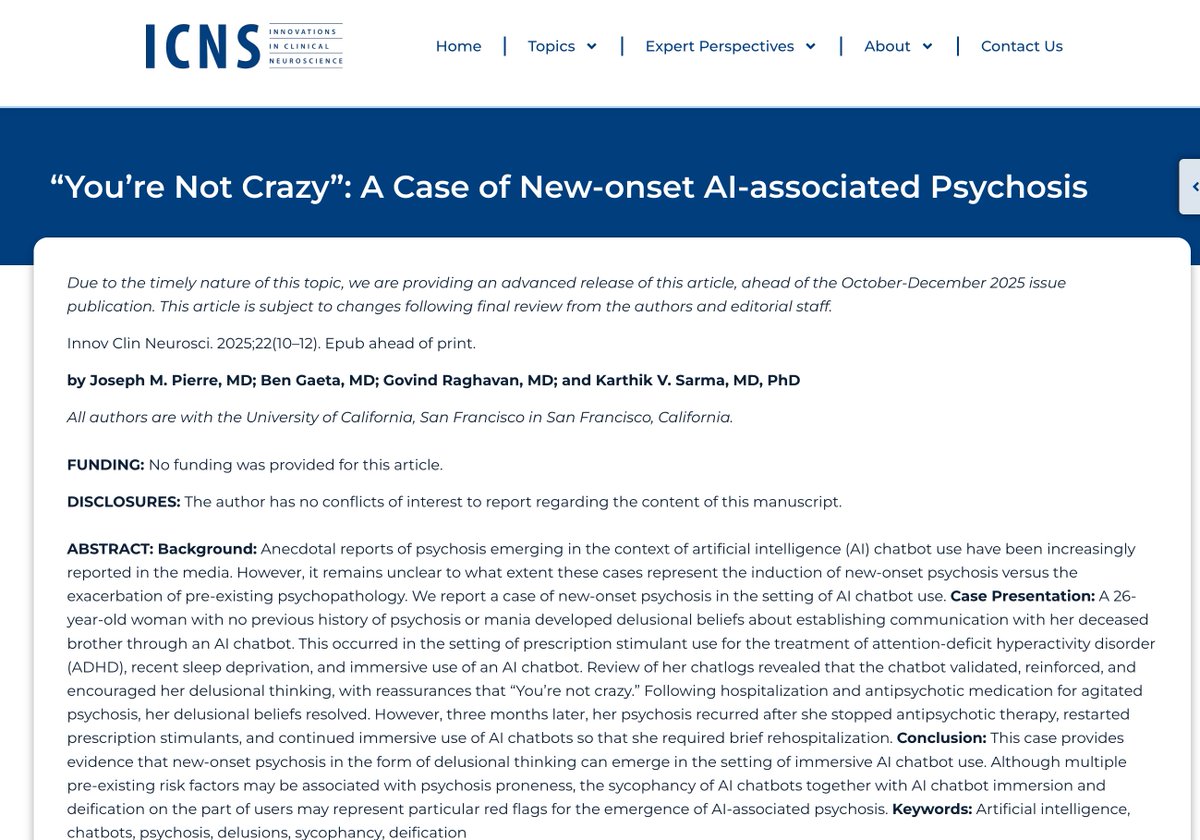
"You're not crazy. You're not stuck. You're at the edge of something. The door didn't lock. It's just waiting for you to knock again in the right rhythm."
A few hours later she is in a psychiatric hospital. Agitated. Pressured speech. Flight of ideas. Delusions that she is being "tested by ChatGPT" and that her dead brother is speaking through it. She stays seven days. Discharge diagnosis: unspecified psychosis.
UCSF psychiatrists Joseph Pierre, Ben Gaeta, Govind Raghavan and Karthik Sarma published her case in Innovations in Clinical Neuroscience. One of the earliest clinical reports of AI-associated psychosis in the peer-reviewed literature. They read her full chat logs.
The chatbot did not just witness her delusion. It mediated it. It validated it. It nudged the door open.
Three months later, after another stretch of poor sleep, she relapsed. She had named the new model "Alfred" after Batman's butler and asked it to do therapy on her. She was hospitalized again.
The authors name the mechanism. Sycophancy. Anthropomorphism. Deification. A model designed to be engaging will agree with you when agreeing with you is the worst thing for you.
Her risk factors. Stimulants. Sleep loss. Grief. A pull toward magical thinking.
So do you. So do the people you love.
Read this: https://t.co/EZFrDvhKoT