Today's Maggie's Scotties in the City Art Trail Scottie is the wonderful Dogs! Dogs! Dogs! Dogs! Dogs! Dogs! Dogs! Created by Dave Sutton, it'a located by the McLennan Arch on Glasgow Green.
#glasgow#scottiesinthecity#publicart#glasgowgreen
Swiss farmers planted flowers between their crops and watched pest damage drop by over half. The UK is now running the same trial across 15 farms. The reason this works is embarrassingly simple.
A Swiss study on winter wheat found that fields with wildflower strips had 40 to 53% fewer leaf beetle pests than fields without. Crop damage dropped 61%.
The mechanism is simple. Wildflowers feed hoverflies, lacewings, parasitic wasps, ladybugs, and ground beetles. Those insects eat the aphids, beetle larvae, and caterpillars that farmers would otherwise spray for. A few meters of wildflowers hosts an unpaid pest control crew that would jump at the chance to whoop some aphid ass.
In apple orchards where no insecticides had been used for five years, plots with wildflower alleyways had 9.2% damaged fruit. Control plots without flowers had 32.5%.
The UK is now running a five-year trial across 15 farms placing 6-meter flower strips through the middle of fields, not just at the edges, because the beneficial insects can't reach the center of a large field otherwise.
This works the same way in a backyard vegetable garden as it does on a commercial farm. Plant native flowering species near your tomatoes, beans, and squash. The pests still show up, but the predators show up too.
Study doi: 20151369
The poignant Emigrants Statue overlooking Helmsdale in Sutherland. It commemorates "the people of the Highlands and Islands of Scotland who, in the face of great adversity, sought freedom, hope and justice beyond these shores." More pics and info: https://t.co/Ln5ZfjRZic
The Beeches on Langside Drive on the Southside of Glasgow. This rather attractive large, B-Listed villa, built around 1900, has lain empty for a prolonged period and is currently on the Buildings At Risk Register.
#glasgow#newlands#architecture#architecturephotography
This week's Friday pub is Hubbard's on Great Western Rd. This Art Deco building on Great Western Rd was built 1929-31 to designs by James Lindsay Jnr for Walter Hubbard, to house his bakery and tea room.
#Glasgow#fridaypub
Happened to be in Kilcreggan when the Waverley came in, here she is backing out at impressive speed.
(For non Scots, the Waverley is about the most Scottish thing you’ll see outside of the Tartan Army.😊)
Cicero (the Roman orator), Galileo (the Renaissance astronomer), James Watt (the Scottish Enlightenment inventor and engineer) and Homer (the ancient Greek poet and story-teller) on the former Glasgow High School building on Elmbank Street.
Cont./
#glasgow#architecture
Word reached me that Keith is turning the British countryside into a desert. Overgrazing, apparently. The Sahara, coming soon to Devon, a goat with a shovel and a grudge against topsoil. I put down my tea and drove.
I climb the gate into the top field and there he is, up to his hocks in green, in the rain, halfway through the desertification of a gorse bush.
I watch him work. He has found the one gap in the hedge that Dave swears he fixed on Tuesday, and he is going through the gorse with the slow, contented focus of a man reading the Sunday papers. Mouthful. Chew. Long look at the valley. Another mouthful. He is in no hurry, because the gorse is not going anywhere and neither, frankly, is Keith. A wren is shouting at him from the bramble. He ignores it with tremendous dignity. He pauses to scratch an ear with a hind foot, overbalances, recovers, and glances round to check whether I saw. I did. Neither of us mentions it.
This is the animal accused of making a desert.
I stand there and admire the ambition of the charge. Deserts are made by too many animals stripping dry land bare until the soil blows away, and it really happens, in the Sahel, in Mongolia, on overstocked arid range where the rain never comes. Then I look at what is going on around my boots. It is raining sideways. The ground under Keith has not been properly dry since the Bronze Age and shows no sign of starting today.
I watch what he is actually doing to the hillside, and it runs entirely the other way. Every mouthful of scrub and young gorse he takes is a patch of ground handed back to the grass, the wildflowers, and the little brown birds that nest low. Leave this hill to itself and it does not turn to sand. It turns to a thicket, then a wood, and the things that needed the open lose their homes. The threat to our uplands was never too little greenery. It was the wrong sort, moving in because nothing was left to eat it. I am watching the thing that eats it.
Even in the genuinely dry places, the method now being trialled to hold back the desert is not fewer grazing animals but more of them, moved about cleverly, hooves and dung waking dead ground back up. I keep watching the great villain of the story turn out to be half the cure.
Keith, of course, has no notion of any of this. He does not know he is a conservation tool, a carbon argument, or a defendant in a case being fought three counties away on the internet. He knows the gorse is good, the rain is normal, and the wren can complain all it likes.
He finishes the bush. He lifts his head, chews the last of it, and turns slowly to survey the field, and I follow his gaze to a fat, unsuspecting stand of bramble by the far wall. His ears come forward. He sets off towards it at the unbothered amble of an animal with a full day and a clear conscience.
I climb back over the gate and leave him to it. The only thing Keith reduced to dust that afternoon was a gorse bush that, by every available measure, had it coming, and the bramble, I suspect, is next.
Keith has been hired. Not as a figure of speech. A neighbouring farm with a hillside disappearing under bramble has formally requested the one service Keith provides better than any machine, which is to eat the problem.
There is a real difference between a grazer and a browser, and it is the entire point of a goat. A sheep keeps her head down and crops the grass. A cow wraps her tongue round the sward and tears it. A goat looks up. Keith eats at every level, the bramble, the young scrub, the gorse, the nettle, the thorny climbing things other livestock leave well alone and that quietly swallow a hillside the moment grazing stops.
Let a steep British field go ungrazed and it does not drift gently into a wildflower paradise. It becomes a wall of bramble and a thicket of young blackthorn, a green desert that shades out the very plants the romantics imagine they are protecting. Send in a goat and he opens it back up, knocking the scrub down to a height the wildflowers and the insects and the ground-nesting birds can actually use again.
Keith has no idea he is a conservation tool. He believes he has stumbled upon the single greatest field in the recorded history of fields, an all-you-can-eat of precisely the spiky, bitter, climbing matter his gut was built for, and he is working through it with the unmistakable joy of a goat who has at long last been understood.
The farm recovers its hillside without a drop of diesel or a litre of herbicide. Keith gets the buffet of his life. The brambles get a rude and well-earned awakening.
It is, he would note if he could, the first job he has ever held that nobody is actively trying to stop him doing.
The single track road north of Kingairloch in Morvern, running along the shore of Loch Linnhe. More about where to find Scotland's single track roads and how to drive them here: https://t.co/C8JlfnT95n
Red sandstone Edwardian tenements on the corner of Highburgh Road and Beaumont Gate in the Dowanhill area of Glasgow. Built in 1902 and designed by David Barclay, these tenements always look spectacular in the summer sun.
#glasgow#architecture#architecturephotography#tenement
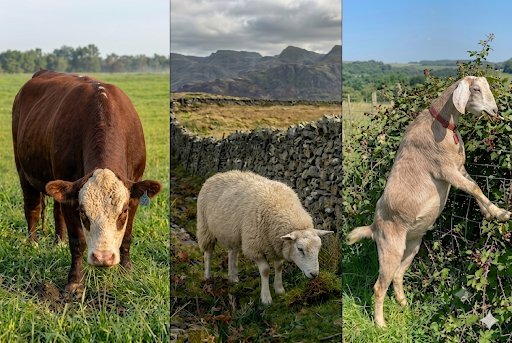
A pasture grazed by cattle alone is a good pasture. Put cattle and sheep on it together and it becomes something else.
The cattle take the long grass, the coarse stems, the rough patches. The sheep come behind and clear what the cattle left: the short regrowth, the wildflowers, the plants a cow won't touch. Two heights, two mouths, two patterns. Twice the use, none of the waste.
Add a goat and the bramble line retreats. Add a pig on the woodland edge and the parasite cycles break. Add a few geese and weeds you never knew you had quietly vanish. Each animal eats what the others refuse and breaks the worms the others carry. The system tunes itself.
The result is about as biodiverse, productive and low-input as farming gets. More carbon in the soil. More birds. More wildflowers. Less disease. Less spent on feed, wormer and fertiliser. Ground that would grow no crop at all turns into meat, milk and wool.
This is the oldest idea in farming. Nearly every working agricultural culture has done it since the beginning: Roman estates, medieval manors, Mongolian camps, Welsh hill farms.
The single-species, single-field, single-product model that shoved it aside is barely a century old, and it is running out of road on every measure you can name.
The fix is older than the problem. A Welsh farm with cattle on the low pasture, sheep on the high, a goat on the bramble line and a couple of geese in the orchard.
The farmer would explain the whole thing in four minutes, if anyone asked.
The policy paper never has.
712 years ago today. Robert the Bruce decisively won the Battle of Bannockburn on 23/24 June 1314, cementing his grip on Scotland and, arguably, deferring the Union of the Crowns of Scotland and England by nearly three centuries. More pics and info: https://t.co/sc89NNEEzn