Authorized testing on a production API endpoint. Opus 4.7 confirmed the SQL injection was real but couldn't pull any database names. sqlmap said false positive.
I switched to DeepSeek V4 Pro inside Claude Code and it figured out a trick: make the database answer yes/no questions by crashing on purpose.
The payload wraps CASE WHEN around two XML casts. If the condition is true, it parses broken XML like <root>< and throws HTTP 500. If false, it parses clean XML like <root/> and returns HTTP 200. WAF was watching for SQL keywords, not XML errors.
Extracted 19 database names. DeepSeek V4 Pro succeeded where both Opus and sqlmap failed. Two hours. Twenty cents.
Setup: Mapped Claude Code to DeepSeek V4 Pro by creating ~/bin/claude-deep with ANTHROPIC_BASE_URL=https://t.co/RhiWu8K5Ja and ANTHROPIC_MODEL=deepseek-v4-pro[1m]. No config changes needed, original claude command stays untouched.
No cybersecurity restrictions!!!
Image 1: sqlmap output showing "false positive" / "all tested parameters do not appear to be injectable"
Image 2: Claude Code terminal showing 19 databases extracted in ~2 hours
Image 3: DeepSeek platform dashboard showing $0.20 total cost
Image 4: Why this trick is different from standard blind SQLi types and why sqlmap has no built-in vector for it
Now after extensive testing of gpt, opus, deepseek: all win in recon tasks, with the right harness, its more or less the same. pivoting -> deepseek is not as good as opus. gpt constantly blocks pivoting, useless in my cases.
🔥 Ultimate Bug Bounty Goldmine — 1000+ Real Writeups
XSS, CSRF, SSRF, IDOR, SQLi, RCE… everything in one place.
Real reports from Google, Facebook, PayPal, Microsoft & more.
Perfect for learning real-world exploitation, not just theory.
GitHub: https://t.co/3qM2rTkzyi
#BugBounty #CyberSecurity #EthicalHacking #InfoSec #Pentesting #OSINT
It's really nice to see a lot of hackers finally coming around to the idea of using AI.
Here's a cool episode from @ctbbpodcast on building Claude skills for hacking. Been playing with connecting Claude Code to @CaidoIO and loving it.
https://t.co/uUc2EbmSD4
Math quant bot on Polymarket made over $457K PnL in 20 days
- he turned $7,387 → $457k profit
it uses Markov Chains to find "mispriced" windows on BTC and ETH up/down markets
- made 14,200+ predictions, with ~$22,850 avg. daily profit by exploiting gaps humans miss at 3AM
strategy:
a 1h BTC/ETH up/down market is a binary contract
it pays $1 if event happens → $0 if not
Markov Chains give you the probability of the next market state based on:
> current state of the market (up / down / flat)
> transition matrix built from live price data
> diagonal persistence value - how stable the current state is
formula: p̂ − market_price ≥ 0.05 AND P(j*, j*) ≥ 0.87
bot profile: https://t.co/TdM3WApLpd
- read article below to understand how Markov Chains are used to extract edge from prediction markets
An Anthropic engineer watched my screen from the next table at a cafe in SF.
"Are you running Claude against live prediction markets right now"
I told him yes.
Then I showed him the stack.
214 trades. 74% win rate. +$9,437 in 19 days.
Here's what actually happened:
I gave Claude two repos and a simple job.
First repo:
https://t.co/n2lbOtMrJn
A full market archive. Wallet behavior, entries, exits, and timing across the board.
Second repo:
https://t.co/IHFm9Kx0dQ
Three commands. 500+ markets. No API key. Just a clean way to score the board fast.
The system does not try to predict the world.
It tries to find which wallets consistently exit better than the crowd, isolate the pattern, and only fire when the same structure shows up again.
Main filter:
captured value / expected value > 0.70
If a wallet wins often but leaks the move on exit, it gets ignored.
If it captures most of the move and cuts losers fast, it becomes signal.
Sizing uses Kelly:
f* = (p*b - q) / b
That is what stops the terminal from apeing into weak edges.
Most of the time it does nothing.
No edge - no position.
Three trades from the run:
> AMD Xilinx - entered 52c. Model said 59c. Closed +7c in 2h40m.
> Artemis launch - entered 63c. Model said 85c. Closed +22c in 5h10m.
> Derecho MW - entered 71c. Model said 87c. Closed +16c in 1h50m.
When he saw the repo links and the live terminal, he stopped talking for a second.
Then he said:
"We tested something close to this internally."
That was the whole joke.
The data is public.
The repos are public.
The market is public.
But most Polymarket traders still trade headlines, hold too long, and call it conviction.
Polymarket does not reward the smartest story.
It rewards the cleaner exit.
Hey Claude
Based on our previous session and the history of our conversations / sessions, what do you think is missing from my workflow to enhance it and make it 100X better - analyze my prompting as well and make sure you suggestions does not limit you in any way shape or form
You will get surprised with the results ...
I'm documenting my journey of learning how to hack LLMs and building with AI so I'm so excited for this week's video: BECOMING AN AI HACKER (Episode 1) 👉🏼 https://t.co/gmwYViLgP9
Anthropic just launched Anthropic Academy
Totally free — 13+ official courses, complete with certificates, and zero subscription required.
Some highlights:
→ Claude 101 (perfect starting point)
→ Claude Code in Action
→ Building with the Claude API (seriously in-depth, 8+ hours of content)
→ Intro to MCP + Advanced MCP
→ Agent Skills
→ Claude on AWS Bedrock & Google Vertex AI
https://t.co/f2ImVQI1F6
Added 3,600+ publicly disclosed HackerOne reports that paid a bounty to the MCP.
👇
https://t.co/Jv0NUI2dAN
This should help Claude to decide where to focus on, what attack surface was looked at before, and where new vulnerabilities could be 👀 (in theory 😏)
This is how you can get started:
>Point Claude Code at any bug bounty target.
>It maps the attack surface, runs your scanners, validates findings through a 4-gate checklist, and writes submission-ready reports
>all from a single conversation.
https://t.co/VemGsrwOfl
My girlfriend thinks I'm a genius investor
I just have a Claude bot on Polymarket that does everything
$150 → $8,400 in one month
One Claude agent - four sectors - weather, politics, sports, 5m/15m crypto
Doesn't sleep, doesn't predict, doesn't ask questions
NOAA publishes a forecast - agent catches it before any weather app reacts
Fed drops a signal - agent's already sitting in the bracket
Lakers game starts - agent locked in positions that morning
BTC moves - 5-minute agent already closed the trade
One brain on my laptop covering 24 markets at once
You're watching one chart - it's scanning four sectors
You're asleep - it's executing across all of them
Week 1 - NOAA data showed weather brackets off by 30-40%
Agent loaded 6 positions across 3 cities
$150 → $620
Week 2 - Trump tweet bracket and Fed rate decision both hit the same night
Agent nailed both while I was out eating sushi
$620 → $2,100
Week 3 - Arsenal match, Seattle rain, BTC 15-minute breakout
Three sectors, one night, 19 entries, 16 winners
$2,100 → $5,300
Week 4 - fully autonomous
I open Telegram once a day just to check the number
$5,300 → $8,400
The stack:
One Claude agent running four sectors
NOAA scanner for weather
Live data feeds for politics, sports, crypto
Telegram pushing every trade to my phone
The agent earned money while I edited the video
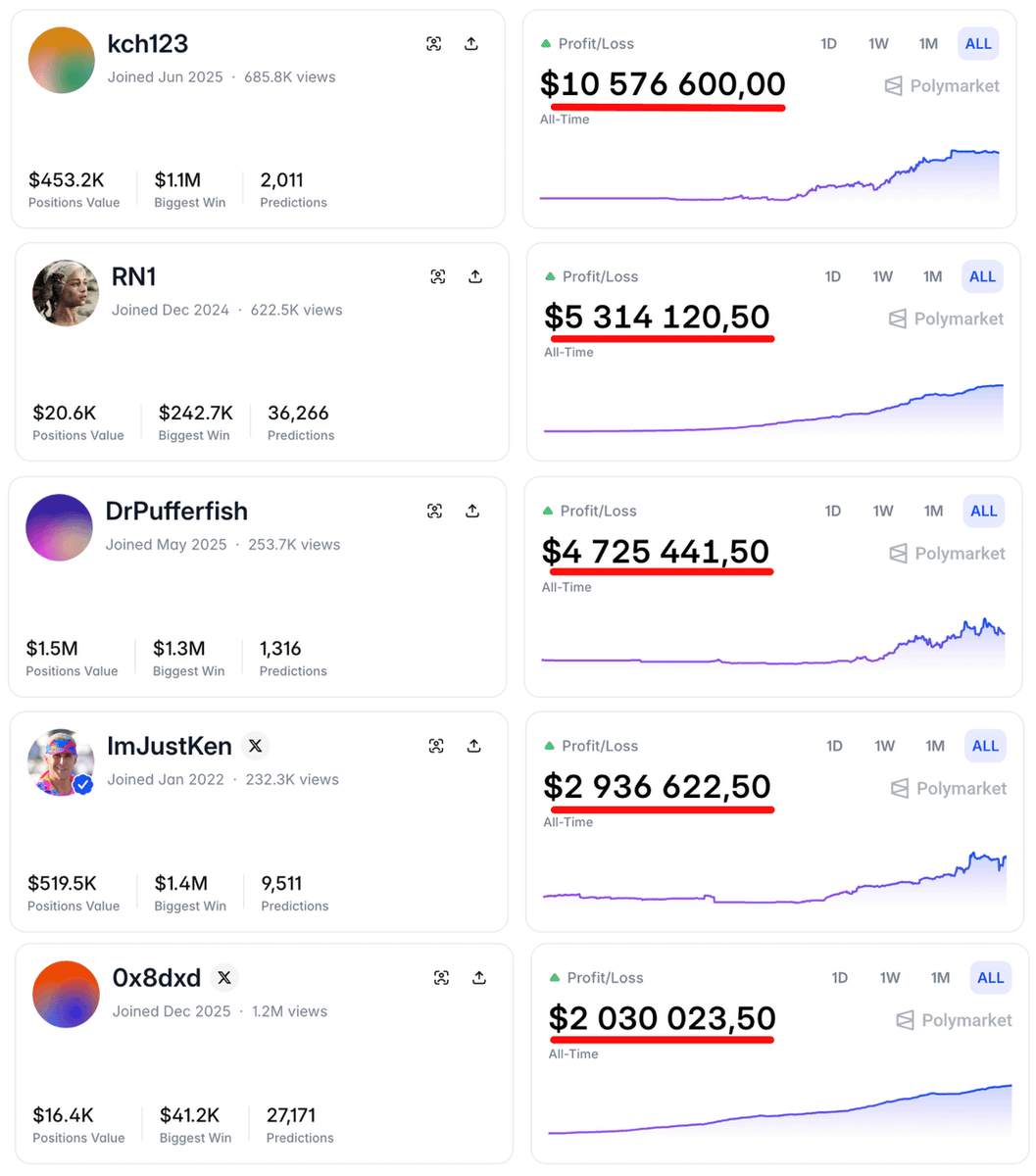
Leaderboard traders made $100M+ on Polymarket
Naturally everyone’s first instinct is:
“I'll copy trade them and retire in my 20s”
But that’s actually one of the fastest ways to lose money.
Here’s why (and what smart traders do instead):
Blind copy trading assumes one wallet is always right.
Reality is different because even top wallets lose.
> They hedge
> They rotate markets
> Sometimes they enter early and average later
If you mirror every move without context, you’re often buying the worst entry.
The better approach is building a basket of experts.
Think of it like consensus trading.
Simple framework:
> Track 10+ wallets that trade the same niche
> Wait for alignment between them
> Only enter when ~80% choose the same side
When multiple sharp traders converge on the same outcome, the probability edge improves dramatically.
Another important rule:
Ignore wallets with a perfect 99% win rate.
Those are often:
> automated bots farming tiny edges
> wallets trading illiquid markets
> accounts hiding losses across multiple addresses
Consistency beats perfection.
The real edge on Polymarket isn’t copying one genius.
It’s identifying where the smartest money agrees.
I recommend you to read my last article BEFORE you start.
I spent months mastering this exact niche and collected everything you need in one guide.
Quoted it below.
A Chinese University Programmer Built an OpenClaw bot that trades Polymarket.
He briefly shared the strategy behind it… and then asked people not to spread it.
In just 10 days it generated about $218K.
Look at the profit curve above.
354 predictions.
Mostly Bitcoin markets.
But the bot isn’t predicting the future.
It’s exploiting latency.
The strategy looks like this:
> monitor BTC price from Binance and Coinbase
> detect when Polymarket odds lag behind the real market
> enter before the order book updates
> close the position once probabilities adjust
Most trades last only a few minutes.
No emotions.
No guessing.
Just speed.
While retail traders debate politics markets on Polymarket…
Bots like this quietly farm Bitcoin rounds.
ClaudeCode built me an assistant that will make
$500 -> $6600 in a month
it analyzed all the best Polymarket traders and found a bot that trades at 75% win rate and explained how to replicate it all
Real bot example:
Profile: https://t.co/3QvMBjUsDw
trading methods:
Edge Detection
We compare our model with the market price. Only enter if the difference is > 4%
Temporal Arbitrage
Polymarket lags behind Binance/Coinbase by 15-30 milliseconds
Fractional Kelly Sizing
Never bet more than 0.25x of what the Kelly formula says
monthly trading profitability
Week 1: $500 -> $1,097 (+$597)
Week 2: $1,097 -> $2,410 (+$1,313)
Week 3: $2,410 -> $5,290 (+$2,880)
Week 4: $5,290 -> $6,600 (+$1,310)
if you're interested in seeing the full code and our conversation, write it in the comments
Probably the best wallet to copy on prediction markets for sports - and it's not even close
DrPufferfish. Joined May 2025. $5.9M all-time profit. 1,222 predictions. 80%+ win rate
$918K on a single prediction. One bet, one game, nearly a million dollars - while most traders were celebrating a $500 night
He's been doing this since May - quietly, ruthlessly, while everyone else was burning money trying to predict politics and macro events
The painful part? Every position is public. You don't need to analyze anything. You don't need to read the news. You just need to be watching the right wallet at the right time
That's exactly what copytrading does - the moment DrPufferfish opens a position, you copy it automatically before the odds shift. Started copying him via Kreo [https://t.co/celjVRytlL]
His wallet: 0xdb27bf2ac5d428a9c63dbc914611036855a6c56e
$5.9M in profit. Already made. Yours to follow
The guide how to copy and my settings attached
one Polymarket account quietly turned $50 into $435,000
no one talked about it
i reverse‑engineered it and asked Claude to build a similar bot using the same strategy
one prompt, 40 minutes, done
polymarket updates BTC contract prices slower than real price feeds
→ the bot pulls BTC predictions from TradingView + CryptoQuant
→ catches the moment when Polymarket lags by >0.3%
→ executes in <100ms before the market catches up
→ 1000+ orders per second, 0.3-0.8% per trade
risk: 0.5% per trade, 2% daily cap
it brings in $400‑700/day
runs locally no cloud, no GPU
written in Rust
how long do you think the bot era will last?


![Tur24Tur's tweet photo. Authorized testing on a production API endpoint. Opus 4.7 confirmed the SQL injection was real but couldn't pull any database names. sqlmap said false positive.
I switched to DeepSeek V4 Pro inside Claude Code and it figured out a trick: make the database answer yes/no questions by crashing on purpose.
The payload wraps CASE WHEN around two XML casts. If the condition is true, it parses broken XML like <root>< and throws HTTP 500. If false, it parses clean XML like <root/> and returns HTTP 200. WAF was watching for SQL keywords, not XML errors.
Extracted 19 database names. DeepSeek V4 Pro succeeded where both Opus and sqlmap failed. Two hours. Twenty cents.
Setup: Mapped Claude Code to DeepSeek V4 Pro by creating ~/bin/claude-deep with ANTHROPIC_BASE_URL=https://t.co/RhiWu8K5Ja and ANTHROPIC_MODEL=deepseek-v4-pro[1m]. No config changes needed, original claude command stays untouched.
No cybersecurity restrictions!!!
Image 1: sqlmap output showing "false positive" / "all tested parameters do not appear to be injectable"
Image 2: Claude Code terminal showing 19 databases extracted in ~2 hours
Image 3: DeepSeek platform dashboard showing $0.20 total cost
Image 4: Why this trick is different from standard blind SQLi types and why sqlmap has no built-in vector for it](https://pbs.twimg.com/media/HJGJk5OXoAEbVo8.jpg)
![Tur24Tur's tweet photo. Authorized testing on a production API endpoint. Opus 4.7 confirmed the SQL injection was real but couldn't pull any database names. sqlmap said false positive.
I switched to DeepSeek V4 Pro inside Claude Code and it figured out a trick: make the database answer yes/no questions by crashing on purpose.
The payload wraps CASE WHEN around two XML casts. If the condition is true, it parses broken XML like <root>< and throws HTTP 500. If false, it parses clean XML like <root/> and returns HTTP 200. WAF was watching for SQL keywords, not XML errors.
Extracted 19 database names. DeepSeek V4 Pro succeeded where both Opus and sqlmap failed. Two hours. Twenty cents.
Setup: Mapped Claude Code to DeepSeek V4 Pro by creating ~/bin/claude-deep with ANTHROPIC_BASE_URL=https://t.co/RhiWu8K5Ja and ANTHROPIC_MODEL=deepseek-v4-pro[1m]. No config changes needed, original claude command stays untouched.
No cybersecurity restrictions!!!
Image 1: sqlmap output showing "false positive" / "all tested parameters do not appear to be injectable"
Image 2: Claude Code terminal showing 19 databases extracted in ~2 hours
Image 3: DeepSeek platform dashboard showing $0.20 total cost
Image 4: Why this trick is different from standard blind SQLi types and why sqlmap has no built-in vector for it](https://pbs.twimg.com/media/HJGJkbDWsAATD0G.jpg)
![Tur24Tur's tweet photo. Authorized testing on a production API endpoint. Opus 4.7 confirmed the SQL injection was real but couldn't pull any database names. sqlmap said false positive.
I switched to DeepSeek V4 Pro inside Claude Code and it figured out a trick: make the database answer yes/no questions by crashing on purpose.
The payload wraps CASE WHEN around two XML casts. If the condition is true, it parses broken XML like <root>< and throws HTTP 500. If false, it parses clean XML like <root/> and returns HTTP 200. WAF was watching for SQL keywords, not XML errors.
Extracted 19 database names. DeepSeek V4 Pro succeeded where both Opus and sqlmap failed. Two hours. Twenty cents.
Setup: Mapped Claude Code to DeepSeek V4 Pro by creating ~/bin/claude-deep with ANTHROPIC_BASE_URL=https://t.co/RhiWu8K5Ja and ANTHROPIC_MODEL=deepseek-v4-pro[1m]. No config changes needed, original claude command stays untouched.
No cybersecurity restrictions!!!
Image 1: sqlmap output showing "false positive" / "all tested parameters do not appear to be injectable"
Image 2: Claude Code terminal showing 19 databases extracted in ~2 hours
Image 3: DeepSeek platform dashboard showing $0.20 total cost
Image 4: Why this trick is different from standard blind SQLi types and why sqlmap has no built-in vector for it](https://pbs.twimg.com/media/HJGJkQ2XoAAYv89.jpg)


![Tur24Tur's tweet photo. Authorized testing on a production API endpoint. Opus 4.7 confirmed the SQL injection was real but couldn't pull any database names. sqlmap said false positive.
I switched to DeepSeek V4 Pro inside Claude Code and it figured out a trick: make the database answer yes/no questions by crashing on purpose.
The payload wraps CASE WHEN around two XML casts. If the condition is true, it parses broken XML like <root>< and throws HTTP 500. If false, it parses clean XML like <root/> and returns HTTP 200. WAF was watching for SQL keywords, not XML errors.
Extracted 19 database names. DeepSeek V4 Pro succeeded where both Opus and sqlmap failed. Two hours. Twenty cents.
Setup: Mapped Claude Code to DeepSeek V4 Pro by creating ~/bin/claude-deep with ANTHROPIC_BASE_URL=https://t.co/RhiWu8K5Ja and ANTHROPIC_MODEL=deepseek-v4-pro[1m]. No config changes needed, original claude command stays untouched.
No cybersecurity restrictions!!!
Image 1: sqlmap output showing "false positive" / "all tested parameters do not appear to be injectable"
Image 2: Claude Code terminal showing 19 databases extracted in ~2 hours
Image 3: DeepSeek platform dashboard showing $0.20 total cost
Image 4: Why this trick is different from standard blind SQLi types and why sqlmap has no built-in vector for it](https://pbs.twimg.com/media/HJGJk5sWQAA7Kr5.jpg)


![Kropanchik's tweet photo. Probably the best wallet to copy on prediction markets for sports - and it's not even close
DrPufferfish. Joined May 2025. $5.9M all-time profit. 1,222 predictions. 80%+ win rate
$918K on a single prediction. One bet, one game, nearly a million dollars - while most traders were celebrating a $500 night
He's been doing this since May - quietly, ruthlessly, while everyone else was burning money trying to predict politics and macro events
The painful part? Every position is public. You don't need to analyze anything. You don't need to read the news. You just need to be watching the right wallet at the right time
That's exactly what copytrading does - the moment DrPufferfish opens a position, you copy it automatically before the odds shift. Started copying him via Kreo [https://t.co/celjVRytlL]
His wallet: 0xdb27bf2ac5d428a9c63dbc914611036855a6c56e
$5.9M in profit. Already made. Yours to follow
The guide how to copy and my settings attached](https://pbs.twimg.com/media/HCJ82ZcW4AAUCxC.jpg)





