@LaSambruna mi sa che il papà del ragazzetto è ordinario di medicina alla sapienza mentre la madre è direttrice dei musei vaticani https://t.co/Lez8tOaFkf
The Exchange Stabilization Fund was used to rescue Mexico during the 1994-95 Tequila Crisis. To my knowledge it wasn’t used again after that. And this comes after 20 billions from the IMF. This looks increasingly unsustainable
Per il secondo giorno consecutivo la Banca centrale argentina interviene vendendo dollari per sostenere il cambio.
Ieri bruciati 379 mln$.
Intanto il dollaro supera 1500, mentre il limite fissato dal FmI era 1470.
Milei punta sull'abbassamento dei tassi per rilanciare la domanda interna in quest'ultimo mese prima delle elezioni, ma rischia di finire impallato da una fuga di capitali che sta assumendo dimensioni sempre più grandi.
Dice el @jpmorgan
“El riesgo político, y no un agotamiento del programa macroeconómico actual, resultó la principal fuente de volatilidad local. Superar las elecciones debería colaborar para restablecer la estabilidad”.
La idea que transmite JP Morgan —atribuir la inestabilidad principalmente al riesgo político— es errónea.
El banco probablemente lo sepa, pero también conoce el peso que tiene su palabra en los mercados.
El problema de fondo es económico: se eligió mantener un dólar barato como estrategia para reducir la inflación rápidamente y, al mismo tiempo, practicar un “populismo cambiario” que permitiera llegar a las elecciones con una clase media contenta gastando dólares, como tantas veces en el pasado.
A ello se sumó un error grave: no acumular reservas propias entre marzo y julio.
El gobierno renunció a protegerse para atravesar el invierno y, con ello, incumplió el punto central del acuerdo con el FMI (enrostrándoselo en la cara).
Hoy, en lugar de contar con ese colchón, se están utilizando dólares del Tesoro destinados al pago de deuda, lo que dispara el riesgo país.
Como si fuera poco, se agregó la “comedia de enredos” de eliminar las LEFI, lo que abrió dudas sobre las capacidades técnicas del equipo económico y del propio presidente.
El resultado: una tasa de interés exorbitante y la decisión insólita de endogeneizar los encajes bancarios, una medida que somete al sistema financiero a un nivel de estrés inédito desde 2000-2001.
Todo ello está hundiendo a la economía en una recesión que inevitablemente impactará sobre el superávit fiscal, el empleo, la inversión y la morosidad.
En este escenario, gane o pierda el gobierno de @JMilei en el corto plazo, casi todo el mercado descuenta que habrá un cambio de régimen cambiario, acompañado quizás por cambios políticos y en el equipo de gestión.
De ese evento se cubren los mercados y los ahorristas.
Contra eso no se preparó el gobierno
#Elecciones2025 #deuda #riesgopais #dolar
@chiadegli@DAVIDPARENZO il ruolo della Cina nei paesi in via di sviluppo è sempre opaco, tuttavia bisogna ammettere che c'è anche tanta narrativa anticinese
https://t.co/CVTZZPI2Ni
Un esempio è la questione della debt trap diplomacy tra Cina e PVS
https://t.co/8DUWXYc2Jm
@francelenzi Tra l'altro il conto corrente sarebbe ancora più negativo se non fosse per il gasdotto a Vaca Muerta (ex gasdotto Nestor Kirchner, nome poi cambiato da Milei in gasdotto Perito Francisco Pascasio Moreno), opera pubblica, messo in funzione nel luglio 2023
https://t.co/vbotdP6VEB
La balanza comercial volvió a ser positiva, pero cada vez más sostenida por el gasoducto Néstor Kirchner.
En abril, registró un superávit de USD 204 millones y acumula USD 1.265 millones en lo que va del año.
Sin el saldo positivo de la balanza energética, la balanza comercial habría sido deficitaria.
Sólo en abril, el sector energético aportó USD 573 millones, y en lo que va de 2025 acumula USD 2.684 millones.
Lo dijimos el año pasado y también luego con el Acuerdo con el FMI
La rapidez para revertir superávits en Cta Cte de Argentina en un caso muy especial en las comparaciones entre países de dinámicas de las Cta Ctes.
Por eso los pronósticos de Cta Cte del Staff Report del FMI eran poco creíbles, como lo son los de crecimiento.
Sobre todo, cuando hay una fuerte sobrevaluación cambiaria percibida por todos los agentes económicos.
Importante ver en detalle el saldo de la balanza comercial, aun con una óptima cosecha, Vaca Muerta aprovechando el gasoducto (menos impo) y generando más exportaciones y con la ayuda de la minería.
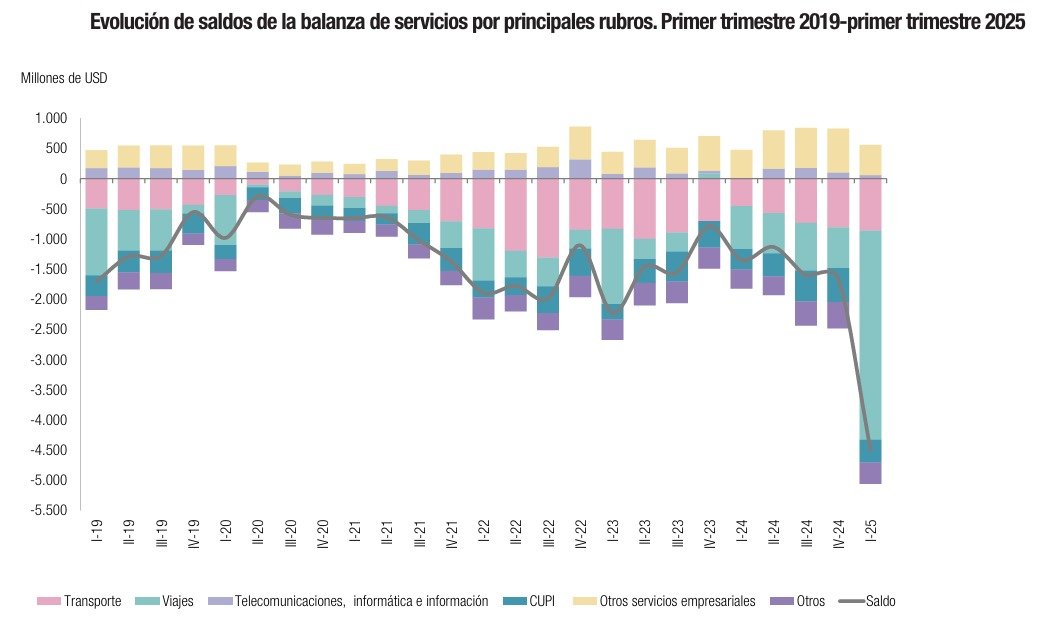
Impacta el deterioro de la balanza de servicios y ver la dinámica de los viajes. Mucho mas intensa que con Macri (2do gráfico)
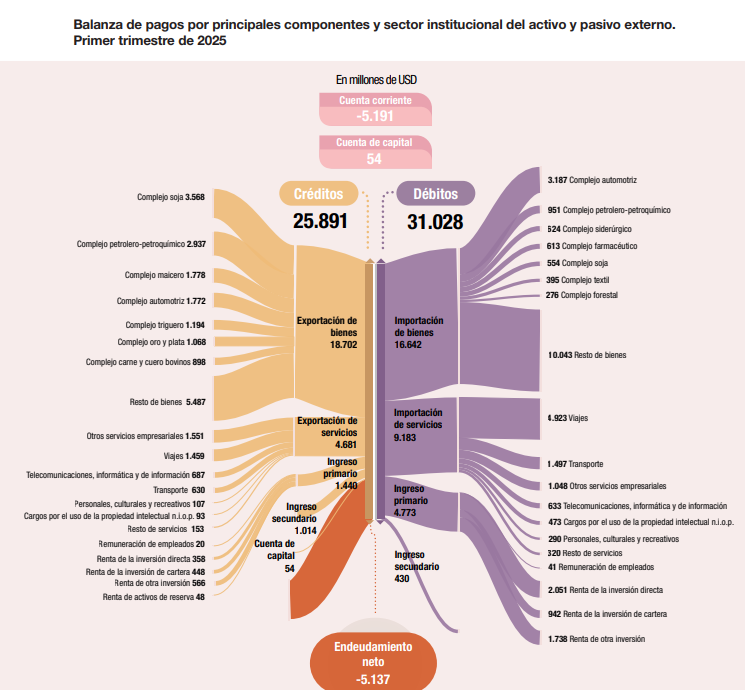
En particular, es relevante ver como viene los aportes netos de los complejos sectoriales (3er gráfico)
1/2
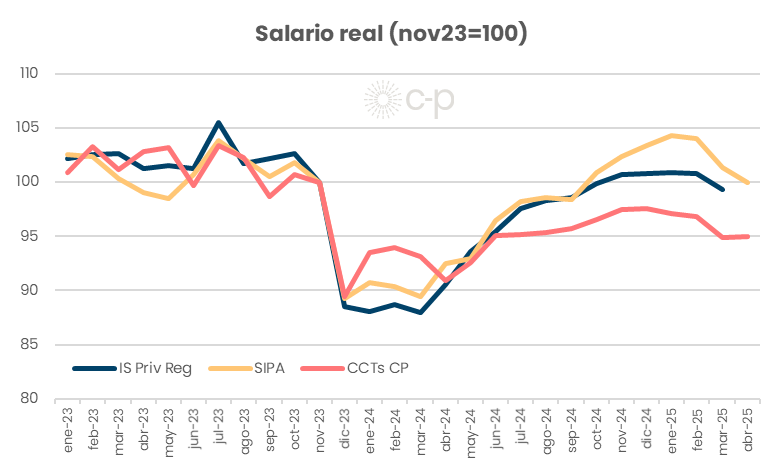
Qué dicen los datos de ayer sobre la dinámica actual de precios y salarios?
Cae el salario real? Hay una tendencia al estancamiento en los prox meses?
Cómo afectan las paritarias a los salarios? Y la pauta del gobierno?
Hilo sobre política salarial, inflación y paritarias👇
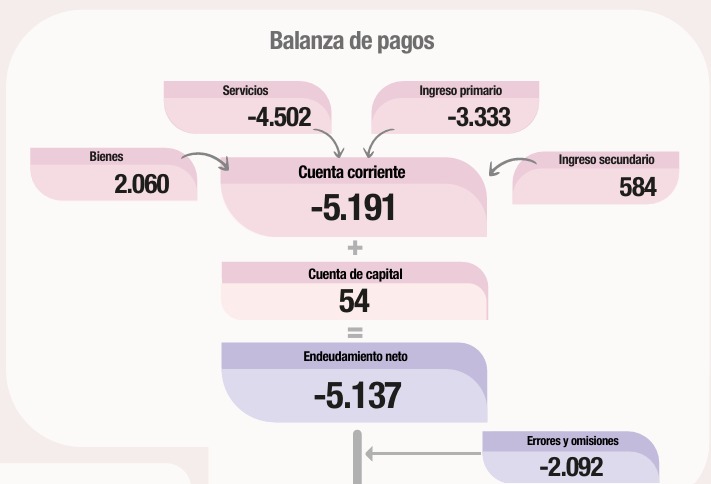
Non ha per niente risolto il problema di insufficienti riserve valutarie, che erano alla base della repressione finanziaria e dell'inflazione. Ha dovuto pertanto rinegoziare e aumentare il prestito con il FMI perché non c'erano soldi per pagare il debito estero che scadeva nel 2025. La sua disinflazione infatti, giocando su un cambio sopravvalutato, aveva fatto sprofondare la competitività estera argentina, recuperata con la svalutazione di fine 2023 (causa della botta inflattiva al 25%/mese). Il saldo di partite correnti peggiora da diversi trimestri e andrà in negativo quest'anno, consumando altre riserve valutarie.
Lo studieremo sui libri... boh. Speriamo per gli argentini non come si studia Menem.
La Corte Suprema consagró la “autoría por omisión impropia”: Cristina Kirchner no fue condenada en la Causa Vialidad por actos propios, sino por no impedir fraudes ajenos desde su rol de “garante institucional”. No se probó dolo directo, se criminalizó la actividad presidencial. Con esta jurisprudencia vigente, Macri y Milei también deberán terminar presos. No es opinión, es precedente penal.
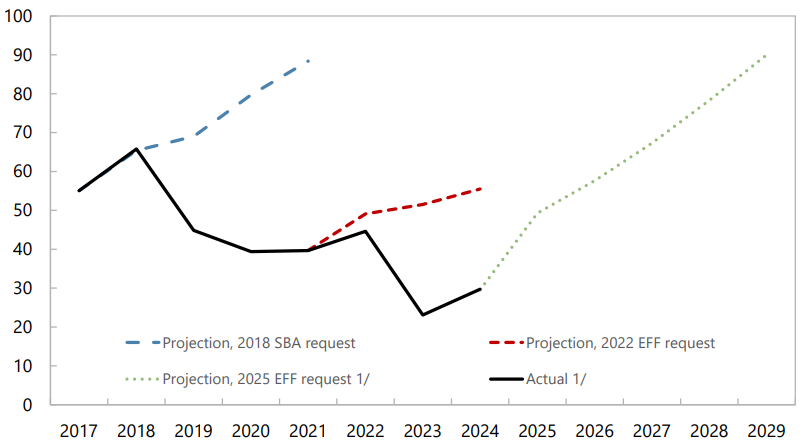
Este gráfico, que sale del propio memorándum con el FMI, debería ser suficiente para mandarlos a todos presos. El gráfico muestra la proyección estimada de acumulación de reservas al momento de la firma de cada acuerdo y el resultado real.
This is batshit insane, no other way to call it.
We now have the first attempt by the White House—specifically by Steve Miran, the Chair of the Council of Economic Advisers—to justify the tariffs based on economic "theory", and it's without a doubt the most dishonest piece of economic reading that's I've ever had the misfortune to lay my eyes upon.
The gist of Miran's argument is to reposition the global reserve currency status of the dollar not as an exorbitant privilege (as erstwhile French President Valéry Giscard d'Estaing once characterized it), but as somehow a "burden" that the rest of the world needs to compensate the US for bearing.
As Miran explains it, having the dollar as a reserve currency "has caused persistent currency distortions and contributed, along with other countries’ unfair barriers to trade, to unsustainable trade deficits" which "have decimated our manufacturing sector."
So he wants to give up the reserve currency status of the dollar, right? Wrong. He wants to have it both ways.
He says that America's "financial dominance cannot be taken for granted; and the Trump Administration is determined to preserve [it]" but this same financial dominance "comes at a cost" and "other nations" need to pay for it.
And he means this literally. He made a list of what exactly he means by "burden sharing" and one of the forms it can take is countries "simply writ[ing] checks to Treasury that help us finance global public goods."
Let's pause a moment here to contemplate the sheer insanity of this: the U.S. is literally suggesting that countries should mail checks to the US Treasury as tribute for the 'privilege' of maintaining the dollar as a global reserve currency, when it is this very reserve status of the dollar that is the cornerstone of US power.
It's the equivalent of Samson asking everyone to pay him to keep his hair.
Because that's what Miran is conveniently not mentioning in his text. The reason Giscard d'Estaing called it an "exorbitant privilege" is that it allows the U.S. to quite literally have its way of life subsidized by the rest of the world.
Miran (and Trump) complain about the trade deficits, but they are the very manifestation of this subsidization: countries normally cannot run a permanent trade deficit because they'd one day face a balance of payments crisis.
It's like a private individual: you cannot indefinitely buy more from others than what you yourself earn. At some point you'll have to pay up. Unless, that is, you're the issuer of the currency everyone uses, in which case the normal rules of economic gravity are suspended.
While other nations must balance their books eventually, the dollar's reserve status gives America the unique ability to consume more than it produces perpetually, with the world eagerly accepting dollars that cost nothing to create in exchange for real goods and services. That's not a "burden", it very much is an "exorbitant privilege".
So yes, sure, because America can effectively buy most of what it needs from the rest of the world for "free" (by printing dollars), this situation doesn't exactly create incentives to do the hard work of manufacturing goods domestically. But framing this as other countries taking advantage of America rather than America taking advantage of its currency dominance is an astonishing inversion of reality.
And even more astonishing is Miran's ask that countries now compensate the U.S. for this. Some people mention that it's like asking vassals for tribute but it's actually even worse than this. The tribute is already embedded in the global reserve currency status of the dollar: other countries work hard for the U.S. while they can just issue IOUs that never come due.
What Miran is thus proposing is effectively demanding vassals make payments for the privilege of already making payments—a double tribute system where countries first subsidize American living standards by accepting dollars as reserves, and then must pay an additional fee for the 'burden' this supposedly places on the US.
Miran's piece is replete with other complete inversions of reality. For instance, he now blames China for the 2008 crash because "their holdings of U.S. mortgage debt helped fuel the housing bubble, forcing hundreds of billions of dollars of credit into the housing sector without regard as to whether the investments made sense."
Anyone with even a rudimentary knowledge of the 2008 financial crisis would have their breath taken away by such brazen revisionism. Not only is the crisis universally known to have been caused by US regulatory failures and the reckless securitization of subprime mortgages by Wall Street firms, but China in this instance literally saved U.S. markets from complete meltdown after Hank Paulson personally appealed to Beijing to continue purchasing US Treasury bonds during the height of the crisis, which they did.
To now blame them for the very crisis they helped mitigate and played no part in creating is beyond dishonest—it's gaslighting on a geopolitical scale.
All in all, it's clear what the US is trying to achieve here, they effectively want to have their cake and eat it. They want to keep the privilege and want the rest of the world to pay for the downsides that come with it.
Which means we're truly at a crossroad in history where nations must make an immensely consequential choice: acquiesce to this insane double tribute system or stand against it. There are very few precedents in world history for such a nakedly exploitative power play, but history is very clear on two things: submitting to extortion only invites more of it, and collective resistance is the only effective response.
To illustrate just how nonsensically these tariffs were calculated, take the example of Lesotho, one of the poorest countries in Africa with just $2.4 billion in annual GDP, which is being struck with a 50% tariff rate under the Trump plan, the highest rate among all countries on the list.
Why? Does Lesotho apply extortionate tariffs on U.S. products and the U.S. is merely being "reciprocal" here? Not at all, despite what Trump is saying, it's NOT the way these tariffs are defined.
As a matter of fact Lesotho, as a member of the Southern African Customs Union (SACU), applies the common external tariff structure established by this regional trade bloc.
Which means it applies the same tariffs on U.S. products as South Africa does, as well as the 3 other members of the bloc: Namibia, Eswatini and Botswana.
So since the tariffs charged by these 5 countries on U.S. products are exactly the same, they must all be struck with a 50% tariff rate by the U.S., right? Not at all: South Africa is getting 30%, Namibia 21%, Botswana 37% and Eswatini just 10%, the lowest rate possible among all countries.
So what gives? Again, the way these tariffs are calculated has absolutely zero relationship with actual tariffs imposed by these countries on U.S. products. Instead, they appear to be simply derived from trade deficit calculations.
Looking at Lesotho specifically, every year the U.S. imports approximately $236 million in goods from Lesotho (primarily diamonds, textiles and apparel) while exporting only about $7 million worth of goods to Lesotho (https://t.co/uHvem6nH2o).
Why do they export so little? Again this is an extremely poor country where 56.2% of the population lives with less than $3.65 a day (https://t.co/GEho8xFjAp), i.e. $1,300 a year. They simply can't afford U.S. products, no-one is going to buy an iPhone or a Tesla on that sort of income...
The way the tariffs are ACTUALLY calculated appears to be based on a simplistic and economically senseless formula: you take the trade deficit the U.S. has with a country, divide it by that country's exports to the U.S and declare this - falsely - "the tariff they charge on the U.S."
And then as Trump did in his speech last night, you magnanimously declare that you'll only "reciprocate" by charging half that "tariff" on them.
As such, for Lesotho, the calculation goes like this: ($236M - $7M)/$235M = 97%. That's the "tariff" Lesotho is deemed to charge this U.S. and half of that, i.e. roughly 50% is what the U.S. "reciprocates" with.
It's extremely easy to see why this makes no sense at all.
First of all, there's nothing Lesotho can do about it: they can't change tariffs they allegedly charge the U.S. to reduce the tariff rate the U.S. "reciprocates" with because, again, it's NOT based on any tariff that they charge.
Similarly they can't do much about reducing the trade deficit they have with the U.S. because, again, they simply don't have enough money to buy U.S. products.
Also the main rational Trump gave for the tariffs is to get production back to the U.S., to "bring manufacturing back". 47.3% of Lesotho's exports are diamonds: how do you bring the "manufacturing" of that "back to the U.S."? Anyone can see it makes just about zero sense.
The Lesotho example exposes the fundamental economic incoherence of these tariffs. Rather than addressing actual trade barriers, they punish countries based on trade deficits that arise from structural economic realities. All the more countries like Lesotho which pose zero competitive threat to American industry.
Worse yet, these tariffs will likely make these structural realities even worse: the U.S. is Lesotho's second most important export destination so it's a fair bet that applying 50% tariffs on their products will make people in Lesotho even poorer, and therefore even LESS able to afford U.S. products.
But perhaps the most unfair and detrimental aspect of all this is that these tariffs represent a complete reversal of longstanding U.S. development policy, and therefore a betrayal of countries - like Lesotho - who chose to follow U.S. advice in the past.
For decades the U.S. has used preferential trade access to encourage economic development in the world's poorest nations, recognizing that trade, not just aid, could get them out of poverty and ultimately put them in a position where they too could afford iPhones or Tesla.
They're now effectively penalizing countries for following previous U.S. policy, a lesson which I bet they won't forget anytime soon.
So all in all the irony is painful: in the name of fighting unfair trade, America has just demonstrated what truly unfair trade looks like.
This isn't something designed to address genuine trade issues, but simply a mechanism based on arbitrary math to punish countries for the affront of selling more to the United States than they buy.





![RnaudBertrand's tweet photo. This is batshit insane, no other way to call it.
We now have the first attempt by the White House—specifically by Steve Miran, the Chair of the Council of Economic Advisers—to justify the tariffs based on economic "theory", and it's without a doubt the most dishonest piece of economic reading that's I've ever had the misfortune to lay my eyes upon.
The gist of Miran's argument is to reposition the global reserve currency status of the dollar not as an exorbitant privilege (as erstwhile French President Valéry Giscard d'Estaing once characterized it), but as somehow a "burden" that the rest of the world needs to compensate the US for bearing.
As Miran explains it, having the dollar as a reserve currency "has caused persistent currency distortions and contributed, along with other countries’ unfair barriers to trade, to unsustainable trade deficits" which "have decimated our manufacturing sector."
So he wants to give up the reserve currency status of the dollar, right? Wrong. He wants to have it both ways.
He says that America's "financial dominance cannot be taken for granted; and the Trump Administration is determined to preserve [it]" but this same financial dominance "comes at a cost" and "other nations" need to pay for it.
And he means this literally. He made a list of what exactly he means by "burden sharing" and one of the forms it can take is countries "simply writ[ing] checks to Treasury that help us finance global public goods."
Let's pause a moment here to contemplate the sheer insanity of this: the U.S. is literally suggesting that countries should mail checks to the US Treasury as tribute for the 'privilege' of maintaining the dollar as a global reserve currency, when it is this very reserve status of the dollar that is the cornerstone of US power.
It's the equivalent of Samson asking everyone to pay him to keep his hair.
Because that's what Miran is conveniently not mentioning in his text. The reason Giscard d'Estaing called it an "exorbitant privilege" is that it allows the U.S. to quite literally have its way of life subsidized by the rest of the world.
Miran (and Trump) complain about the trade deficits, but they are the very manifestation of this subsidization: countries normally cannot run a permanent trade deficit because they'd one day face a balance of payments crisis.
It's like a private individual: you cannot indefinitely buy more from others than what you yourself earn. At some point you'll have to pay up. Unless, that is, you're the issuer of the currency everyone uses, in which case the normal rules of economic gravity are suspended.
While other nations must balance their books eventually, the dollar's reserve status gives America the unique ability to consume more than it produces perpetually, with the world eagerly accepting dollars that cost nothing to create in exchange for real goods and services. That's not a "burden", it very much is an "exorbitant privilege".
So yes, sure, because America can effectively buy most of what it needs from the rest of the world for "free" (by printing dollars), this situation doesn't exactly create incentives to do the hard work of manufacturing goods domestically. But framing this as other countries taking advantage of America rather than America taking advantage of its currency dominance is an astonishing inversion of reality.
And even more astonishing is Miran's ask that countries now compensate the U.S. for this. Some people mention that it's like asking vassals for tribute but it's actually even worse than this. The tribute is already embedded in the global reserve currency status of the dollar: other countries work hard for the U.S. while they can just issue IOUs that never come due.
What Miran is thus proposing is effectively demanding vassals make payments for the privilege of already making payments—a double tribute system where countries first subsidize American living standards by accepting dollars as reserves, and then must pay an additional fee for the 'burden' this supposedly places on the US.
Miran's piece is replete with other complete inversions of reality. For instance, he now blames China for the 2008 crash because "their holdings of U.S. mortgage debt helped fuel the housing bubble, forcing hundreds of billions of dollars of credit into the housing sector without regard as to whether the investments made sense."
Anyone with even a rudimentary knowledge of the 2008 financial crisis would have their breath taken away by such brazen revisionism. Not only is the crisis universally known to have been caused by US regulatory failures and the reckless securitization of subprime mortgages by Wall Street firms, but China in this instance literally saved U.S. markets from complete meltdown after Hank Paulson personally appealed to Beijing to continue purchasing US Treasury bonds during the height of the crisis, which they did.
To now blame them for the very crisis they helped mitigate and played no part in creating is beyond dishonest—it's gaslighting on a geopolitical scale.
All in all, it's clear what the US is trying to achieve here, they effectively want to have their cake and eat it. They want to keep the privilege and want the rest of the world to pay for the downsides that come with it.
Which means we're truly at a crossroad in history where nations must make an immensely consequential choice: acquiesce to this insane double tribute system or stand against it. There are very few precedents in world history for such a nakedly exploitative power play, but history is very clear on two things: submitting to extortion only invites more of it, and collective resistance is the only effective response.](https://pbs.twimg.com/media/GoDyY9SbwAEF3Fd.jpg)


