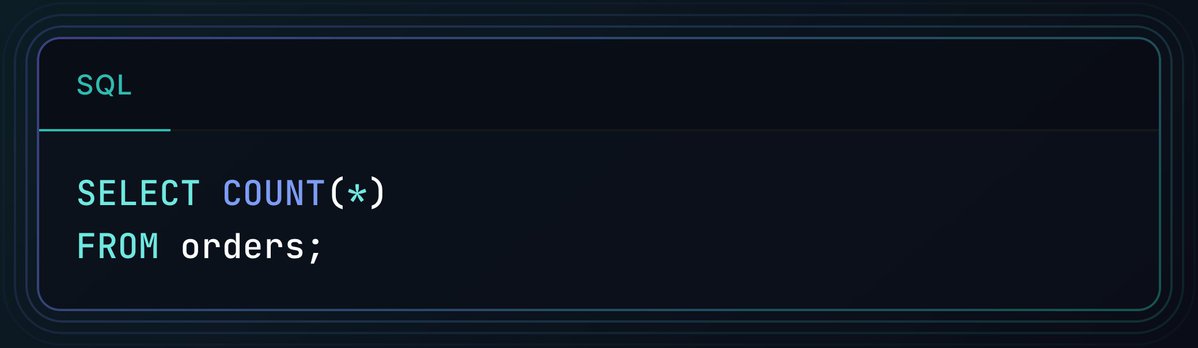
🚀 Unveiling the power of SQL window functions! 📊✨ Dive deep with me in my latest @Medium article as we demystify these dynamic tools for efficient data analysis. 🚀🔍 #SQL
https://t.co/xVsrndgUN6
INSTEAD OF WATCHING AN HOUR OF NETFLIX TONIGHT.
This 1 hour Stanford lecture by Joel Peterson will teach you more about negotiation and getting what you want than most people learn in years.
Bookmark it and give it an hour, no matter what.
Had a 1:1 call today with a guy who wants to get good at full stack development.
Here are some of the projects to get better at understanding kafka and event driven systems.
---
Order Processing System
Build a small e-commerce backend.
Flow:
User places order → order event goes to Kafka → inventory service consumes it → payment service consumes it → notification service sends email/SMS.
You will learn:
Kafka topics
producers
consumers
consumer groups
event-driven architecture
retry handling
dead-letter queues
idempotency
This is probably the best beginner Kafka project because it teaches how real companies use Kafka.
---
Real-Time Stock Price / Crypto Price Pipeline
Take live price data from Binance, CoinGecko, or any mock price generator.
Flow:
Price producer → Kafka topic → consumer stores data in Postgres/ClickHouse → another consumer calculates moving averages → frontend shows real-time chart.
You will learn:
streaming data
high-frequency events
batching
backpressure
time-series storage
consumer lag
WebSocket updates
This is great because Kafka is mostly used when data keeps flowing continuously.
---
Logging Pipeline
Create multiple fake microservices and make them generate logs.
Flow:
Service logs → Kafka → log processor → Elasticsearch/OpenSearch → dashboard.
You will learn:
log aggregation
partitioning
high-volume writes
schema design
filtering events
observability basics
This is how many real monitoring systems work internally.
---
User Activity Tracking System
Build something like analytics for a website.
Flow:
User clicks button → frontend sends event → backend publishes to Kafka → consumers process page views, clicks, sessions, conversion events.
You will learn:
event tracking
analytics pipelines
deduplication
event ordering
batch processing
real-time metrics
This is very close to how companies track product usage.
---
Notification System
Build a system where users receive email, SMS, and push notifications.
Flow:
App creates notification event → Kafka topic → email consumer, SMS consumer, push consumer.
Add retry logic for failed notifications.
You will learn:
fan-out pattern
consumer groups
retry topics
dead-letter topics
rate limiting
failure handling
This project is simple but teaches production-grade Kafka concepts.
---
Payment Event System
Create a fake wallet/payment app.
Flow:
Payment initiated → payment pending event → payment success/failure event → ledger update → notification → fraud check.
You will learn:
idempotency
exactly-once thinking
transactions
outbox pattern
event replay
data consistency
This is more advanced, but very valuable for fintech/backend roles.
---
Food Delivery Order Tracker
Build a Swiggy/Uber Eats style order tracking system.
Flow:
Restaurant accepts order → delivery partner assigned → location updates come continuously → Kafka processes updates → user sees live order status.
You will learn:
real-time location events
partition keys
ordering by order ID
WebSocket consumers
high-throughput ingestion
This is a very good system design + Kafka project.
---
Outbox Pattern Project
Build a simple service with Postgres + Kafka.
When a user creates an order, first write order data into Postgres and also write an event into an outbox_events table.
Then a background worker reads the outbox table and publishes to Kafka.
You will learn one of the most important real-world Kafka patterns:
Database and Kafka consistency.
Most noobs directly write to DB and Kafka separately.
But in production, if DB write succeeds and Kafka publish fails, your system becomes inconsistent.
Outbox pattern solves that.
---
Kafka Consumer Lag Dashboard
Build your own small Kafka monitoring tool.
Show:
consumer group
topic
partition
latest offset
committed offset
lag
messages per second
You will learn:
Kafka internals
offsets
partitions
consumer groups
monitoring
admin APIs
This project will make you understand Kafka much deeper than just building producers and consumers.
---
Mini Event-Driven Banking System
Build accounts, transactions, ledger, fraud check, and notifications.
Flow:
Money transfer request → Kafka event → ledger service → fraud service → notification service → audit service.
Important part:
Do not update balance casually.
Use a ledger table.
Every transaction should be append-only.
You will learn:
event sourcing basics
audit logs
financial consistency
idempotency keys
replayability
distributed system tradeoffs
---
Start with this:
- Order Processing System
- Notification System
- User Activity Tracking
- Outbox Pattern
- Payment/Ledger System
- Kafka Lag Dashboard
---
Also do not just “use Kafka”.
Actually break things.
Kill a consumer.
Restart Kafka.
Publish duplicate messages.
Make consumer fail randomly.
Add retry topic.
Add dead-letter topic.
Add idempotency key.
Increase partitions.
Run two consumers in same group.
Run two consumers in different groups.
Check what happens to ordering.
That is where Kafka learning actually starts.
Because Kafka is not hard because of producer and consumer code.
Kafka is hard because of failure, ordering, replay, duplication, lag, and consistency.
---
Feel free to book 1:1 calls with me (if you find this stuff useful)
https://t.co/d6Kktv8S7s
Most software engineers do not need 10 years to become senior.
They need 2 years of focused work.
But most people spend those 2 years like this:
8 hours office work
2 hours scrolling
1 hour complaining about manager
1 hour comparing salary on LinkedIn
30 minutes saving system design posts
0 minutes actually building depth
Then after 5 years they wonder why they are still being treated like a mid-level engineer.
The senior engineer path is boring but simple:
- Write 2 design docs every month.
- Debug 1 real production issue deeply instead of just patching it.
- Read 1 technical book every quarter.
- Build 1 side project where you handle auth, caching, queues, retries, observability, rate limits and deployments.
- Spend 30 minutes daily understanding databases, networking, distributed systems or cloud infra.
Do this for 12 months and you will not even recognize your old self.
The difference between mid-level and senior is not age.
It is ownership.
Mid-level engineers ask, “What should I build?”
Senior engineers ask, “What problem are we really solving, what can break, who gets impacted, and how do we make this reliable?”
Hard work is tiring.
But staying average for 10 years while knowing you had more inside you is a different kind of pain.
INSTEAD OF WATCHING AN HOUR OF NETFLIX TONIGHT.
This 1 hour Stanford lecture by Joel Peterson will teach you more about negotiation and getting what you want than most people learn in years.
Bookmark it and give it an hour, no matter what.
Best Model For The Use Case
Front-end coding - Opus 4.7
Back-end coding - GPT 5.5 xHigh
Visual understanding- Flash 3.5
Cheap - DeepSeek Flash
Video - Seedance 2.0
Image - GPT Image-2.0
Voice - Flash Live
Writing - Gemini 3.1 Pro
Real Time - Grok 4.3
Andrej Karpathy spent 4 minutes in an interview explaining a single idea
about how most people haven’t even started learning how to use AI
and everyone paying $20/month for a subscription.. that's not really using Claude at all
his point is that the real skill gap is the ability to build with AI
he identified 4 behaviors that break Claude Code and put them all into one file
a developer expanded it into 21 rules and published it - 82,000 stars and #1 on GitHub Trending
coding accuracy jumped from 65% to 94%
here's what these 21 rules actually are and why most developers using Claude every day have never configured them
the full breakdown is covered in the article below 👇
If recruiters were serious people, they'd be getting mad talent from this website. Especially in tech.
Here you don't get people who sit around to tick performance review boxes. You find people who do software becuase they love the shit out of it and they do not have anything else going.
These MOFOs will will port your entire arch to a more efficient stack and save you like $1k monthly all this without compromising the normal sprints.
They are so proud of their work. They talk about it everywhere. They love the work more than the pay.
But oh, you wanna go to LinkedIn and look for people with corporate mumbo Jumbo. I get it though, corporate doesn't like people who ask questions if they did, Safaricom would not have a disatrous app launch.
Big tech cracked the code. You do not treat techies like suits. You treat them like obsessed big babies. Then you watch magic happen. A suits guy would force uuid to work, and obsessed big baby would experiment with Snowflake or even create a whole language in their free time and. call it Rust. All this because an elevator kept on mulfunctioning due to memory bugs.
Over the past month, some of you reported Claude Code's quality had slipped. We investigated, and published a post-mortem on the three issues we found.
All are fixed in v2.1.116+ and we’ve reset usage limits for all subscribers.