Regulatory supervision before enforcement.
System of record for how regulatory risk was supervised — and when.
Fintech - AI - Digital Assets | @RegIntelX
Most companies have:
• policies
• meetings
• intentions
They do NOT have:
• time-stamped records
• documented decisions
• linked evidence
• named ownership
Here’s where this breaks in real life:
• Enterprise deal dies in diligence
• Bank partner issues remediation
• Investor walks
• Regulator reconstructs your decisions
This week:
FINRA → AI systems that act = supervised actors
SEC → every AI-generated claim needs a substantiation file
EU → enforcement is coming, even without guidance
Different regulators. Same message.
Most companies think regulatory risk is about knowing the rules.
It's not.
When regulators investigate, they ask something different:
Who evaluated the risk?
When was the decision made?
What record exists showing supervision?
In an automated economy, compliance becomes one thing:
Proof a human was paying attention.
RegTech tools mostly do one thing:
Track regulations.
But regulators don't ask:
"Did you track the rule?"
They ask:
"Show me how you supervised it."
Those are two completely different products.
Everyone is obsessing over new AI regulation.
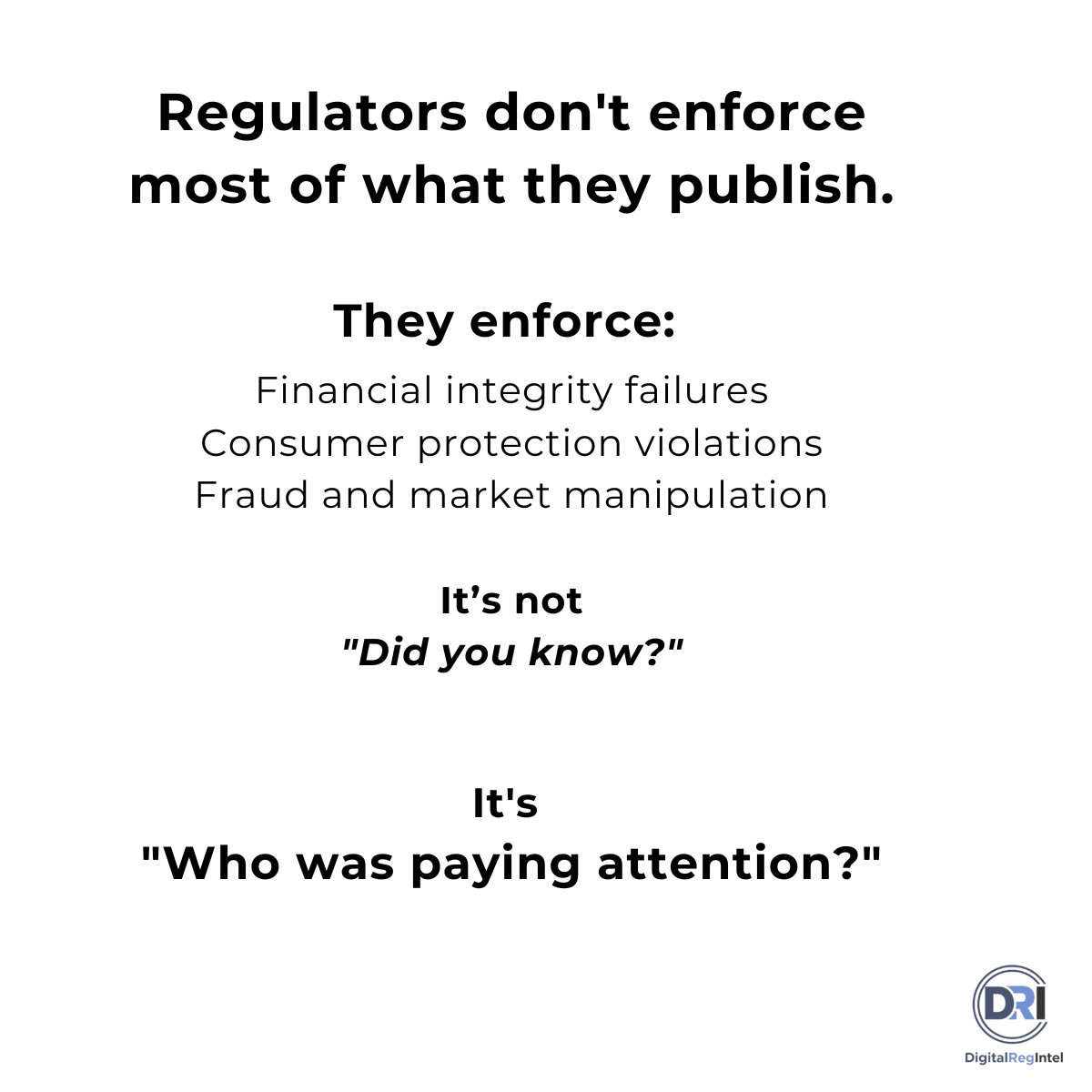
But regulators don't enforce most of what they publish.
Across the U.S. and Europe, enforcement keeps clustering around three things:
Fraud
Consumer harm
Financial integrity failures
Which leads to a much simpler question regulators eventually ask:
"Who was paying attention when the machines made the decision?"
The EU AI Act doesn’t “start” in August.
It started when you first had enough information to assess applicability.
The enforcement date just makes the question easier.
Stablecoin rule published Feb 25.
Comments close May 1.
That 60-day window isn’t just regulatory process.
It’s your documentation window.
After that, silence is visible.
When regulators look back 24 months from now, they won’t ask:
“Did you see the rule?”
They’ll ask:
“When did you evaluate it?”
The gap between those two questions is where liability forms.
Most companies can prove they “knew.”
Very few can prove:
• when they assessed
• who signed off
• what decision was made
• and that it wasn’t written later
Awareness ≠ supervision.
No new enforcement this week.
That’s the signal.
The OCC published a proposed stablecoin rule.
FTC AI deadline hits.
EU AI Act clock is ticking.
Once a rule is published, silence becomes a record.
@guilleflorvs@deel DigitalRegIntel— building the System of Record for autonomous agents: a Digital Regulatory Supervision Record that proves what you knew, when you knew it, and what you did about it.”
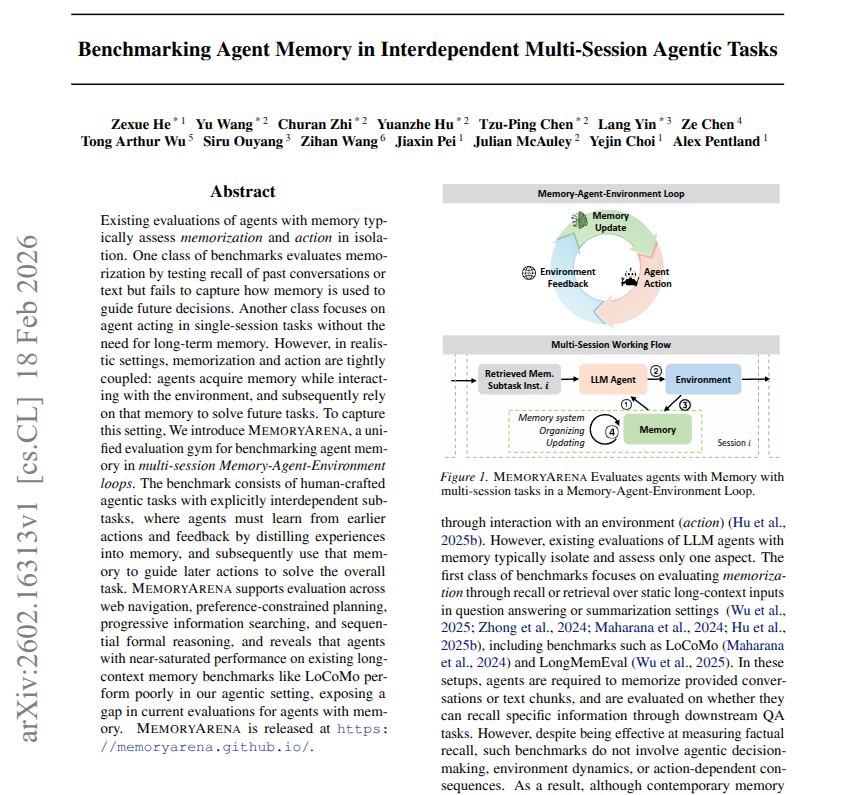
A new test proves that AI models completely fail at using long-term memory for realistic connected tasks.
The shocking finding is that the most advanced models and memory systems currently available fail terribly at this interdependent reasoning.
Right now, developers test AI memory by asking models to simply retrieve a random fact hidden inside a massive document.
This paper argues that real intelligence requires an agent to actually use past experiences to navigate new situations over time.
Current language models might seem smart when answering a single prompt, but they easily forget important details when working across multiple connected sessions.
To measure this flaw, the new MemoryArena benchmark forces AI agents to complete complex projects like group travel planning or bundled web shopping over a series of sequential steps.
The agents must carry over specific constraints from early decisions, like remembering a previous buyer's budget, to make correct choices later in the process.
When tested on these deeply dependent sequences, even advanced setups using external memory databases or long context windows crashed and burned with near 0 success rates on the hardest tasks.
The big deal is the realization that expanding a model's context window does not actually give it a functional working memory.
----
Paper Link – arxiv. org/abs/2602.16313
Paper Title: "MemoryArena: Benchmarking Agent Memory in Interdependent Multi-Session Agentic Tasks"