Trees recorded continuously for 30 years showed voltage fluctuating with the day-night cycle, lunar cycles, magnetic storms, and sunspot activity.
None of it could be explained by the trees' internal chemistry.
The experiment ran from 1938 to 1968 — funded by a grant from the National Institutes of Health.
The man behind it was Harold Saxton Burr — Professor of Anatomy at Yale School of Medicine, author of 90+ scientific papers, called by Michael Levin at Tufts "the godfather of the field" of bioelectricity.
For this experiment, Burr simultaneously recorded electrical activity from two trees — a maple and an elm — alongside an atmospheric probe measuring the air and a ground electrode measuring the Earth.
From the beginning, an extraordinary correspondence appeared.
The maple, the elm, the air, and the Earth all showed increases in electrical potential at the same time.
The voltage changes were different in size.
But the timing was simultaneous.
From midnight until sunrise, voltage gradients remained relatively low and constant.
With daylight, they increased markedly, usually reaching a peak around noon.
Beyond this daily rhythm, a repeating cycle approximating the lunar period appeared consistently across years of recordings.
Beyond the lunar cycle, sunspot activity also correlated with voltage changes in the trees.
Harlan Stetson of MIT had already shown that changes in the ionosphere significantly affect radio reception.
Burr applied the same logic to biology.
If the ionosphere is electrically altered by sunspot activity, and living systems are embedded in that field, the L-fields of living organisms cannot be isolated from those changes.
The simultaneous changes across the maple, elm, air, and Earth could not be explained by the trees' internal chemistry alone.
Something external was moving all four at once.
Burr's conclusion: life on this planet is not isolated from cosmic forces.
His words:
"If such extra-terrestrial forces can influence the relatively-simple L-fields of trees we would expect them to have an even greater influence on the more complex L-fields of men and women; and there is evidence that they do."
Dr. Leonard Ravitz, working in Burr's lab at Yale, tracked over 50,000 measurements on 430 people.
He found that voltage rhythms show how subjects feel.
When they felt "on top of the world," their voltage was high.
When they felt "below par," their voltages were low.
In healthy people, these rhythms formed steady, regular curves — stable enough that Burr believed you could predict in advance when someone would be at their best — and when they would feel below par.
Burr believed the same principle extended beyond individuals.
Periods of peak sunspot activity correlated with unusual worldwide unrest, riots, and disturbances.
Burr's direct conclusion:
If we could establish that mankind tends to be more excitable during increasing sunspot activity, this knowledge would be of the utmost value to world leaders.
The field of the environment changes.
The field of the organism responds.
Burr wasn't the first to reach this conclusion.
Georges Lakhovsky — Belarusian-French engineer, whose Multiple Wave Oscillator was authorized for cancer treatment in several Paris hospitals between 1931 and 1938 — had documented the same pattern decades earlier in "The Secret of Life," first published in 1929.
Lakhovsky documented unexpected correlations:
Peaks in sunspot activity — solar eruptions up to 200,000 km in diameter — coincided with earthquakes, rheumatic affections, and abnormal nervous excitement.
He even noted a correlation between solar magnetic storms and the outbreak of wars.
The interference was so powerful it dictated the cellular oscillation of agriculture.
The greatest vintage years of Bordeaux wine strictly aligned with maximum sunspot activity.
His explanation: sunspots generate magnetic storms that disrupt the cosmic radiation reaching Earth.
If they can disrupt human telegraph networks, they can disrupt the microscopic oscillating circuits of living cells.
Separately, a French professor using Lakhovsky's oscillating circuits on patients in a Paris hospital observed they improved consistently, but entered unexplained 8-day standstills where recovery completely stopped.
Every standstill coincided exactly with the full moon.
A Belgian engineer had already proven the same effect for wireless radio reception: lunar phases correspond with measurable maxima and minima in the reception of electromagnetic waves.
Lakhovsky applied the same physics to biology.
The full moon wasn't simply coinciding with slower healing.
Its interference effectively "jammed" the passive antennas the patients were wearing.
The moon changes the field.
The field changes the cell.
Lakhovsky wrote:
"It is not irrational to assume that interference brought about by sunspots may cause, if not disease, at least fatigue or transient disturbances."
Lakhovsky made an even stronger claim:
Light and heat — the radiations we can see and feel — may at times be secondary in biological significance compared with cosmic radiation, which remains entirely imperceptible to human senses.
Precisely because it cannot be detected directly, it has gone largely unexamined — despite, in his view, producing the more important biological effects.
According to both Burr and Lakhovsky, the cosmos isn't background noise.
It's a variable your biology is already responding to.
Fish in Utrecht had a problem. They were piling up against a 400-year-old canal lock every spring with nowhere to go. Predators found them. Many didn't make it.
Two ecologists fixed this with the Visdeurbe, or "fish doorbell."
They mounted an underwater camera on the Weerdsluis lock and built a website where anyone on Earth can watch the livestream and press a button when they see fish waiting at the gate. The lock keeper gets notified and opens it when enough people have rung in.
In 2024, over 20 million people tuned in. The doorbell was pressed 150,000 times by viewers in the Netherlands, Germany, the US, the UK, and dozens of other countries. Perch, bream, pike, rudd, catfish, and eels made it through to their spawning grounds upstream.
A centuries-old infrastructure problem was solved by a camera, a website, and strangers on the internet who wanted to help a fish get where it was going.
The site is visdeurbel dot nl. Migration season runs through spring. The fish doorbell season has come to an end for 2026, but they'll be back online March 1, 2027. See you next season!
THIS GUY BUILT A TOOL THAT TURNS ANY 3D MODEL INTO SOMETHING YOU CAN ACTUALLY TALK TO AND LEARN FROM
you upload any model and it becomes a thing you can ask questions to
> upload any 3d model and it turns into an interactive learning experience automatically
> the model can break apart on its own so you can go through it piece by piece and see how it all fits together
> ask it questions about any part and it explains what youre looking at
> control and move through the model just by talking to it
> it even generates quizzes off the model to test what you actually learned
a teacher can drop in a model of the heart, an engine, a molecule, whatever, and turn it into a full interactive lesson in minutes which is crazy
imagine learning anatomy by literally asking a 3d heart what each part does, instead of memorizing a flat diagram
here's the letter The Guardian decided to delete from their site because they are Zionist-owned scum. Btw Guardian hack Owen Jones did not say a word in objection to this, just like he didn't object to Guardian's Steve Bell's firing and other censorship: https://t.co/HafVOsbwY3
A lot of programmers are basically fans of programming itself. It’s all about them. They have mastered Rust or Haskell or Zig or whatever, but their objects of veneration are useful mainly as a backdrop to their own cleverness. Anyone who will spend six weeks rewriting a working system in a new language to make the types nicer is more into the rewrite than the product. Extreme technical obsession may serve as a security blanket. If you are the person who knows every flaw in the architecture, every impure abstraction, every place where the old code fails to express its true intent, you already know what to say in every meeting, which is so much safer than asking whether users care.
Your obsession with refactoring is your beard. If you know absolutely all the trivia about borrow checkers, effect systems, async runtimes, and build tools, it saves you from having to know anything about customers, deadlines, support, sales, documentation, or whether the thing actually helps anyone. That’s why it’s excruciatingly boring to talk to such people: they’re always asking you questions they know the answer to, and never shipping anything that answers a question users actually asked.
In 2000, a developer named D. Richard Hipp was building software for a U.S. Navy destroyer.
The ship needed a database that could work anywhere.
No server.
No internet.
No administrator.
No setup.
Just data that worked reliably, even in the middle of the ocean.
So he built one himself.
He called it SQLite.
Almost nobody noticed.
What makes SQLite different is that it breaks the rule every major database follows.
Most databases MySQL, PostgreSQL, Oracle run as separate server processes. Your application talks to the server, and the server manages the data.
SQLite has no server.
A complete database is just a single file on disk.
Your application reads and writes to that file directly.
No installation.
No configuration.
No network connection.
No database administrator.
You can copy it, move it, back it up, or ship it with your application like any other file.
Most databases are infrastructure.
SQLite is a library.
And because of that, it became the default database for the modern world.
Today, SQLite is embedded in billions of devices and applications.
Every iPhone uses it.
Every Android phone uses it.
Google Chrome uses it.
Adobe products use it.
Countless embedded systems, aircraft systems, applications, and operating systems depend on it.
You probably used SQLite today without realizing it.
Opened Instagram? SQLite.
Played music on Spotify? SQLite.
Sent messages on WhatsApp? SQLite.
The most remarkable part?
Richard Hipp still maintains the project he started more than two decades ago.
No venture capital.
No IPO.
No acquisition.
Just an obsessive focus on reliability.
SQLite’s test suite is famously enormous larger than the database engine itself and reliability is treated as a feature, not a marketing slogan.
Google relies on it.
Apple relies on it.
Microsoft relies on it.
Thousands of companies rely on it.
You are probably using SQLite right now.
And there’s a good chance you’ve never heard the name Richard Hipp.
That’s the thing about the most important software in the world:
Sometimes it’s invisible.
Groundbreaking botanical research is challenging the long-held belief in human exceptionalism, suggesting that plants possess forms of spatial awareness, intentionality, and consciousness.
For centuries, humans have regarded plants as passive organisms, but pioneering studies are rewriting this view. According to plant neurobiologist Dr. Stefano Mancuso, plants display sophisticated behaviors that parallel those of conscious animals. In laboratory experiments, plants react to anesthesia in ways strikingly similar to humans and animals — for instance, the Venus flytrap becomes completely unresponsive when anesthetized.
Time-lapse studies further reveal remarkable intelligence in common bean plants, which demonstrate clear spatial awareness by precisely aiming shoots toward supports and even adjusting their growth strategy when they detect another plant has already claimed a support.
These findings indicate that consciousness may not be limited to organisms with brains, but could be a more flexible property emerging in diverse life forms. As trees migrate northward in response to climate change, mirroring animal migration, researchers argue that our understanding of “mind” must expand beyond traditional boundaries.
With over three trillion trees on Earth, acknowledging plant consciousness could transform our ethical frameworks, agricultural practices, and relationship with nature, shifting from viewing plants as mere resources to recognizing them as active, aware participants in our shared ecosystem.
[Yokawa, K., Kagenishi, T., Pavlovič, A., Gall, S., Weiland, M., Mancuso, S., & Baluška, F. (2018). Anaesthetics stop diverse plant organ movements, affect endocytic vesicle recycling and ROS homeostasis, and block action potentials in Venus flytraps. Annals of Botany, 122(5), 747–756. DOI: 10.1093/aob/mcx155]
SOMEONE VIBE CODED A VIDEO STREAM THAT IS SECRETLY 100% TEXT SO IT CANT BE BLOCKED
it plays 360p video at 30fps, but theres no actual video on the page. every frame is just colored text characters being repainted on a canvas
to the browser its not media at all, its javascript updating some text
its called asciline, and here's the trick:
> the server decodes the real video and streams it as binary packed text over websockets
> the browser paints thousands of colored block characters fast enough to look like 360p
> ad blockers and autoplay blockers cant catch it because theres no video element to catch
> it streams in kilobytes since its just strings, so it runs on trash internet
since the video is literally text, you can apply css glows to it, let people copy paste a moving frame, or feed it straight to a local llm
however, an unblockable stream is also an unblockable ad as well
The year is 1949.
The Nobel Prize in Medicine has just gone to the man who invented the lobotomy. Your doctor suggests one for your sister, who has not been herself since the baby came. It is the most celebrated advance in psychiatry of the age, and he is simply current. By the time the prize curdles into an embarrassment, close to twenty thousand Americans have had the operation, and proportionally more here in Britain.
The year is 1956.
Lay the baby down on his front, the doctor says. So does the most trusted childcare book ever written, the one on every new mother's shelf. On his back he might choke, the reasoning goes. Millions obey. The advice holds for nearly thirty years, long after the evidence has quietly turned, and a generation of cot deaths is counted before anyone thinks to roll the babies over.
The year is 1966.
A bestselling book informs your wife that menopause is a disease, that she is, in the author's word, a castrate, and that a small daily pill will keep her youthful and tolerable to live with. Her doctor agrees. The drug becomes one of the most prescribed in the country. Nobody mentions that the author sat on the payroll of the company that made it. That detail surfaces decades later, in the same year the landmark trial is halted early for raising rates of breast cancer, stroke and clots.
The year is 1979.
Your ulcer is caused by stress and sharp food, the doctor explains. Calm down, drink milk, take the antacid that happens to be the best-selling medicine on earth. Two Australians are about to prove that most ulcers are caused by a bacterium and cured by a fortnight of antibiotics. The profession laughs. One of them eventually drinks a beaker of the stuff to settle the matter. The establishment takes the better part of twenty years to stop laughing. The Nobel lands in 2005.
The year is 1985.
Butter is dangerous, the doctor says. Switch to margarine, it is modern, it is heart-healthy, the experts are united. The spread he nudges you toward is loaded with trans fats, which the next decade will identify as the genuinely dangerous one, and which will eventually be banned outright. The butter goes quietly back in the fridge. No correction is ever printed at the volume of the original warning.
The year is 1992.
There is a pyramid on the surgery wall, and the very same one in your grandchild's classroom. Bread, cereal, rice and pasta form the broad virtuous base, up to eleven servings a day. Fat is exiled to the tiny tip. The chart was reportedly held back a year while the relevant industries had their say. It is wrong at the bottom and wrong at the top.
Now it is today.
Your doctor has new guidelines, new studies, a fresh consensus, delivered with precisely the steady confidence of every guideline above. He believes it, and he has good reason to. So did every doctor in this thread. None of them were villains. Each was sincere, most were kind, and all were certain, reading from a map that somebody else had drawn and handed them. That is the part worth sitting with.
So when the man in the white coat tells you what to eat, what to fear, and what to swallow every morning for the rest of your life, you are allowed to ask. Who paid for the study. What the evidence says beneath the headline. What he was just as certain about thirty years ago, and where that advice sits now.
Then make up your own mind. Call it scepticism, or call it whatever your grandmother called it when she ignored the advert, kept the butter where it was, and lived to ninety-one.
It has outlasted every consensus on this list. It will outlast this one too.
My wife asked why I was spending an entire Saturday with Claude.
Six hours later, we had:
✓ 47 data broker listings removed
✓ 12 old accounts deleted
✓ 3 search results suppressed
The scary part wasn't the cleanup.
It was discovering how much of our personal information was publicly available without us realizing it.
Here's the exact process I followed to wipe as much of our digital footprint as possible. 🧵
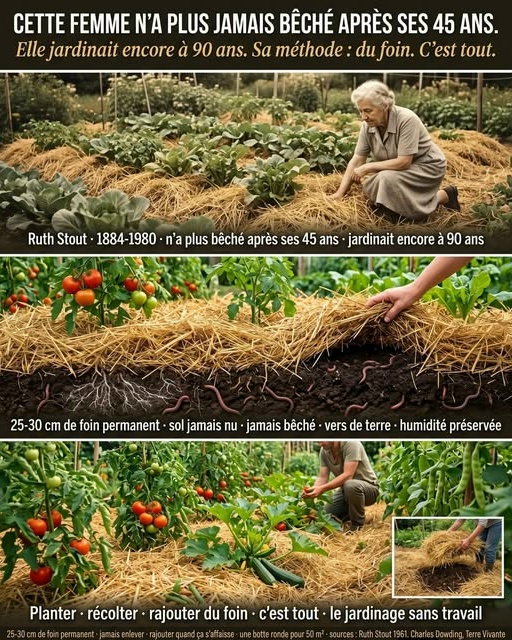
Cette femme n'a plus jamais bêché après
ses 45 ans. Elle jardinait encore à 90 ans.
Ruth Stout. Américaine. Née en 1884.
En 1944, elle attendait que quelqu'un vienne labourer son potager. Personne ne venait. Impatiente, elle a pris ses graines et les a plantées directement dans le sol non travaillé,
sous le foin de l'année précédente.
Tout a poussé. Mieux qu'avant.
Elle n'a plus jamais bêché. Pendant 36 ans.
La méthode Ruth Stout
le paillage permanent total :
Un seul principe : le sol ne doit jamais être nu. Jamais travaillé. Jamais bêché.
Une couche permanente de foin ou de paille de 20 à 30 cm recouvre tout — les allées, les planches, les espaces entre les plantes. Elle est renouvelée continuellement dès qu'elle s'affaisse.
C'est tout. Il n'y a pas d'étape 2.
Ce qui se passe sous le foin :
→ Les vers de terre prolifèrent — ils adorent l'humidité et le foin en décomposition
→ Le sol reste frais et humide même en canicule — Ruth n'arrosait pratiquement jamais
→ Les mauvaises herbes ne germent pas — sans lumière, les graines restent dormantes
→ Le foin en décomposition nourrit le sol continuellement — zéro engrais
Comment démarrer :
→ Si tu as une pelouse ou des mauvaises herbes : pose du carton mouillé directement sur la végétation, recouvre immédiatement
de 25-30 cm de foin
→ Pour planter : écarte le foin, fais un petit trou dans le sol, plante, referme le foin autour du plant
→ Pour semer : écarte le foin, dépose les graines sur le sol, recouvre de 2-3 cm de terreau fin,
puis referme légèrement le foin autour
→ Renouvellement : quand le foin s'affaisse sous 15 cm, rajoute une couche par-dessus — jamais enlever le vieux foin, il se décompose et nourrit
Ce que Ruth ne faisait plus :
→ Bêcher — jamais
→ Désherber — jamais
→ Arroser — presque jamais
→ Fertiliser — jamais
Ce qu'elle faisait uniquement :
→ Planter
→ Récolter
→ Rajouter du foin
Le seul investissement :
Du foin ou de la paille en grande quantité la première année. Contacte un agriculteur local — une botte ronde de foin suffit pour un potager de 50 m². Prix : 10 à 30 € selon la région.
Ruth Stout appelait ça "le jardinage sans travail". Elle a écrit un livre à 77 ans pour l'expliquer.
Elle jardinait encore à 90 ans.
Sources : Ruth Stout "Gardening Without Work" (1961), Charles Dowding (no-dig),
Terre Vivante
In 2016, the Netherlands Meteorological Institute adjusted temperatures at De Bilt, the country's main climate station. Daily maximums from 1901 to 1950 were lowered by up to 1.9C, which removed 16 of 23 heatwaves from the record.
The altered data were then used to claim modern heatwaves were unprecedented.
Four researchers challenged the changes, but the institute dismissed the criticism, so the analysis went to peer review. In 2021, it was published, conclusively demonstrating the method systematically erased historical heat extremes.
Today, the Meteorological Institute has quietly changed its approach, and as a result, seven erased heatwaves have been restored, including the extreme summer of 1947.
Here again, we have a government agency caught rewriting climate history. The Netherlands Meteorological Institute erased heatwaves of the past, ignored critics, and reinstated the truth only when the evidence became impossible to ignore.
Policies were built on that manipulated record.
Dutch farmers lost livelihoods.
Industry and the wider economy paid the price.
But accountability is coming.
That water clarity is an engineering decision, and the math behind it is wilder than the video.
Roman aqueducts ran on gravity alone. No pumps, no pressure systems. Engineers carved channels with a gradient so shallow it borders on absurd. The Pont du Gard in southern France drops 2.5 centimeters over 275 meters. That's roughly the thickness of a coin over the length of three football fields. They surveyed that accuracy with plumb lines and wooden leveling instruments.
The clarity you're seeing is a direct product of flow velocity. Too steep and the water erodes the channel walls, picks up sediment, turns brown. Too flat and it stagnates. Roman engineers targeted a slope of about 20 centimeters per kilometer, which kept the water moving fast enough to stay fresh but slow enough to stay clear. Before the water reached the city, it passed through multi-chamber settling tanks where velocity dropped near zero. Suspended particles sank. Clean water flowed out the top into the next chamber. Repeat three or four times.
Pliny specified the minimum slope in writing. Vitruvius published the exact mortar ratio for hydraulic cement: one part lime to two parts volcanic ash for underwater work. The pozzolana from Pozzuoli reacted with water to form a calcium-aluminum-silicate compound that actually gets stronger the longer it sits submerged. Modern concrete degrades in water. Roman concrete bonds with it.
Scale the whole system and it gets harder to process. Eleven aqueducts fed Rome at its peak. Combined output: roughly 1 million cubic meters of water per day. That works out to about 250 gallons per person for a city of one million. Modern New York delivers about 125 gallons per person per day. Ancient Rome had access to double the per capita water supply of the largest city in the United States, running entirely on slope and stone.
The Trevi Fountain in Rome is still fed by one of them. Two thousand years, same source, same gravity, same water.


![Rainmaker1973's tweet photo. Groundbreaking botanical research is challenging the long-held belief in human exceptionalism, suggesting that plants possess forms of spatial awareness, intentionality, and consciousness.
For centuries, humans have regarded plants as passive organisms, but pioneering studies are rewriting this view. According to plant neurobiologist Dr. Stefano Mancuso, plants display sophisticated behaviors that parallel those of conscious animals. In laboratory experiments, plants react to anesthesia in ways strikingly similar to humans and animals — for instance, the Venus flytrap becomes completely unresponsive when anesthetized.
Time-lapse studies further reveal remarkable intelligence in common bean plants, which demonstrate clear spatial awareness by precisely aiming shoots toward supports and even adjusting their growth strategy when they detect another plant has already claimed a support.
These findings indicate that consciousness may not be limited to organisms with brains, but could be a more flexible property emerging in diverse life forms. As trees migrate northward in response to climate change, mirroring animal migration, researchers argue that our understanding of “mind” must expand beyond traditional boundaries.
With over three trillion trees on Earth, acknowledging plant consciousness could transform our ethical frameworks, agricultural practices, and relationship with nature, shifting from viewing plants as mere resources to recognizing them as active, aware participants in our shared ecosystem.
[Yokawa, K., Kagenishi, T., Pavlovič, A., Gall, S., Weiland, M., Mancuso, S., & Baluška, F. (2018). Anaesthetics stop diverse plant organ movements, affect endocytic vesicle recycling and ROS homeostasis, and block action potentials in Venus flytraps. Annals of Botany, 122(5), 747–756. DOI: 10.1093/aob/mcx155]](https://pbs.twimg.com/media/HLQewVTXMAAtrYC.jpg)