When can we use random unitaries to (efficiently) model physical dynamics? 💻 ⚛️
Excited to share a couple of works with Liang Mao, Fernando Brandão, @RobertHuangHY, Thomas Schuster in which we explore this question!
[1] https://t.co/4fpgcbWO5i
[2] https://t.co/wK4404Qaeq
1/8
Should you do a theory phd in 2026?
Some thoughts from the first half of my own grad school career, for anyone in the midst of applying (or recruiting students!)
[link ↓]
@karch_andreas from quickly glancing over this, it's surprising that out of all the sub-areas, the leading models performed the *worst* on classical physics. should I interpret that to mean that we're better at coming up with hard but well-defined classical physics problems to test them on?
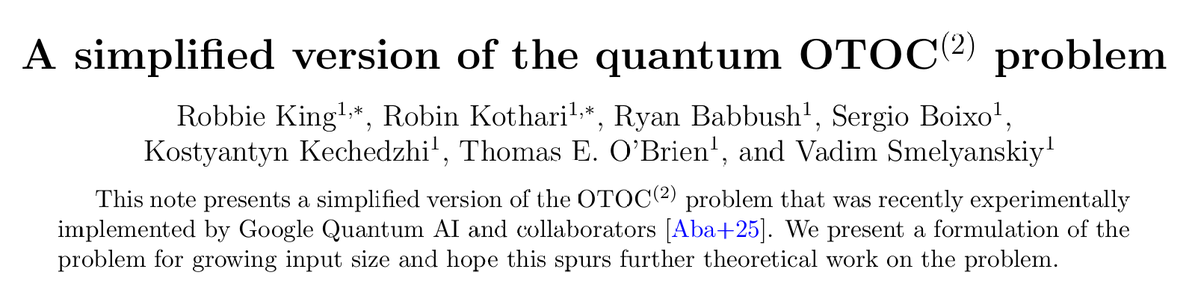
Are you a computer scientist and don't know what an OTOC is, but want to understand the problem solved in the @Nature paper by @GoogleQuantumAI? We wrote a 2-page note that explains the motivation and presents a simplified version of the problem for arbitrary input size.
+ in the non-adaptive setting, there exist ensembles w/ natural spectral distributions whose dynamics look random in O(1) time ⌛
These results complement each other & highlight subtleties in formulating random models which capture the properties of physical dynamics 🔎 ✨
8/8
When can we use random unitaries to (efficiently) model physical dynamics? 💻 ⚛️
Excited to share a couple of works with Liang Mao, Fernando Brandão, @RobertHuangHY, Thomas Schuster in which we explore this question!
[1] https://t.co/4fpgcbWO5i
[2] https://t.co/wK4404Qaeq
1/8
However, when this constraint is relaxed, we show it is possible to construct ensembles of quasi-local time-independent Hamiltonians which generate pseudorandom dynamics!
These ensembles can also be efficiently simulated assuming the existence of quantum-secure OWFs 💻
7/8
The pioneering work of Clarke, Devoret, and Martinis showed that very cold electrical circuits behave in ways that exhibit fundamental principles of quantum physics. Building on this achievement, Devoret, Martinis, and many others are constructing quantum computers, powerful tools for exploring quantum science and solving very hard computational problems. Congratulations!
🚨 Volume VI of MIT Science Policy Review is here! Theme: Ethics in Innovation. 22 peer-reviewed pieces spanning 🌍 climate, 🤖 AI, 🩺healthcare, 🔬 science enterprise & 🚀 space.
Read now 👉 https://t.co/gYNAZbSkTQ





![reionize's tweet photo. When can we use random unitaries to (efficiently) model physical dynamics? 💻 ⚛️
Excited to share a couple of works with Liang Mao, Fernando Brandão, @RobertHuangHY, Thomas Schuster in which we explore this question!
[1] https://t.co/4fpgcbWO5i
[2] https://t.co/wK4404Qaeq
1/8 https://t.co/UGsw4ETjGm](https://pbs.twimg.com/media/G23SA2EaYAAtNyC.png)
![reionize's tweet photo. Should you do a theory phd in 2026?
Some thoughts from the first half of my own grad school career, for anyone in the midst of applying (or recruiting students!)
[link ↓] https://t.co/i7Zo0GYcZu](https://pbs.twimg.com/media/HU4klE0bQAEb5aq.jpg)