Five months’ work. A new book on Fairfax. How did a lost decade give way to a compounding machine—and why might the market be missing the opportunity? The business, the decisions and the lessons for investors. Click the link for a free PDF. $FFH.TO $FRFHF
https://t.co/BRu4QtCNHb
This type of thing is fun to tweet, but it misses the point. Complexity isn’t the reason $NN has been weak, uncertainty is. The asset value has recently been made obvious, the regulatory alignment should be obvious, it’s the precise shape and timing of the ultimate outcome that are fuzzy; and that fuzziness clearly makes many uncomfortable.
Last week we saw the acquisition of 800 MHz spectrum for $8 billion by SpaceX.
This is the most relevant comparable transaction NextNav $NN has had or will have before it runs its own deal process (post-FCC process). It is vital that shareholders know how to interpret it. Maybe someone has broken down the math, but I haven’t seen it. So, I will lay out how I think about it here.
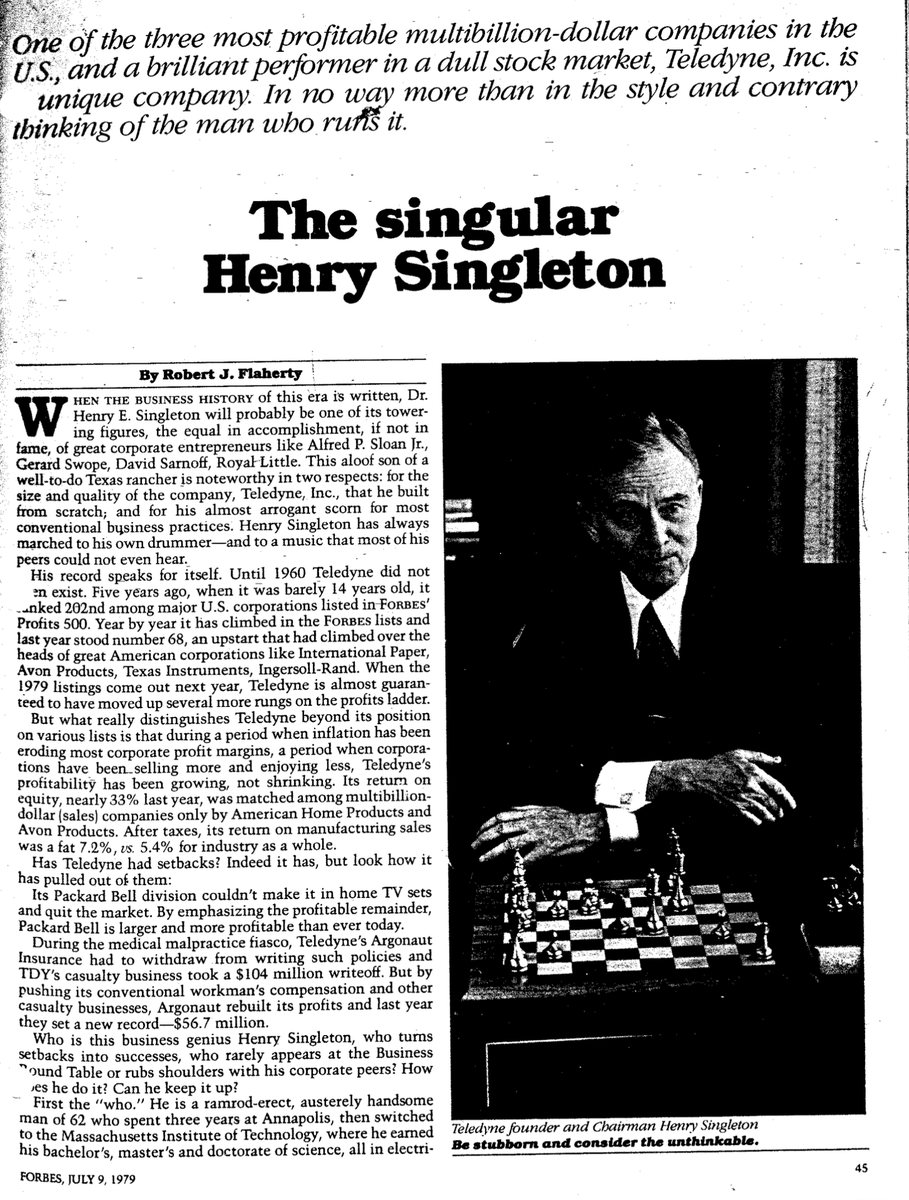
Charlie Munger said "Henry Singleton's financial returns were a mile higher than anyone else's, they were utterly ridiculous."
NEW episode: "HOW HENRY SINGLETON WORKED" based on the hard-to-find book Distant Force: A Memoir of the Teledyne Corporation and The Man Who Created It
0:00 — "He aggressively repurchased his stock, eventually buying over ninety percent of Teledyne's shares."
0:45 — "He was known as The Sphinx for his reluctance to speak with either analysts or journalists."
1:25 — Charlie Munger: "Singleton's financial returns were a mile higher than anyone else's, they were utterly ridiculous."
2:00 — Buffett: "The heads of many companies are not skilled in capital allocation. Their inadequacy is not surprising. Most bosses rise to the top because they've excelled in an area such as marketing, production, engineering, administration, or sometimes institutional politics."
4:10 — Singleton: "Our conclusion was that the key was cash flow. Our attitude towards cash generation and asset management came out of our own thinking. It is not copied."
4:30 — Buffett: "Henry Singleton has the best operating and capital deployment record in American business. If one took the hundred top business school graduates and made a composite of their triumphs, their record would not be as good as Singleton's."
9:40 — Singleton: "If anyone wants to follow Teledyne, they should get used to the fact that our quarterly earnings will jiggle. Our accounting is set to maximize cash flow, not reported earnings."
10:50 — Singleton believed buying stock at attractive prices was self-catalyzing, analogous to coiling a spring that at some future point would surge forward to realize full value."
11:50 — Singleton: "I don't reserve any day-to-day responsibilities for myself, so I don't get into any particular rut. I do not define my job in any rigid terms, but in terms of having the freedom to do whatever seems to be in the best interest of the company at any time."
14:35 — Singleton: "If everyone's doing them, there must be something wrong with them." (on share repurchases by Fortune 500 companies)
26:30 — Singleton: "Teledyne is like a living plant, with our companies as the different branches and each putting out new branches and growing so that no one business is too significant."
28:35 — Singleton: "We work our heads off to increase our own capability at collecting and promoting the right people. To the extent that we succeed, the whole company will succeed."
32:30 — "What's unique about him is that I'll ask him a question about one of these companies that I've asked him to supervise, and he always knows the exact numerical answer. That's the kind of fellow that you pick who runs a company and does it well."
35:00 — Singleton: "There are tremendous values in the stock market, but in buying stocks, not entire companies. Buying companies tends to raise the purchase price too high."
41:35 — Claude Shannon on Singleton: "He always tries to work out the best moves, and maybe he doesn't like to talk too much because when you're playing a game, you don't tell anyone else what your strategy is."
42:00 — Singleton: "We are not particularly persuaded by quick, temporary gains. We'd rather get something permanent, and that takes time."
44:40 — Munger: "Henry Singleton was the smartest single human being I've ever known in my entire life."
45:00 — Munger: "Henry was a lot smarter, but Warren had thought about investments a lot longer." (distinguishing raw intelligence from accumulated experience)
We compare some great P/C insurers. Today an investor is able to buy the top performing P/C insurer - with among the best future prospects - at the cheapest valuation. Nuts. Click the link for details. $FFH.TO $BRK $WRB $IFC.TO $BRK.B $BRK $TRV $CB $MKL
https://t.co/Ha7FzWL4M7
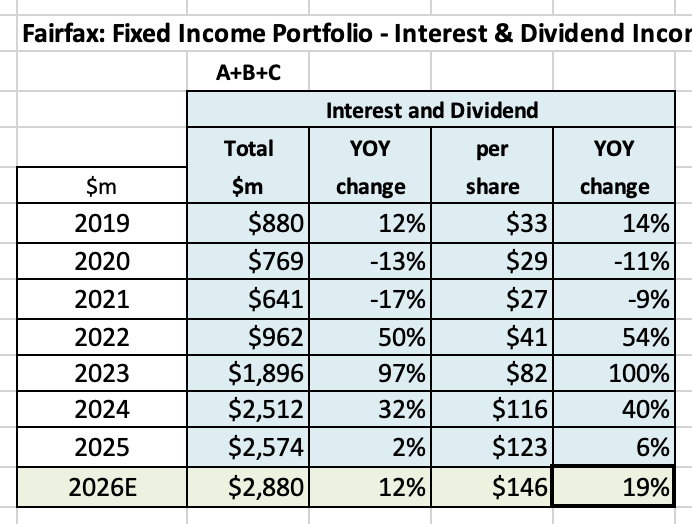
Interest and dividend income has become - by far - the most important of Fairfax's 5 income streams. How is it performing in 2026? Up 19% to $2.9B or $146/share. Outstanding. Low duration + higher rates + aggressive share buybacks = much higher I&D income/share.
$FFH.TO $FRFHF
$OMER My friend Matt just sent this to me. Great review of how Yartemlia works.
Narsoplimab Mechanism of Action: Fighting Transplant–Associated Thrombot... https://t.co/cxTshzo3Qq via @YouTube
$FFH.TO buybacks confirmed. They did buy the big block and cancelled almost 500k shares in June. I like that they continued to pick away after the block. I expect they slow down in July as they usually do when they report earnings.
@papaspectrum@darkstarsats Seeing a specific month attached, instead of “TBD” shows the FCC still has it on the active schedule to drop in July. But realistically (as you pointed out), nobody knows exactly when or if, it will drop this month. The “07/00/2026” is just a place holder.
Does management/culture matter? That is the topic we will explore in 6 articles in the next week. We start with one of the most important aspects: Is management shareholder-friendly? We have 7 tests. We also review how Fairfax stacks up. $FFH.TO $BRK.A
https://t.co/P0h4Y8IWXS
$MAKO
Stifel analyst Ryan Walker initiates coverage on Mako with C$20 price target.
"We see production more than quadrupling to 173koz by 2030... AISC declining 23 per cent to US$1,449/oz."
https://t.co/vy9EDxNZUh
Henry Singleton on Teledyne's share buybacks, 1972:
"In October 1972 we tendered for 1 million shares and 8.9 million came in. We took them all at $20 and figured that was a fluke. But instead of going up, our stock went down. So we kept tendering."
Between 1972 and 1976 he reduced Teledyne's outstanding shares 64%, from 32 million to 11.4 million. The investors who happily sold at $14 watched the stock reach $130 a few years later.
"Just buy very good value," Singleton said, "and when the market is ready that value will be recognized."
Excellent summary of $ELF.TO by @East72Dynasty .
$ELF.TO Discounted (38% discount to NAV), Compounder (12.4% NAV CAGR since 1969), Quality/Diversified assets with high insider ownership and sharp capital allocation. @BrownMarubozu
A takeout on succession and the long term future at Fairfax, with insights from Prem Watsa taken from my book, The Fairfax Way. $ffh.to
The Fairfax playbook, Part 2: Inside Prem Watsa’s long-term plan for family control and corporate longevity - https://t.co/rrlo1Oeldo
Here NextNav demonstrates very clearly that retailers worried about RFID can relax. $NN
NextNav credibility score upgraded, IMO.
NextNav Demonstrates 5G and RFID Coexistence in the Lower 900 MHz Band https://t.co/U8yMutEhVs via @YouTube