Charlie Munger once read a single magazine article, spent ninety minutes thinking about it, and made $80 million investing in the idea.
The company looked like a disaster. It had a ton of debt after five spinoffs in six years, and its revenues shrunk because of the 2001 recession. Principal payments on its debt were coming due that the company couldn't make.
I spent weeks reconstructing what Munger actually saw, down to finding the exact article he likely read in 2001.
New series at The Owner's Memo.
https://t.co/puPcZn7OfP
John Templeton believed that you must be a positive person to succeed in life. In The Templeton Plan, he compiled a list of quotes about positive behavior:
“When you look at the world in a narrow way, how narrow it seems! When you look at it in a mean way, how mean it is! When you look at it selfishly, how selfish it is! But when you look at it in a broad, generous, friendly spirit, what wonderful people you find in it.”
- Horace Rutledge
“You find yourself refreshed by the presence of cheerful people. Why not make an earnest effort to confer that pleasure on others? Half the battle is gained if you never allow yourself to say anything gloomy.”
- Lydia Maria Child
“Wear a smile and have friends; wear a scowl and have wrinkles. What do we live for if not to make the world less difficult for each other?”
- George Eliot
“Kind words do not cost much. They never blister the tongue or lips. Mental trouble was never known to arise from such quarters. Though they do not cost much yet they accomplish much. They make other people good-natured. They also produce their own image on men’s souls, and a beautiful image it is.”
- Blaise Pascal
“I can complain because rosebushes have thorns or rejoice because thornbushes have roses. It’s all how you look at it.”
- J. Kenfield Morley
“A pessimist is one who makes difficulties of his opportunities; an optimist is one who makes opportunities of his difficulties.”
- Reginald B. Mansell
“The world is a looking glass and gives back to every man the reflection of his own face. Frown at it and it will in turn look sourly upon you; laugh at it and with it and it is a jolly, kind companion.”
- William Makepeace Thackeray
This is a good example of how great businesses can constantly surprise you in their ability to expand and generate more revenue.
Stratechery is and always has been great and unique. Now, Ben has another (likely huge) stream of revenue dropping right to the bottom line.
I always intended Stratechery to have a sponsorship component; it just took me 12 years to get back to it. That I could do so with the company that made the subscription business possible makes me so happy. There is nothing better than endorsing a product you whole-heartedly believe in.
I heard a fascinating story about human behaviour today.
A tour guide at a historic castle was getting very high ratings from tourists.
They went to see what he was doing differently.
On several of the rooms he had used the red velvet ropes to block the doors.
These were normally used when the rooms were being repaired or cleaned. He had put them up at the beginning of each day.
During g the tour he would look around and say to the group “would you like to have a quick look in here?” And they would say yes in hushed tones.
He would ceremoniously unclip the rope and let them through into the room. A room that was always a normal part of every tour.
This simple little bit of theatre made people love the tour that much more.
Humans love what we can’t have.
“A good way to discover your shortcomings,” said the Master, “is to observe what irritates you in others.”
The ideas here are so deep they need to be sat with and thought about. Not ideal for X, obviously, so give it a moment if you can.
Anthony de Mello 🗣️
“A good way to discover your shortcomings,” said the Master, “is to observe what irritates you in others.”
"Live your life as you see fit. That's not selfish. Selfish is to demand that others live their lives as you see fit."
"Seek to change yourself, not other people. It is easier to protect your feet with slippers than to carpet the whole of the earth."
"If people want happiness so badly, why don’t they attempt to understand their false beliefs? First, because it never occurs to them to see them as false or even as beliefs. They see them as facts and reality, so deeply have they been programmed."
“As soon as you look at the world through an ideology you are finished. No reality fits an ideology. Life is beyond that. … That is why people are always searching for a meaning to life… Meaning is only found when you go beyond meaning."
“People who want a cure, provided they can have it without pain, are like those who favour progress, provided they can have it without change.”
“The world is full of sorrow. The root of sorrow is attachment. The uprooting of sorrow means the uprooting, the dropping of attachments.”
"Sinners often speak the truth. And saints have led people astray. Examine what is said, not the one who says it."
“Suffering occurs when you clash with reality. When your illusions clash with reality, when your falsehoods clash with truth, then you have suffering. Otherwise there is no suffering.”
“All I can do for you is help you to unlearn. That’s what learning is all about where spirituality is concerned: unlearning, unlearning almost everything you’ve been taught. A willingness to unlearn, to listen.”
“Think of a flabby person covered with fat. That is what your mind can become—flabby, covered with layers of fat till it becomes too dull and lazy to think, to observe, to explore, to discover. It loses its alertness, its aliveness, its flexibility and goes to sleep. What are these layers? Every belief that you hold, every conclusion you have reached about persons and things, every habit and every attachment. In your formative years you should have been helped to scrape off these layers and liberate your mind. Instead your society, your culture, which put these layers on your mind in the first place, has educated you to not even notice them, to go to sleep and let other people—the experts: your politicians, your cultural and religious leaders—do your thinking for you. So you are weighed down with the load of unexamined, unquestioned authority and tradition.”
“When you come to see you are not as wise today as you thought you were yesterday, you are wiser today.”
“Of what use is it to be tolerant of others if you are convinced that you are right and everyone who disagrees with you is wrong? That isn’t tolerance but condescension.”
“To be properly wicked, you do not have to break the Law. Just observe it to the letter.”
“Certainty is the culprit. The spiritual person knows uncertainty—a state of mind unknown to the religious fanatic.”
“Most people end up being conformists; they adapt to prison life. A few become reformers; they fight for better lighting, better ventilation. Hardly anyone becomes a rebel, a revolutionary who breaks down the prison walls. You can only be a revolutionary when you see the prison walls in the first place.”
“The neurotic is a person who worries about something that did not happen in the past. He’s not like us normal people who worry about things that will not happen in the future.”
“You listen,” said the Master, “not to discover, but to find something that confirms your own thoughts. You argue, not to find the truth, but to vindicate your thinking.”
"Another illusion is that external events have the power to hurt you, that other people have the power to hurt you. They don't. It's you who give this power to them."
"Enlightenment is: absolute cooperation with the inevitable."
“If you see through yourself, you will see through everyone.”
Early photo of Li Lu (right) with Chinese student leaders at Tiananmen Square in June 1989. Li would later flee to France and then to the US, where he enrolled at Columbia University.
https://t.co/kvHmAORcO0
While I don't love Stewart's tone and language in the interview (which doesn't give enough shrift to the potential good that AI will bring), his comments about work and purpose are good ones.
The psychologist Phil Stutz says that one of the things healthy people always have is a need for constant work.
AI will not relieve that. It will just relieve us of many tasks. But each of us will still face our need to work on something meaningful, and abundance will not prevent us from finding it, each in our own way.
Former Anthropic researcher Jacob Coxon (@hilbertspaess) and Jon Stewart discuss AI, jobs disappearing, universal income, and whether tech CEOs are creating a dystopian future
Nice Q3 letter from Graham Rhodes (@longriver_hk) at Longriver. He creates an update of William Thorndike's work in The Outsiders and finds 24 current "Insider" CEOs.
https://t.co/awrfWjvSJx
The best companies in the world have the highest ROICs. If they can keep those ROICs, they can be great investments.
In Michael Mauboussin and Dan Callahan's data from 1990 to 2022, companies that started a three-year period in the top quintile of ROIC and stayed there returned 20% a year to shareholders.
However, companies that started in the bottom quintile and climbed to the top returned 33% a year. Very few can make the climb, and I wanted to find some today.
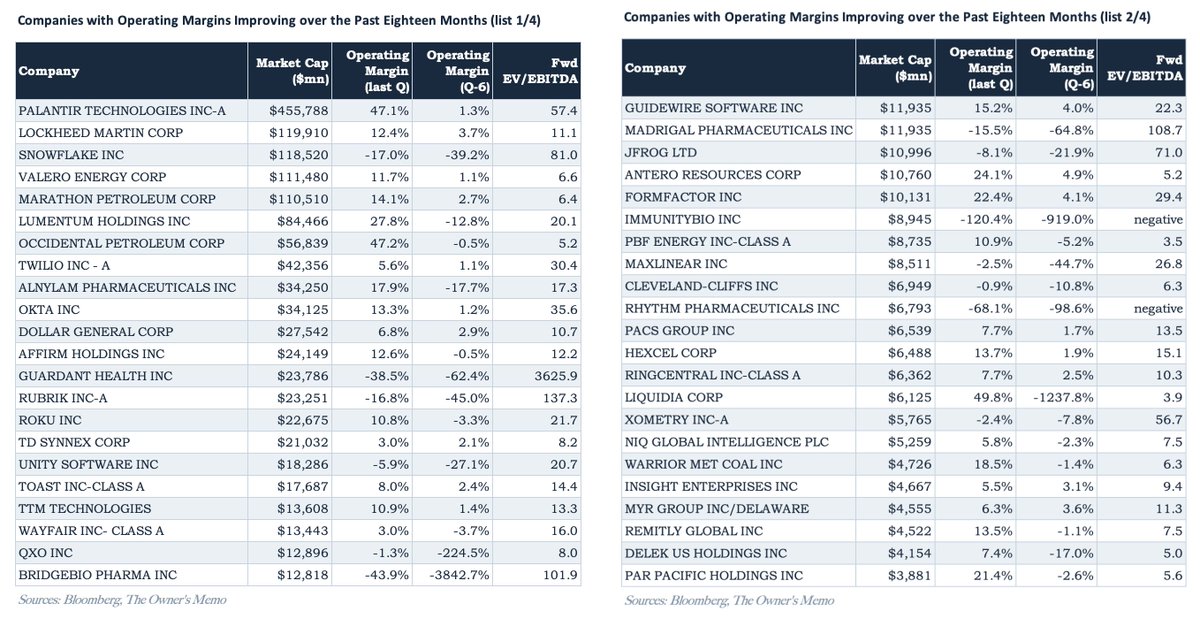
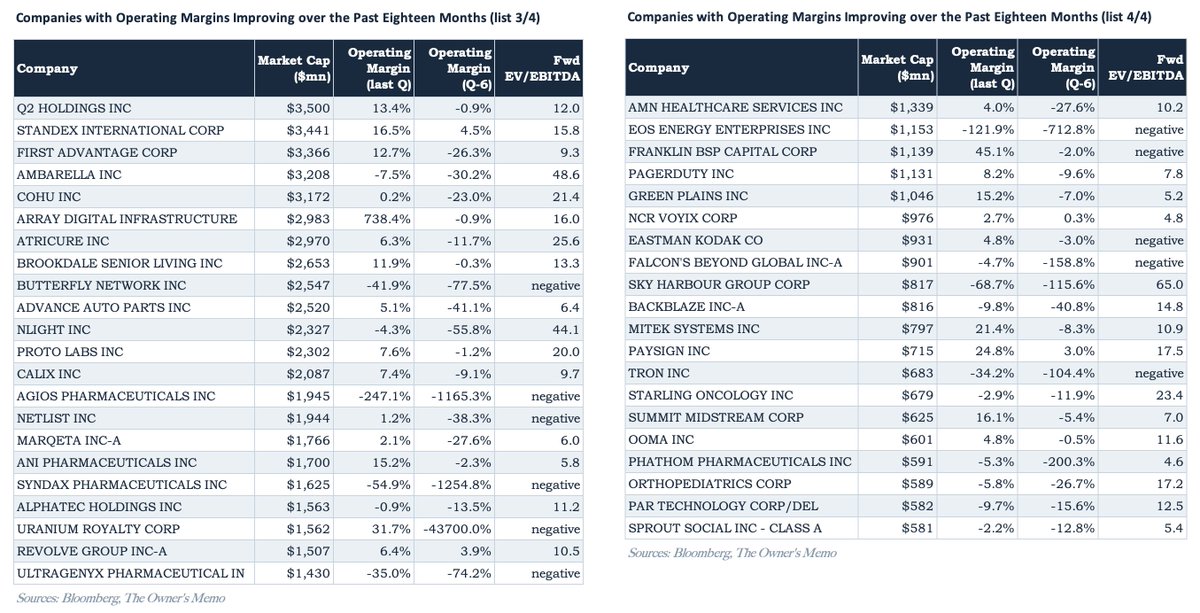
The authors also note at the end of their paper that high operating margins matter substantially more than high turnover in a company's ability to deliver high and sustained ROICs. So I screened for companies whose operating margins sat in the bottom two quintiles eighteen months ago and have risen every six months since.
Those 86 companies are shown below.
Two of them, Remitly ($RELY) and Toast ($TOST) , are businesses I had come across before. Both companies are showing the operating leverage that the framework suggests can carry a stock upward.
The Owner's Memo #26 is out today. Link in the comments.