The Rising Price of Time
One of the biggest changes in the world over the past century has been the rising value of human time. We often think about how much wealthier people have become, but rarely consider what that wealth has done to the value of an hour. A hundred years ago, someone might spend half a day doing something that today we can accomplish in minutes. As societies become wealthier, money becomes more abundant, but time remains stubbornly limited to 24 hours a day.
I think this creates an enormous opportunity for certain businesses, and one that investors often underestimate. Consider $AMZN, $UBER, $DASH, or even a dishwasher. These businesses and products aren’t just selling convenience. They’re giving people something they can never manufacture more of, time. And as their customers become wealthier, that time becomes increasingly valuable.
What’s particularly interesting is that a business can become more valuable to its customers without necessarily improving its product. Something that saves you an hour today may be worth considerably more to you in 20 years, simply because your time has become more valuable. The reverse is equally important. Businesses that waste their customers’ time may become increasingly unattractive even if nothing about their service changes.
Of course, saving time doesn’t automatically make something a great investment. Competition can drive prices down, and not every hour saved is equally valuable. Sometimes people actually enjoy spending their time cooking, shopping, or doing things themselves. But the underlying economic force is powerful, and I believe it will only become more important as the world grows wealthier.
When I study a business, I like to ask myself questions that go beyond revenue, margins, and growth rates. Here’s one worth considering: As your customers become wealthier, does your product become more valuable to them, or less?
Because some of the greatest investment opportunities come from owning businesses that benefit from forces much larger than themselves. And the rising value of human time may be one of the most enduring forces of all.
If this gave you something new to think about, share it with someone who loves investing. 🌹
I revisit this article about Microsoft’s frenzied IPO often.
Those lucky enough to get shares at the IPO or buy shortly after were sitting on a once-in-a-generation opportunity.
But how many actually held on?
The odds of finding the next Microsoft are close to zero.
But you don’t have to, and what you already own may be enough to make you wealthier than you ever imagined.
Product-market fit is one of the few buzzwords that actually means something.
Most businesses have to work hard and spend a lot of money to get their products into customers’ hands.
But a small number have such strong product-market fit that the world almost pulls their products into existence.
When you find one, hold on, even if the stock looks a little expensive.
No one wants you to know this, but game theory teaches that the secret to success is weak competition. Capitalism pays when you are the best at something. It almost doesn't matter what the thing is as long as there is some demand. You can be the best fisherman in a little town in Malaysia and you'll have plenty of work.
You're always competing with other people for attention, a job, a conversation, goodwill, college entry, etc. Selecting a game where you have an edge over other players (or can build one) is just as important as being genuinely good at it.
I remember going to math olympiads as a kid; it was the first time this insight struck me. I passed 3-4 rounds and kind of brute-forced my way into the regionals, but that's when I saw how ill-prepared I was. While I had rudimentary training, other kids knew trigonometry, equations, and whatnot. I still did fine but ultimately didn't make it to the nationals because of that. An assignment was easily solvable with trigonometry while I was there trying to 'figure it out'. I was the weak competition.
Opposite example: earlier this year, I co-developed an education platform for a specific university (with Claude). We first launched in only one course and, funnily enough, we had competition and they were the first movers. My sense is that we still got 75%+ of the market (~35 users spent ~20hs each on ours). The only reason we displaced the already-known brand + first-mover is because they mis-targeted their offer. They built a mobile app when it was obvious that a website was better, their app was too crowded whereas ours was specifically tailored to this exam, etc.
If you play poker against pros, you'll lose; same with life. Search for uncrowded, unserved markets, or markets where you can build an edge through some specific mechanism.
Side note. This is why Peter Thiel said competition is for losers and why Rockefeller bought all his competitors to establish a virtual monopoly. "Competition is a sin," it drives profits to zero. As a system, it works perfectly because consumers are the winners. However, as a person or business, it's best to avoid it.
📨Out now!
🛩️Long IA.
💡First initial research / new name that I’ve highlighted in years.
🙋🏻♂️This is just me answering the questions I asked myself as I got to know this biz.
👍🏼Writing is a cool tool in that way
Time and time again we see the cash box strategy pay off.
1) Find business with net cash at or above market cap.
2) Make sure biz is profitable.
3) Avoid co's run by crooks.
4) Buy a handful of companies meeting criteria 1-3.
Think it'll work out well.
When I worked in fund management, I went through training to prepare for meetings with clients and pitching our strategy to consultants and prospects.
As I got up to speed with the presentation, something hit me.
The slide deck wasn’t really describing what we did. It was describing what we hoped to do in an ideal world, assuming reality didn’t get in the way.
I think the same thing applies to how CEOs present their companies.
What they’re describing isn’t what’s happening today. It’s what an ideal version of the business looks like, or what they’re trying to build toward in the future.
The reality behind the scenes is almost certainly far messier.
As investors, it’s worth remembering that there’s often a wide gap between the company being presented and what’s happening on the ground.
Somewhere along the way, too many public company management teams seem to have forgotten something.
Shareholders own the business. Management works for them.
Every dollar spent, every share issued, every acquisition pursued should be evaluated through the lens of creating value for those owners.
It's shareholder capital. It truly pisses me off when I see companies not treating it that way.
Same idea applies to investing, which requires doing two or three things unusually well.
Most investors do them, but also do five other things that detract from performance.
So doing less is the key to better returns.
Not all struggling businesses need a turnaround. Sometimes they just need to stop doing unproductive things.
There is an important distinction between the two, particularly when investing in smaller companies.
A turnaround can be risky. The company's products or services may be outdated, no longer relevant to customers, or losing ground to competitors. The core business needs to be fixed, which is difficult work, often takes years, and takes flawless execution. Even with a capable CEO, there is no guarantee customers will come back or that the business can regain its former position. Oftentimes the business is already dead, it just doesn’t know it yet.
Pruning is different.
In this case there is a perfectly good core operation that has become distracted. It might have unrelated subsidiaries, unprofitable customers who are kept simply for their revenue, or just overhead that becomes unintentionally bloated over many years. The company is doing too many things, and some of them are destroying value.
A new CEO can make a meaningful, almost immediate difference by simply deciding what not to do. Sell the non-core businesses. Walk away from unprofitable customers. Cut unnecessary costs. Give the productive parts of the business more attention and resources.
The key is there is no need for the core business to reinvent itself. Management just needs to get out of its own way.
I find these opportunities particularly interesting in the microcap world. Smaller businesses generally have fewer moving parts, less bureaucracy, and simpler organizational structures. A new CEO can often make changes quickly and have an almost immediate impact on the results.
The market may see a struggling business and assume it needs a difficult turnaround. But sometimes the answer is much simpler.
The difference matters - turnarounds require a business to become something different. Pruning opportunities often just require a business to become a better version of what it already is.
These can be some of the lowest risk, highest return opportunities.
Not all struggling businesses need a turnaround. Sometimes they just need to stop doing unproductive things.
There is an important distinction between the two, particularly when investing in smaller companies.
A turnaround can be risky. The company's products or services may be outdated, no longer relevant to customers, or losing ground to competitors. The core business needs to be fixed, which is difficult work, often takes years, and takes flawless execution. Even with a capable CEO, there is no guarantee customers will come back or that the business can regain its former position. Oftentimes the business is already dead, it just doesn’t know it yet.
Pruning is different.
In this case there is a perfectly good core operation that has become distracted. It might have unrelated subsidiaries, unprofitable customers who are kept simply for their revenue, or just overhead that becomes unintentionally bloated over many years. The company is doing too many things, and some of them are destroying value.
A new CEO can make a meaningful, almost immediate difference by simply deciding what not to do. Sell the non-core businesses. Walk away from unprofitable customers. Cut unnecessary costs. Give the productive parts of the business more attention and resources.
The key is there is no need for the core business to reinvent itself. Management just needs to get out of its own way.
I find these opportunities particularly interesting in the microcap world. Smaller businesses generally have fewer moving parts, less bureaucracy, and simpler organizational structures. A new CEO can often make changes quickly and have an almost immediate impact on the results.
The market may see a struggling business and assume it needs a difficult turnaround. But sometimes the answer is much simpler.
The difference matters - turnarounds require a business to become something different. Pruning opportunities often just require a business to become a better version of what it already is.
These can be some of the lowest risk, highest return opportunities.
“We are, in part, engaged in the business of trying to invest in the lengthened shadows of the right sort of people.”
- Charlie Munger
Latest post…
https://t.co/voYBbSampR
This idea shows up in different places.
It’s counterintuitive which makes it hard to internalize, and is a gift to investors.
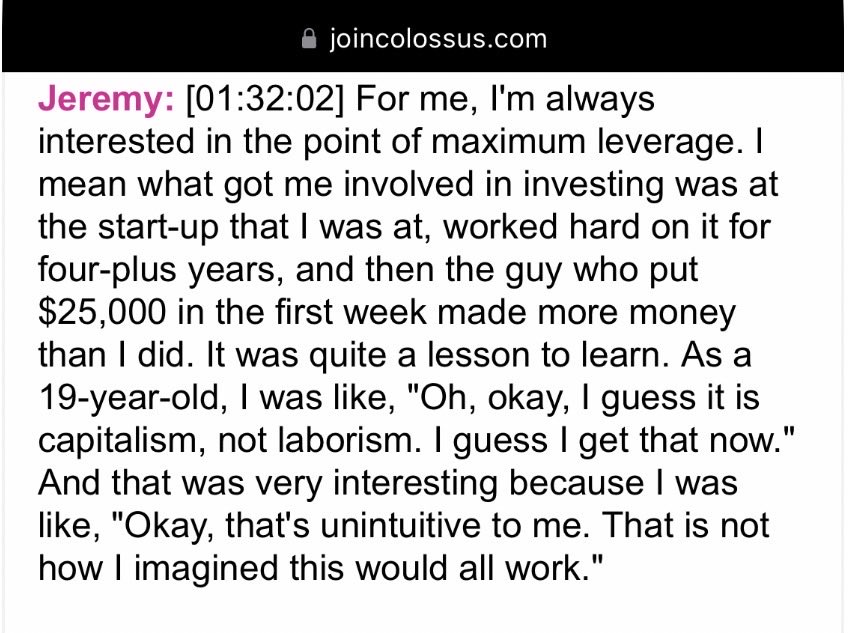
You don’t get paid for working hard, having a high IQ or being clever.
You get paid for risking capital and being right.