Cash offer today for Just Group, 75% above yesterday’s closing price 😍
My Annals of Actuarial Science papers on NNEG are now market consistent 🤣
Long-term option pricing with a lower reflecting barrier
https://t.co/0IfQjVINOV
@LT3000Lyall 1. The dichotomy "leave vs. fight" is canonically known as "exit vs. voice" (Hirschman) https://t.co/09BKUTJowz
2. For moving people from 0 to 1 to 2.., writing may be better than direct discussions or debates https://t.co/Zq1iweBQHx
@AAGresearch 1. (Obvious) For more than half the history of the title, these countries did not exist (the land they cover was the USSR).
2. (Less obvious, but see Wikipedia) To gain entry to the title, someone in the country has to pay a franchise fee. Nobody in the USSR could do that.
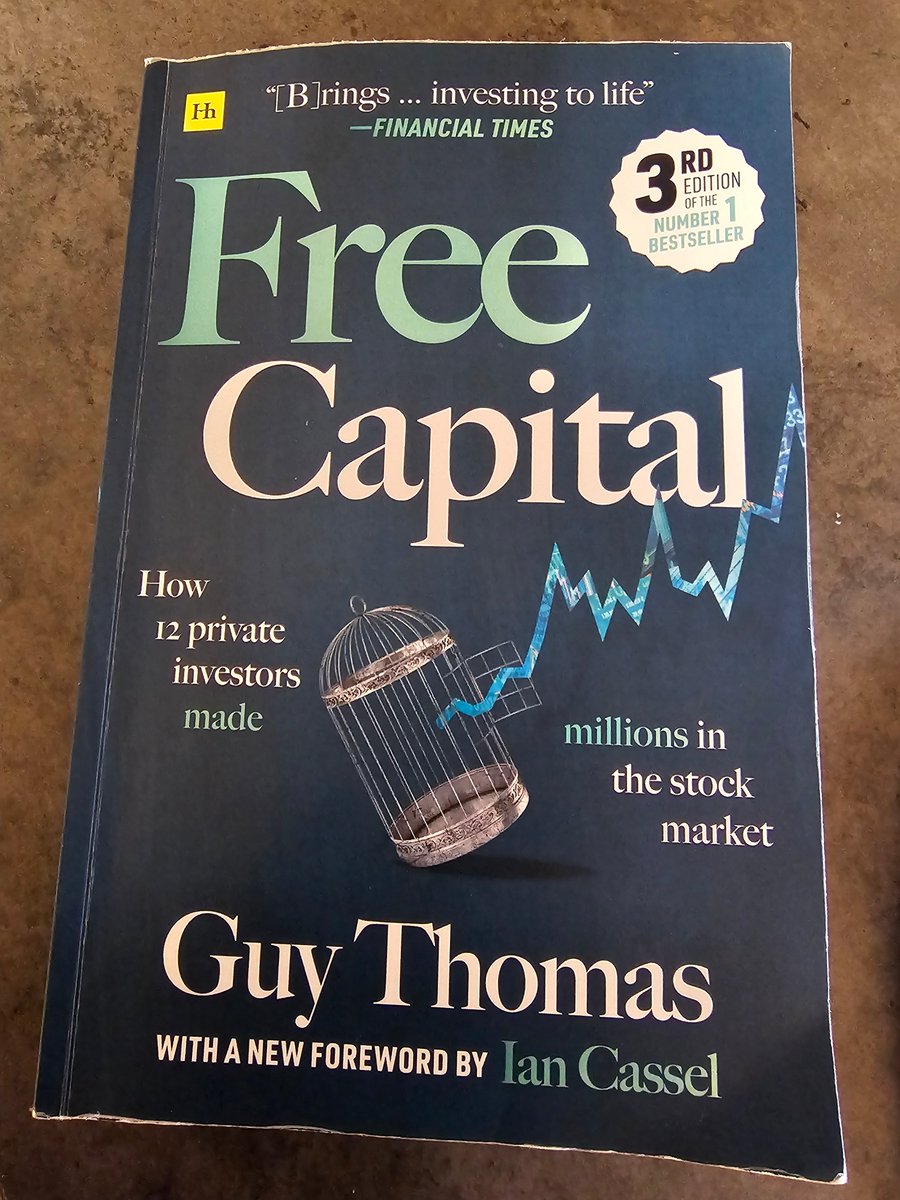
A review of the book for every private investor that takes investing seriously - "Free Capital: How 12 Private Investors Made Millions in the Stock Market" by Guy Thomas, by @Vintage_Analyst https://t.co/WfETs4W67u
1/6
I’ve read the book 'Free Capital: How 12 private investors made millions in the stock market' by
@guy_thomas
There are a few similarities that most of these investors seem to share which I wanted to briefly explore.
- They all had different investing strategies, but they all not only focused on how much money they could make, they focused on how much they could lose. Even though there are many ways to make money, there are a few main ways you can lose money.
- Most of the investors made a conscious call early in their lives to live within or below their means. Other than home loans they had very little debt. This allowed them to become full time investors quicker as they didn't have to make large sums of money to fund their lifestyle.
- Most of the investors started full time investing later in life. They worked through their 20s and 30s while learning how to invest on the side. This allowed them to continue to learn from their mistakes and improve while their jobs paid the bills.
- They majority of the investors didn't grow up always wanting to be investors. Their negative experiences in the corporate world drove them to focus more and more of their time on tightening their investing skills, rather than trying to climb the corporate ladder.
- Most of the investors understood that luck had a role to play in their success. This allowed them, in my view, to keep their profits in the long term. Humility was definitely a factor for pretty much all of the 12 investors.
- By keeping their losses small, it was really a few big winners that made the majority of their money. This just goes to show that a few stocks can really make your year or even decade. By focusing on limiting losses, they were able to let their winners run.
A great book all investors should read.
REQUEST:
Title of a book of reflections / memoir written by a former CEO or non-executive director of small UK quoted companies, published a year or two ago? (I may be hallucinating this. Can’t find on Amazon or ChatGPT.)
Statistical fairness trilemma:
Any binary predictor applied across two groups with different base rates can satisfy at most two out of the three criteria:
– well-calibrated
– equal false positive rates
– equal false negative rates
Full blog: https://t.co/JY1uQk7nls
In advance of this interview I am doing tomorrow https://t.co/mBkgimEj1V
here are some reviews of Free Capital
https://t.co/V0R1BFBaJ8
https://t.co/zKNhFvNMZz
https://t.co/9enHrHDlri
https://t.co/MpPvUvrKCr
https://t.co/xJdtSjqv77
https://t.co/iwroRh9v17
This short review of Free Capital gets it. The book is about life choices and chances. NOT about specific stock-picking methods. (There are lots of other books for that.)
I’ve read the book 'Free Capital: How 12 private investors made millions in the stock market' by @guy_thomas. There are a few similarities that most of these investors seem to share which I wanted to briefly explore.
They all had different investing strategies, but they all not only focused on how much money they could make, they focused on how much they could lose. Even though there are many ways to make money, there are a few main ways you can lose money.
- Most of the investors made a conscious call early in their lives to live within or below their means. Other than home loans they had very little debt. This allowed them to become full time investors quicker as they didn't have to make large sums of money to fund their lifestyle.
- Most of the investors started full time investing later in life. They worked through their 20s and 30s while learning how to invest on the side. This allowed them to continue to learn from their mistakes and improve while their jobs paid the bills.
- They majority of the investors didn't grow up always wanting to be investors. Their negative experiences in the corporate world drove them to focus more and more of their time on tightening their investing skills, rather than trying to climb the corporate ladder.
- Most of the investors understood that luck had a role to play in their success. This allowed them, in my view, to keep their profits in the long term. Humility was definitely a factor for pretty much all of the 12 investors.
- By keeping their losses small, it was really a few big winners that made the majority of their money. This just goes to show that a few stocks can really make your year or even decade. By focusing on limiting losses, they were able to let their winners run.
A great book all investors should read.
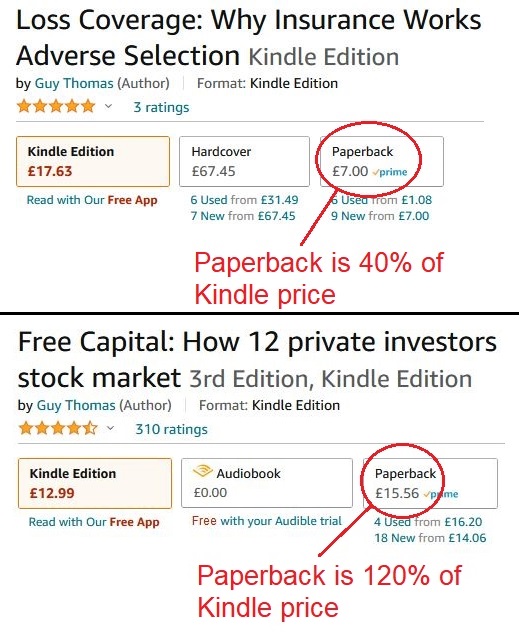
“Loss Coverage” now £7 on Amazon (40% of its Kindle price).
Meanwhile “Free Capital” is £15.56 (120% of its Kindle price)
The mysteries of price discrimination. The irony is that “Free Capital” is readable on Kindle, but “Loss Coverage” is not (diagrams, maths, footnotes).