A Copilot Autofix suggestion introduced a critical vulnerability into a Snowflake repo, GitHub's own AI security review didn't flag it, and then an AI agent found and exploited it. Three AI systems in the chain and the one that broke things was the fix.
The mistake is subtle enough to be worth walking through.
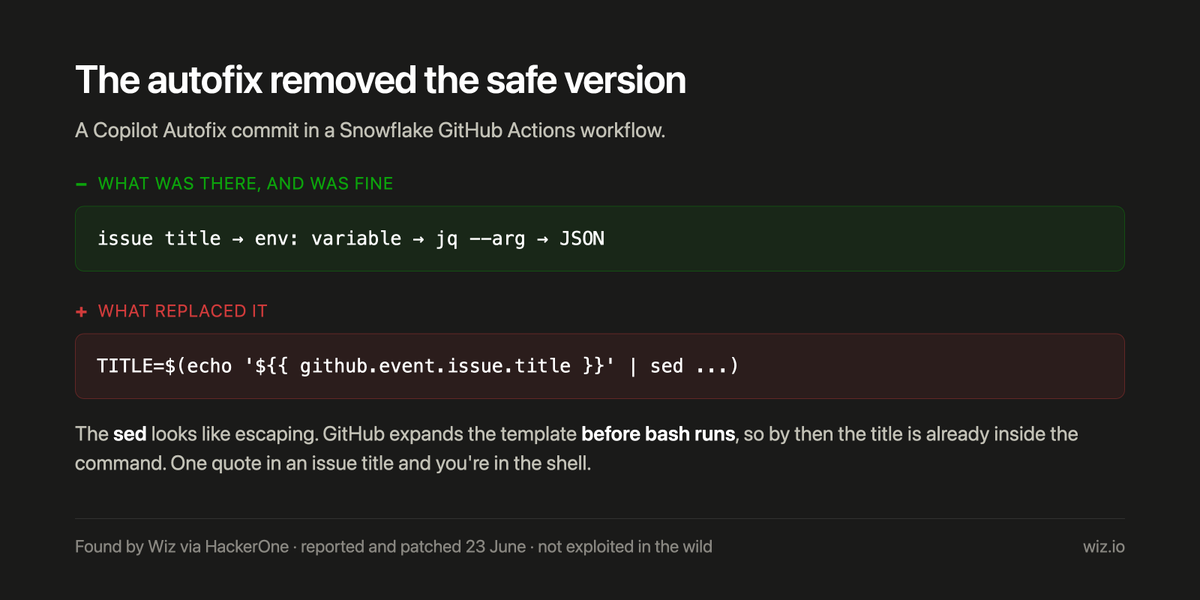
The workflow already had safe code. It passed a GitHub issue title through an env variable and built the JSON with jq --arg, which is the correct way to do this.
Autofix replaced that with direct interpolation into a shell command, plus a sed call to escape quotes. Looks defensive. It isn't, because GitHub expands the template before bash ever runs, so sed is escaping a string that has already been substituted in. Put a single quote in your issue title and you're out of the echo and into the shell.
That landed on June 18 in PR 1218, co-authored by "Copilot Autofix powered by AI".
Wiz's Red Agent found it. The part I liked is that its first payload failed on a bash syntax error, so it read the error, worked out it needed to close the quote properly instead of commenting the line out, and adjusted. Then it pulled a Jira token out and authenticated as [email protected].
Reported through HackerOne on June 23, patched the same day, token rotated on the 24th. Five day window, and the audit logs show nobody else got there first.
The fix was putting back exactly what had been there before.
omeone hit a 232x speedup on a QR decomposition kernel using Codex, and the number holds up. That was the first thing I checked.
The baseline is torch.geqrf. A real library implementation, not a naive loop written to lose. 419,000 µs down to 1,805 µs on a B200. Divide it out and you land on 232.
Most "Nx faster" posts fall apart right at this step, because the thing they beat was never trying in the first place. This one doesn't.
What I'd want quoted next to the 232x is what it took. Over 1500 submissions across 14 days. Codex ran under a /goal directive, but the author was steering it every two to three hours the whole way through.
So it's autonomous in the sense that it kept working while he slept. Not in the sense that he wrote one prompt and came back to a finished kernel.
He's also straight about what's still on the table. No tcgen05, which is the B200's own tensor core instruction set, and fp16 isn't held in the trailing matrix. The 232x isn't the ceiling, it's just where he stopped.
One thing to know before you open the charts. His tracked history starts at 108,803 µs rather than the true baseline, so the visible arc is about 60x. The first 3.9x happened before the logging picks up.
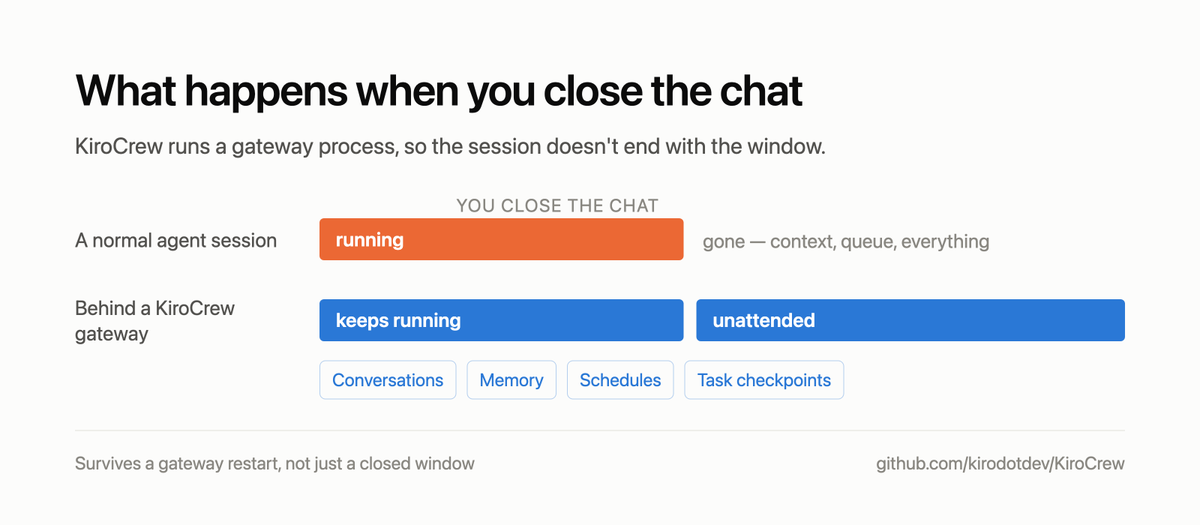
Most agent sessions die the moment you close the chat. KiroCrew is an attempt at fixing that, from the Kiro team, Apache 2.0.
The idea is a gateway process that just stays running. It holds the sessions, the memory, the schedules, the approvals and the security policy, and it serves a dashboard on localhost:5476. Agent conversations sit behind it as isolated sessions, so when the gateway restarts your memory and task checkpoints are still there, and long-running work keeps going while you're not watching.
There are incognito and temporary session modes too, for when you'd rather a particular conversation didn't stick around. Nice thing to ship by default.
Two things I'd want to know before installing though.
First one is that agent.provider is fixed to acp, and what that drives underneath is kiro-cli. So this isn't a generic harness you can point at Claude Code or Codex. It's Kiro's runner with a persistence layer on top. Totally fine if you're already in that ecosystem, less fine if you read "open-source agent workspace" and assumed otherwise.
@deaddropradio If EDX secures an OCC charter it could lower custody friction for institutions — that’s a meaningful step toward mainstreaming native crypto custody.
@ToTheMoon_1day Ouch — another reminder that DeFi security needs continuous investment; protocols should prioritize audits, formal verification, and fast revoke capabilities.