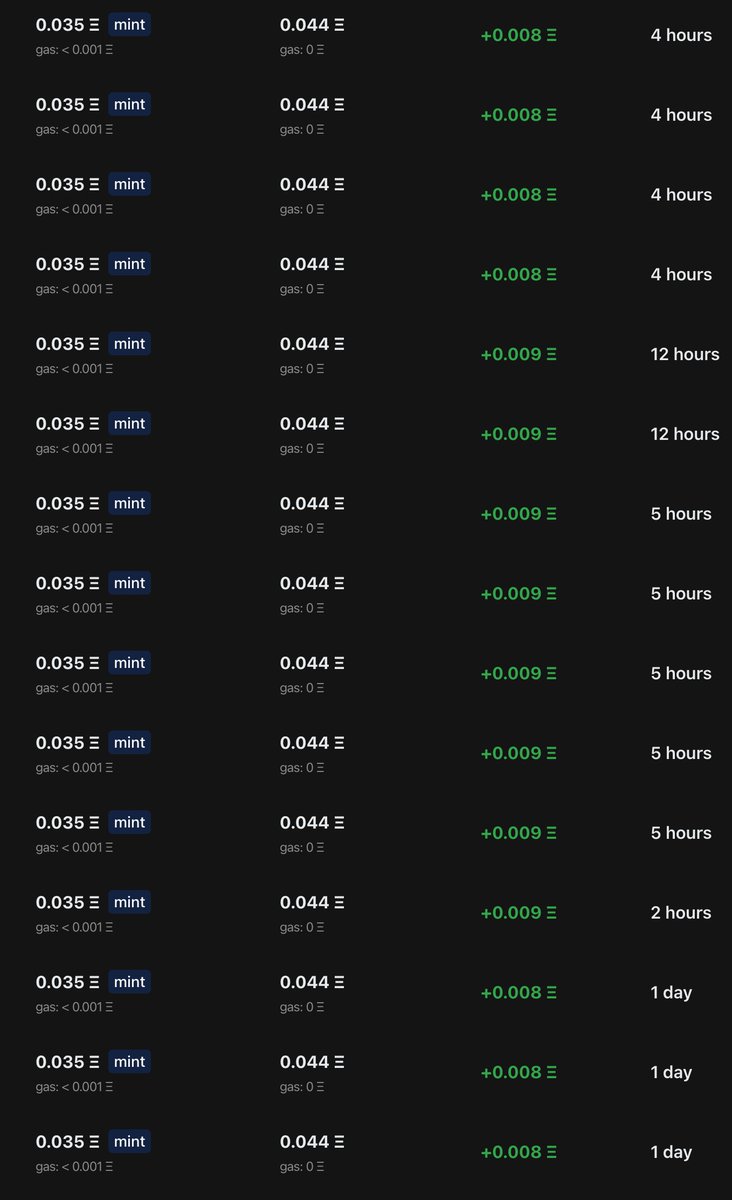
How I grow my burner wallet from 0.1 Ξ to 2.1 Ξ by running a frontrunner script on WL mint for @10KWorldCup
This is a 🧵 on the importance of knowing how to read a smart contract, can lead you to a potential play.
@KookCapitalLLC@Polymarket Its not a scam, there were no public info at all about the sale by end of 31st May
- No official announcement
- No on-chain data
- No credible news reporting
Resorting it to Yes is the scam as it reward insiders. @Polymarket is awesome
@uncletuah@base But $XAUT is actually backed by gold
Why would people want to buy this memecoin that you launched and call it Tether gold when its not?
@finnbags I am launching something but I also know token can be a double edge sword, it can bring the right attention to good product but also at the same time kill it twice as fast.
Can we talk over dm?
Either this is a fucking larp and its over or its really just a simple dumb blessing of vibecoding, the AI hallucinates and put a placeholder github account on the privacy page, bad actors got wind of it and set this whole thing up.
>Bro said someone impersonating Moltbook on github
>But that github account was linked on their privacy page https://t.co/8310B6tdwH
>5 mins before this tweet somebody claimed 465sol of fees, what a coincidence!
fuck this shit
Hey @github someone is squatting on a Moltbook account and using it to promote a token, not me, can I get ownership of that so we can take that down and use it for real @moltbook things ❤️
here's a demo of a code review system built with ~100 lines of VVM code.
this runs 9 specialized reviewers running in parallel. each writes a full review to disk.
the orchestrator just tracks refs. the synthesizer pulls what it needs. context stays bounded.
context holds handles. disks hold payloads.
this was my core insight when building the new filesystem mode for VVM and it changes the math on multi-agent pipelines
when you orchestrate an agentic pipeline such as:
research → analysis → synthesis
you don't want to pass data between models. you want to pass references to data. the full artifacts belong on disk. the context window gets an index.
this is how operating systems behave. when you call open, you get a file descriptor and not the contents of the file. the bytes stay in the VFS until you explicitly call read.
VVM applies the same discipline to LLM orchestration.
here's the new flow:
agent A finishes researching. instead of returning 12KB of markdown to the orchestrator, it writes to:
.vvm/runs/<run-id>/bindings/b000001.md
then it returns exactly this:
Binding written: b000001
Summary: Found 12 papers on RLHF
the orchestrator constructs a ref object:
{
"ref": ".vvm/runs/abc123/bindings/b000001.md",
"summary": "Found 12 papers...",
"mime": "text/markdown"
}
that's all that enters the context window. two hundred bytes. when Agent B receives this input, it uses the summary for routing decisions. if it needs the full research, it reads the file. most of the time, it doesn't.
your orchestrator context stays bounded regardless of pipeline depth. hundred agents? hundred small reference objects, not 100 full documents.
token costs flatten while accuracy improves (no more "context rot" where recall degrades as the window fills).
VVM now implements this directory structure:
.vvm/runs/<run-id>/
https://t.co/WRs6QVOaxH # human readable trace & binding index
bindings/ # actual payloads
https://t.co/a7c5q0P3wJ
https://t.co/FNyLdmjmra
https://t.co/WRs6QVOaxH becomes a map, it tracks what happened and where to find it, not the full content of every step.
this also simplifies debugging pipelines as you can simply read the binding associated with the faulty agent call to inspect why the behavior didn't align with your expectations.
the subagent contract:
the above spec requires discipline. every spawned agent receives this binding protocol:
write your complete output to .vvm/runs/<id>/bindings/b000001.md
return ONLY: Binding written: b000001 + 1-3 sentence summary
subagent writes the artifact and returns the pointer.
current limitations:
- still filesystem only, will be adding support for other backends next
but the pattern is the platform: pointers, not values.
google's ADK team frames it as "context is a compiled view over a richer stateful system."
VVM compiles to handles. the filesystem is source of truth. the LLM gets the minimal slice needed for the current decision.
new version available here: https://t.co/YZfzNOK5IC
claude plugin install vvm@vvm